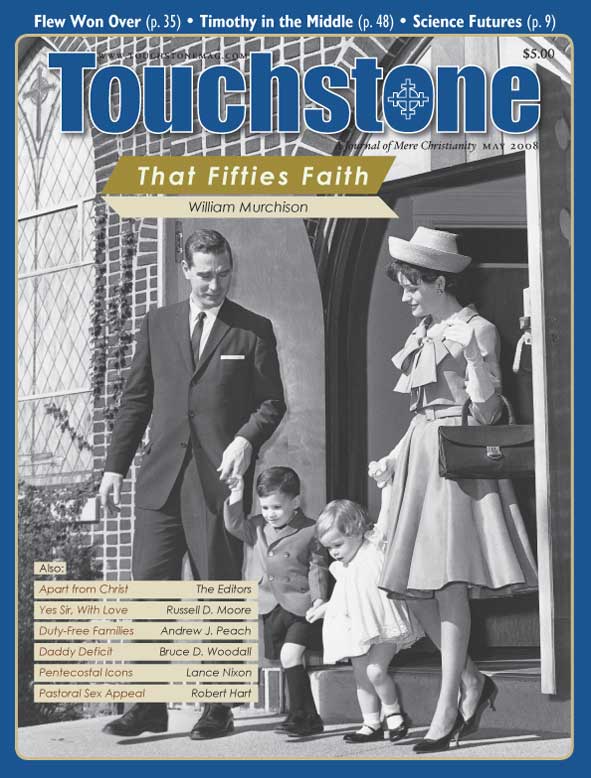
The Way We Weren’t by William Murchison
The Way We Weren’t
Churches in the Fifties Were Filled, But Were They Faithful?
by William Murchison
Watching, a little idly, some recent televised reenactment of the Exodus
story, I had a recurrent thought: Wasn’t it nice when Americans, by and
large, to one degree or another, acknowledged Great Moments in Theological
History—the parting of the Red Sea, Samson and Delilah, hungry lions
versus stalwart Christians—and shelled out to see the cinematic reenactments
of these moments? Wasn’t it nice? Although . . .
Although what? That’s the point. If you have the impression that the
1950s constituted some kind of last frontier of religious conviction and inspiration
in the United States, you might wish to reexamine that impression with dispatch.
A Place to Mourn
I say this out of concern for intellectual clarity in the way American Christians
address concerns unimaginable not many years ago: Christian moral standards
viewed as impositions on personal expression; choice in abortion as the law
of the land, with support growing for medical research on living embryos; once-sturdy
churches shredded by assertions of a right to practice homosexuality; growing
illiteracy among Christians as to the basics of their own faith; a mounting
perception that religion is the source more of ignorance and persecution than
of perfection in the purposes of Almighty God.
Doesn’t it make you want to close your eyes and relive the era when
prayer at school was a human right, as well as a duty, and Bishop Fulton J.
Sheen, with wondrous clarity, and on television yet, set forth the case for
Christianity? I understand the temptation to look back on pre-Madalyn Murray
O’Hair America as a place we do well to mourn, the chances for emulation
having all but vanished.
A lot was good back then. Writing of a recent civil libertarian furor in
Texas, concerning the Legislature’s doubtless futile attempt to protect “a
student’s voluntary expression of a religious viewpoint,” I mentioned
how things were done in ye olden times. For instance, prior to football kickoffs,
our state’s high schools not only allowed but actually sponsored invocations
of divine grace, conveyed by loudspeaker.
I mentioned likewise the pre-school devotionals held weekly in our high-school
auditorium under student council auspices. Gasp! Religion on stage, flanked
by Old Glory and the Lone Star flag!
The fifties really were a time when the culture broadly affirmed Christianity
as a Good Thing. I was there. I saw it; I heard it.
And yet some kind of demurral is strongly indicated: some sign of recognition
that no human society, whatever its good intentions and methods, has lived
unburdened, unencumbered by the crushing weight of human fallenness. Good as
life may appear to have been in the cities and universities of France and Italy
in the thirteenth century, or amid the sweaty fervor of the camp meetings in
nineteenth-century America, or among the fierce faith of the emancipators,
always human pride and general nuttiness were there to spoil the broth.
The fifties were not the summum bonum. They were an episode—a
highly instructive one, I might add, full of dangers as well as satisfactions.
We really don’t want to bring them back. We want something better, which
is to learn from them.
A Going Religion
“Men ever praise the olden time,” observed Machiavelli in his Discourses, “and
find fault with the present.” Or, to cite a more modern authority, Jack
Burden, in Robert Penn Warren’s great novel All the King’s
Men:
What you mean is that it was a fine, beautiful time back then, but if it
was such a God-damned fine, beautiful time, why did it turn into this time
which is not so damned fine and beautiful if there wasn’t something
in that time which wasn’t fine and beautiful? Answer that one.
So it was a fine, beautiful time back then? In the religious sense? Hmmm,
well . . .
Religion was a going thing, that was for sure. The war was over. Americans
wanted something that looked more normal than a carrier deck or a pup tent.
Moreover, the war years had in some ways been a praying time: Foxholes were,
generally speaking, the last places you’d look for atheists.
The churches had been on hand—heroically, sacrificially. The Four Chaplains
had given their life preservers to soldiers on the sinking Dorchester. An
elderly Episcopal priest, whom I knew long after the war, had buried, I was
later to learn, more than 500 American soldiers during the sanguinary slog
from Normandy to the Rhine. The military issued New Testaments to the troops.
(I have preserved my father’s copy.) Christianity, and to a proportionately
smaller extent, Judaism, emerged from the war looking better than they had
since perhaps the first piercing notes of the Jazz Age.
A key element of post-war normalcy was anchorage in a church. By 1960, an
astounding 69 percent of Americans claimed membership in one church or another.
Here was evangelization—self-evangelization, really—on the grand
scale.
Popular culture, being popular, was suffused with religion: anyway a sort
of religion, obscuring more than highlighting doctrinal differences. Where
the customers led, the entertainment industry followed, with Quo Vadis,
The Robe, Demetrius and the Gladiators, and, above all, Cecil B. de Mille’s
cheerfully over-the-top The Ten Commandments, with Charlton Heston
as parter of the Red Sea (from which latter film we kids picked up and parodied
many a juicy line, including Pharaoh’s economical formula for disciplining
Egypt: “So let it be written; so let it be done.”)
Fulton Sheen was anything but alone among religious figures dispensing enlightenment
and counsel. It was the age also of the Rev. Dr. Norman Vincent Peale and The
Power of Positive Thinking. Peale’s attractive, and moneymaking,
proposition was that “you can think your way to success and happiness.”
Wow! Success and happiness, and all by my little old self! Peale encouraged
readers to perform small spiritual exercises, such as affirming, with St. Paul,
that “I can do all things through Christ which strenghteneth me.”
Small wonder that this accomplished updater of the gospel was at least as
well-known to Americans of the fifties as was the considerably more theological
Billy Graham, who voiced greater concern for the soul than for the bank account.
Pelagius, the British monk whom the great Augustine had opposed, taught a gospel
of self-improvement not incompatible with Dr. Peale’s.
An American Faith
There was unmistakably an element of American-ness in the postwar American
embrace of organized religion.
Into a Pledge of Allegiance too flat and secular for some tastes, Congress,
in the mid-fifties, slipped the words “under God” by way of affirming
the religious commitment everyone assumed we always had had. Charlton Heston
as Moses, in the version of The Ten Commandments I saw as a high-school
sophomore, could be viewed as defining the Exodus in Cold War terms: deliverance
from tyranny by a jealous God with little time for tinpot despots and their
minions.
President Eisenhower, the hero of the American people, put the matter with
secular acuity: “Our government makes no sense unless it is founded in
a deeply felt religious faith—and I don’t care what it is.” No,
indeed—I am embroidering on the thought—so long as the bearers
of that faith kept in mind the special providence of God for the United States
of America and understood that here, in America, doctrines weren’t things
over which you slit throats or used the rack to elongate the occasional heretic.
Surely it was enough, of a Sunday, to put on a blue serge suit and striped
necktie, walk the family to the church door, greet the grocer and the lawyer
and the electrician, cut loose with “Holy, Holy, Holy, Lord God Almighty,” bow
heads for the Lord’s Prayer, favor the collection plate with a few appropriately
sized bills—then head home, or to a good restaurant, for the Sunday repast.
I myself spent many a Sunday this way.
It was no bad way to spend a Sunday, I must remark in retrospect. Was it
a good way? That might seem the larger question. It certainly was the question
for at least some partakers of American worship in the 1950s. Was this all?
For this, Christ had suffered and died? That his people might beam at each
other from pew to pew and lay plans for the week, not all such plans being
strictly religious in nature?
Not unless the whole human condition had changed mysteriously with the overthrow
of the Axis powers. A hunger in the human soul called for feeding and care.
Certain of the Christian intellects that in the fifties asked serious questions
about Christian duties gave evidence of acknowledging what theologians had
always acknowledged: the sweeping imperfection of merely human arrangements.
For instance (as some Christians asked), was it enough just to sit
in church?
It was a good enough question. Yet the answer America gave could not be called
wholly unreasonable. Look (the answer went), things never were as good as the
Lord would have them, were they? We could always do better: pray more, read
the Bible more, try harder to live by the Golden Rule.
Still, weren’t these present times at least pretty good on
a scale of one to ten? Moreover, with America facing a godless foe whose baleful
intentions toward us could hardly be underestimated, was it not something that
half the population of democracy’s stronghold bowed head or knee to the
Lord God of Hosts?
I think it dicey, at fifty or sixty years’ remove, to say that either
human disposition—criticism or rejection of criticism—was entirely
mistaken in its appraisal of modern needs. At any rate the argument between
the sides commenced with some force and grew louder and louder, gradually drawing
in Christians of every description.
Christianity Without Theology
When the decade began, I was a mere third grader. I remember no ecclesiological
questions arising at the Sunday dinner table.
Only later would I become aware of the critics and their supposed effrontery.
There was, for instance, the Reverend Theodore Wedel, an Episcopal priest,
who, in a 1950 book titled The Christianity of Main Street, argued
that “Christianity is today, among a majority of educated men and women,
including many nominal Protestant Christians, an almost unknown religion”—combining “Golden
Rule idealism” and “moralism”—“a kind of Christianity
without theology, one which does not repudiate the name of God but which has
basically little to do with him.”
At least a few other Americans shared Wedel’s apprehension. For instance,
the Jewish theologian Will Herberg, who found America’s “common
religion” to be nothing less than the American way of life, embracing “such
seemingly incongruous elements as sanitary plumbing and freedom of opportunity,
Coca Cola and an intense faith in education—all felt as moral questions
relating to the proper way of life.” It was “a Puritanism without
transcendence, without sense of sin or judgment.”
These were generalized assertions. What, for many, crystallized the challenge
was civil rights. Midway through the decade, the Supreme Court decreed the
end of school segregation by race. There followed the series of events whose
contours are too familiar to warrant re-sketching: marches by Negroes (as it
was usual then to call the descendants of the African slaves) to procure seats
at all-white restaurants and claim their constitutional right to vote.
The mainline churches, assessing the stakes and weighing the theological
considerations, saw quickly enough where they needed to stand, namely, on the
side of those struggling for freedom and dignity. These might be earthly goods,
yet the Lord had marked them long since as the rightful properties of his people.
The civil rights revolution revolutionized the churches (most of them) at
the very same time it intensified feelings of restlessness and revolt then
abroad in the land. The mainstream churches appropriated accurately enough,
and propounded with some eloquence, the teaching that Christ had died not only
for white adherents to the Gospel of Peale, but for everyone else as well.
On the other hand—especially with the murder of Dr. Martin Luther King,
Jr., who situated the theology
of civil rights in the Old and New Testaments—the cause of liberation
spread like a water puddle, taking on new and sometimes surprising shapes.
As women first, then homosexuals, clamored for recognition as the next civil
rights cause, and as people of all sorts and kinds demanded that their moral
overseers (e.g., parents, clergymen) leave them alone to do as they liked,
the pounding feet of theologically advanced churchmen could be heard, retreating
from obsolete-seeming postulates and positions.
A Dissident Search
Correspondingly, as Douglas Rossinow has written in The Politics of
Authenticity, a new “radical humanism,” fed by the existentialism
of the German martyr-theologian Dietrich Bonhoeffer, began to take shape “at
the conjuncture of historical circumstances amid the synthesis of diverse
elements in the political culture of the United States.” A “dissident
search for democracy and authenticity” commenced.
At the Christian Faith-and-Life Community in placid Austin, Texas (where
I attended college at about the same time), a charismatic minister named Joseph
Wesley Mathews “sought to wrench Christianity out of its ancient trappings
and recast it in modern language, symbols, myths, and hopes,” with Jesus
put forward as “a symbol of openness to risk and extremity.” One
can intuit what follows from teaching of this kind.
It was what more sober church people might have expected. The church of the
fifties had generally identified itself with civic purposes such as patriotism
and moral respectability, along with national recuperation and prosperity.
As those purposes began to wear thin, like a good-luck coin fingered too long
in the pants pocket, could one doubt that a broad search for new purposes would
commence? And not merely at the national or hierarchical level?
A commonplace of human experience is that assumptions, firmly or lightly
held, underlie thought and action. What one takes in over and over—e.g.,
God’s serene attachment to the American way of life—can become
an article of faith. That is, until it is wrenched from its central position
on the living room mantle, whereupon something else takes its place: the next
big, good, true thing, as unconsciously imbibed as chlorine in water.
Are the 1950s in any way a useful model for American Christians of the twenty-first
century? Would we like to go back? Would it be better, for instance, if the
movie moguls returned to producing religious epics like The Ten Commandments, with
their earnest depictions of the power of God? Would the renewal of prayers
before football games in any way strengthen the fabric of public life?
In weighing such considerations, we could take a cue from Jack Burden: If
all these occasions, these commitments, made for such a fine, beautiful time,
what happened? (Not, as we certainly understand, that any one generation ever
wields power enough to bind the next generation.) What happened was society’s
silent withdrawal of consent from propositions—the sanctity of unborn
life, the importance of church attendance, the scandal of illegitimacy, among
others—once regarded as self-evident, now seen as irrelevant to the good
life.
The epics didn’t go away. The audiences did. When George Stevens’s The
Greatest Story Ever Told fizzled at the box office in 1965, it became
clear that new factors were forming thought—factors that mainstream
Christianity might have addressed, or even headed off at the pass, had it
listened more attentively to some of the unwelcome criticisms launched earlier
against complacency and self-satisfaction.
Worldly Kingdoms
I think what the decade of the 1950s gives us to think about, concerning
the role and duties of religion—the Christian religion, specifically—in
a secular society is a matter of some consequence. Two particulars come to
mind.
First, Christians who are set on identifying themselves with the purposes
of the larger society should be, at the very least—careful. “My
kingdom is not of this world,” said our Lord. And a good thing, too,
given the world’s engagements and preoccupations.
Would we be inspired and thrilled by a church with the various colorations
of Las Vegas—or Washington, D.C.? The world’s conformity to the
purposes of God would seem a matter we might gladly leave to God (save that
Americans rarely leave anything to anybody else).
Second, complacency regarding the world’s purposes requires no less
care and wariness. “Whatever is, is right” may be defective as
counsel in a world like ours, infinitely less stable than that of Alexander
Pope, but acceptance of “whatever is” is a great fallback position
for the lazy and the unconcerned—whose numbers seem to be well distributed
throughout society, the church included, and not just at pew level. Not to
mention the ambitious, who see “going with the flow” as the way
to such fame and fortune as the churches today provide.
If such lessons apply to highly patriotic, cheerfully respectable societies
like ours in the fifties, they apply equally to a church fixated on “liberation” as
the religious be-all and end-all, on the pursuit of “justice” and
the extermination of hunger and the destruction of norms that restrict, ah,
self-expression.
If the church of the fifties wasn’t precisely the kingdom of God on
earth, even less so, in various ways, is the church that followed it. A church—any
church—unduly proud of its position and achievements is a church ripe
for remaking in the image of its Sovereign Lord. As to which, the conscientious
Christians might say, with Mr. de Mille’s
Pharaoh: “So let it be written. So let it be done.”
The Outward Passage
What William Murchison describes
in “The Way We Weren’t” is the experience of
the Protestant mainline, not that of the Fundamentalist and Evangelical
churches—who were still sorting themselves out from one
another in the fifties—and which, while partaking to some
degree in the confident and complacent spirit of the times he
describes, suffered from deep feelings of disenfranchisement
and alienation from the broader culture, which included that
of the mainline churches.
Much of what he describes as the
metamorphosis of this culture into what it is today was violently
opposed by Evangelicals. Norman Vincent Peale, for example, was
universally regarded among them as a heretic, and taking up the
cause of the Negro during the early days of the civil rights
movement, while not actively opposed by Evangelicals, was regarded
as unusual and questionable, not so much from anti-Negro animus,
I think, as because the field was already full of liberal Protestant
do-gooders, trumpeting the righteousness of their essentially
non-Christian faith. Not doing what liberals did in
social ministry was an essential aspect of early Evangelical
piety.
Being Like Folks
One could make a case that Evangelicals
and Fundamentalists shared some of the attitudes Murchison writes
of, but if so, it was largely within the context of their own
groups. These tended to disappear from view when they looked
to the world of the churches at large (they were anti-Catholic,
anti-liberal Protestant, and anti-ecumenical), and eroded their
feelings of content when they looked at their place in American
culture. The greening of the Evangelicals came later, beginning
sometime in the seventies, when the mainline had begun to show
unmistakable signs of weakness and decline, and Evangelicals
were becoming a new mainline.
I believe the pain—and I don’t
think this term is hyperbolic—of not being one of those
described here has been the chief formative and motivating force
behind Evangelicalism from the beginning of its self-awareness.
The desire to be “like folks” has shaped its intelligentsia,
which has taken advantage of the popular tastes and desires of
its constituency to bring the movement as a whole to what it
is today.
Beneath Fundamentalism is the hopelessness
of an underclass of aspiring to any level of status in its culture,
so that the distinction of being “unlike folks” becomes
an invidious token of spiritual superiority to be held
up against one’s betters.
The actual attainment of the status
or tastes of higher culture almost always presages a movement
out of either Evangelicalism or Fundamentalism. The Fundamentalist
goes away to college and becomes an Evangelical; his children
get graduate and professional degrees, begin to make money, and
become Presbyterians or Episcopalians, or, unless they are reconverted
to another and very different form of faith, leave the church
altogether. These movements are not invariable, of course, but
neither are they atypical.
— S. M. Hutchens
|
William Murchison , of Dallas, Texas, is a syndicated columnist and writer. His book on the tribulations of twentieth-century mainstream Christianity—with an emphasis on the Episcopal Church—will be published in late fall 2008 by Encounter Books. |