




With All Thy Soul
Jesus said unto him, “Thou shalt love the Lord thy God with all thy heart, and with all thy soul, and with all thy mind. This is the first and great commandment. And the second is like unto it, Thou shalt love thy neighbor as thyself. On these two commandments hang all the law and the prophets.”
—Matthew 22:37–39
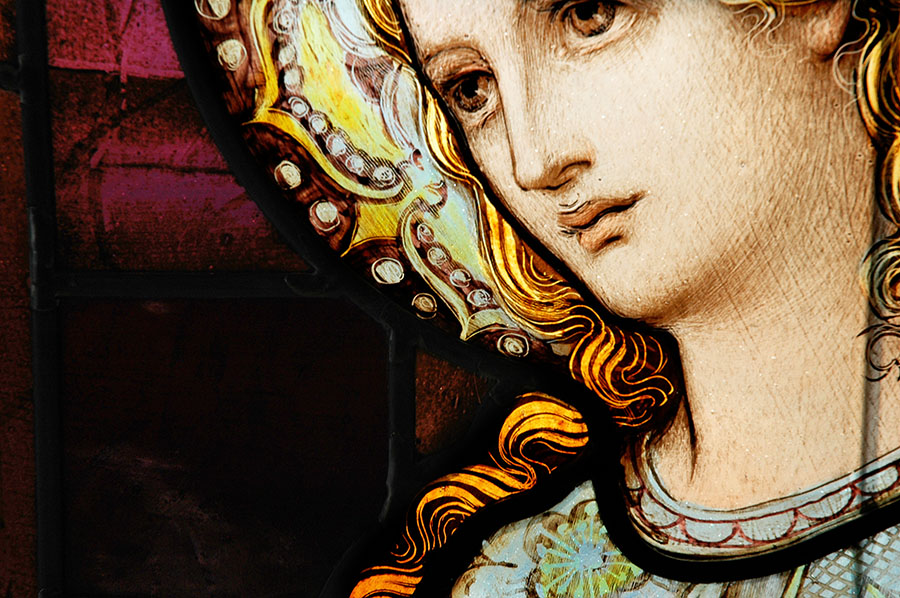
I was recently called in for jury duty and couldn’t help but notice a large bronze plaque mounted beside the front door of the courthouse with the words “SUMMARY OF THE LAW.” Just below this were the commandments our Lord proclaimed to be the first and second greatest, taken from the Shema and the Golden Rule. I must admit to being somewhat surprised that the ACLU hadn’t done its job of making sure our public buildings are free from any hint of the divine, but I was even more surprised when I went inside. The courtroom itself resembled a church far better than many churches I have visited. The room was filled with beautiful stained-glass windows, and we jurors sat on benches that were essentially pews. The tone of the room was one of amazing reverence: the potential jurors remained hushed, with an occasional whisper about “this being just like church.” When we were asked to stand and take an oath to God and the Commonwealth of Pennsylvania that we would tell the truth during the voir dire, I realized that, at its best, the courtroom is about as close as many people will get to understanding God and his laws.
In the courtroom one is judged for one’s crime. A judge, wearing vestments, proclaims the penance that the guilty must perform to atone for his sins. The judge can show mercy, or he can set his face as flint. The guilty has few options but to ask for mercy or to deny his sins and risk the wrath of the judge.
THIS ARTICLE ONLY AVAILABLE TO SUBSCRIBERS.
FOR QUICK ACCESS:
Thomas S. Buchanan is the George W. Laird Professor of Mechanical Engineering and Biomedical Engineering at the University of Delaware. He has studied at UCSD, Northwestern University, and MIT, and has held visiting professorships at the University of Western Australia and the University of Aix-Marseille. He has served as department chairman, deputy dean, and institute director, president of the American Society of Biomechanics, and editor-in-chief of the Journal of Applied Biomechanics. He is on the Board of Trustees of Saint Katherine College, the editorial board of Touchstone, and the board of The Fellowship of St. James.
A Journal of Mere Christianity—Delivered to Your Door
- Essays on theology, culture, and the Church
- Contributors from across the Christian traditions

Six print issues (one year) of Touchstone, plus full online access and PDF downloads for only $39.95.

Get a one-year full-access subscription to the Touchstone online archives for only $19.95.
bulk subscriptions
Order Touchstone subscriptions in bulk and save $10 per sub! Each subscription includes 6 issues of Touchstone plus full online access to touchstonemag.com—including archives, videos, and pdf downloads of recent issues for only $29.95 each! Great for churches or study groups.
Transactions will be processed on a secure server.
more on Bible from the online archives
32.2—March/April 2019
on Preserving Physical & Spiritual Nourishment by Nathanael Devlin
32.3—May/June 2019
on the Implications of Changing the Pater Noster by John M. McCarthy
5.3—Summer 1992
Everything You Need to Know About Morality & the Bible by David Mills
more from the online archives
35.4—Jul/Aug 2022
The Death Rattle of a Tradition
Contemporary Catholic Thinking on the Question of War by Andrew Latham
33.2—March/April 2020
on How Bodily Resurrection Informs Social Justice by W. Ross Blackburn
32.6—November/December 2019
An Open Letter to Christian Readers of Jordan Peterson & Roger Scruton by James Bryson
calling all readers
Please Donate
"There are magazines worth reading but few worth saving . . . Touchstone is just such a magazine."
—Alice von Hildebrand
"Here we do not concede one square millimeter of territory to falsehood, folly, contemporary sentimentality, or fashion. We speak the truth, and let God be our judge. . . . Touchstone is the one committedly Christian conservative journal."
—Anthony Esolen, Touchstone senior editor
