High Praise & Mercy by Anthony Esolen

Illuminations

High Praise & Mercy

In The Wild Orchid, followed by its twin, The Burning Bush, Sigrid Undset tells the story of a young and intelligent Norwegian man, Paul Selmer, who was raised by an unbelieving mother in all of the enlightened liberalism of the early twentieth century. That was when education—the great fraud and mumbo-jumbo of the age, as Muggeridge called it—and science and hygiene were to thrust religion from its place in the hearts of men, reducing it to a hobby or to a provider of songs to celebrate the new order of the ages. Blessed are the clean of flesh, for they shall see a good bank account, one healthy child of each sex, and the inside of a crematorium.

It isn't enough for Paul, whose mind is too keen and whose soul is too sensitive to miss the contradictions: talk of enlightenment, with art that is drab, and the crafts giving way to mass production; talk of peace, in a world that is awash in blood; nervous chatter of the future, with the loss of the past. Yet he would have remained a distant spectator, were it not for the grace of God, pursuing him, convicting him of folly and sin, and compelling him to face that burning bush that is not consumed, and to say, "Take my will, Lord, and make it thine."

Paul has a lot to learn, and a lot to un-learn. I imagine that most converts must find it so. Early in The Wild Orchid, Paul wanders into a Catholic church, out of curiosity or spiritual restlessness. He picks up a prayer book:

He discovered that it contained the Te Deum and the Miserere, and he wanted to look at those. . . . He had got the impression that the Te Deum was a sort of triumphal yell which Catholics are in the habit of uttering when they have had a real good time with a Saint Bartholomew or have put to death a few recreant noblemen, while the Miserere was more appropriate for the burning of heretics or the immuring of nuns who have kicked over the traces. Of course he had had no notion of more than the opening words of them. But they turned out to be quite overpoweringly beautiful. Least of all had he expected that the

Te Deum should end as a humble prayer—Vouchsafe, O Lord, to keep us this day without sin, or something like that, and—day by day we will praise thee—have mercy on us—in thee have we trusted, thou wilt not let us be confounded—it ended something like that.

The Prayer

Undset isn't being quite fair, if she suggests that the Te Deum was not in fact sung in other churches besides the Catholic, though it appears that the Norwegian church was drying up at its historical roots; an Ibsen on his knees, coughing and glancing toward the door.

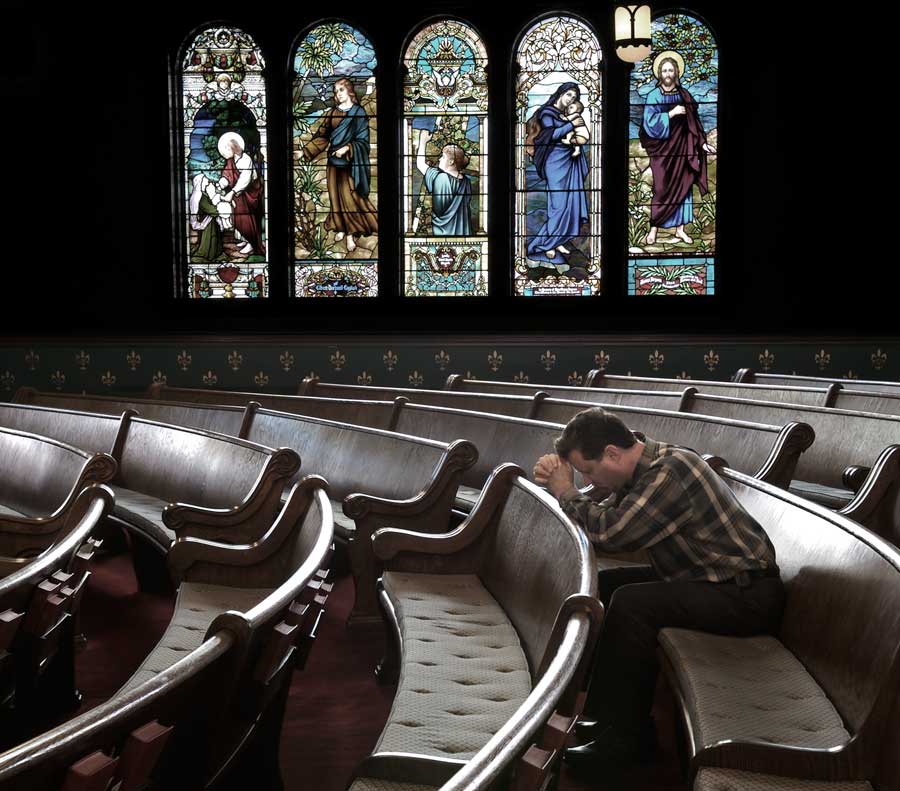
And indeed most Catholics in our time, along with Christians in other communions who do not pray the old prayers, will never have sung a Te Deum in all their lives. I cannot find it in Worship, marginally less awful than the other awful Catholic hymnals commonly in use in the United States. So I shall print it here, from the Service Book and Hymnal of the Lutheran Church in America (1958), commending it to every Christian:

We praise thee, O God: We acknowledge thee to be the Lord.
All the earth doth worship thee: The Father everlasting.
To thee all angels cry aloud: The heavens and all the powers therein.
To thee Cherubim and Seraphim continually do cry:
Holy, holy, holy: Lord God of Sabaoth.
Heaven and earth are full of the Majesty of thy glory.
The glorious company of the Apostles praise thee:
The goodly fellowship of the Prophets praise thee:
The noble army of Martyrs praise thee:
The holy Church throughout the world doth acknowledge thee:
The Father of an infinite Majesty,
Thine adorable true and only Son,
Also the Holy Ghost the Comforter.
Thou art the King of Glory O Christ:
Thou art the everlasting Son of the Father.
When thou tookest upon thee to deliver man:
Thou didst humble thyself to be born of a Virgin.
When thou hadst overcome the sharpness of death:
Thou didst open the kingdom of heaven to all believers.
Thou sittest at the right hand of God:
In the glory of the Father.
We believe that thou shalt come to be our Judge.
We therefore pray thee help thy servants
Whom thou hast redeemed with thy precious Blood.
Make them to be numbered with thy saints
In glory everlasting.
O Lord, save thy people and bless thy heritage.
Govern them and lift them up forever.
Day by day we magnify thee;
And we worship thy Name ever, world without end.
Vouchsafe, O Lord:
To keep us this day without sin.
O Lord, have mercy upon us:
Have mercy upon us.
O Lord, let thy mercy be upon us
As our trust is in thee.
O Lord, in thee have I trusted:
Let me never be confounded.

From Praise to Petition

This prayer, attributed to Saint Ambrose (d. 397), sung at Matins and for major feasts, is unlike anything most of us will now pray or sing. It is distant from Paul Selmer's experience and from what he imagines Christians are all about, and that very distance strikes with great power.


Anthony Esolen is Distinguished Professor of Humanities at Thales College and the author of over 30 books, including Real Music: A Guide to the Timeless Hymns of the Church (Tan, with a CD), Out of the Ashes: Rebuilding American Culture (Regnery), and The Hundredfold: Songs for the Lord (Ignatius). He has also translated Dante’s Divine Comedy (Random House) and, with his wife Debra, publishes the web magazine Word and Song (anthonyesolen.substack.com). He is a senior editor of Touchstone.

A Journal of Mere Christianity—Delivered to Your Door

  • Essays on theology, culture, and the Church
  • Contributors from across the Christian traditions
Subscribe (Print + Online)

Six print issues (one year) of Touchstone, plus full online access and PDF downloads for only $39.95.

Subscribe (Online Only)

Get a one-year full-access subscription to the Touchstone online archives for only $19.95.


bulk subscriptions

Order Touchstone subscriptions in bulk and save $10 per sub! Each subscription includes 6 issues of Touchstone plus full online access to touchstonemag.com—including archives, videos, and pdf downloads of recent issues for only $29.95 each! Great for churches or study groups.

Transactions will be processed on a secure server.


more on poetry from the online archives
37.5—Sept/Oct 2024

Young Folly & Elder Hope

A Battle Plan for Peace While Growing Old by Anthony Esolen


more from the online archives

19.4—May 2006

The Relatively Good Book

on the Liberal Protestant Bible Translation by B. J. Hutto

33.3—May/June 2020

Consolation in Death

Bach's Cantata BWV 106, Gottes Zeit ist die allerbesteZeit (God's time is the very best time) by Ken Myers

22.6—July/August 2009

Unhappy Fault

on the Integration of Anger into the Virtuous Life by Leon J. Podles

calling all readers

Please Donate

"There are magazines worth reading but few worth saving . . . Touchstone is just such a magazine."
—Alice von Hildebrand

"Here we do not concede one square millimeter of territory to falsehood, folly, contemporary sentimentality, or fashion. We speak the truth, and let God be our judge. . . . Touchstone is the one committedly Christian conservative journal."
—Anthony Esolen, Touchstone senior editor

Support Touchstone

00