





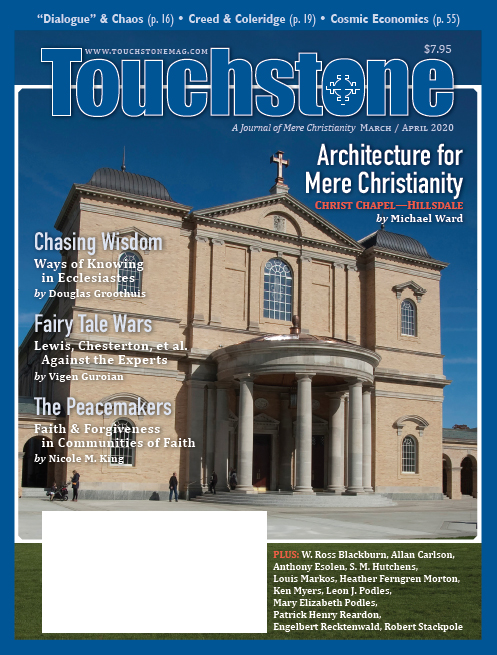
Feature
Blessed Peacemakers
Encounters with Faith & Forgiveness in Communities of Faith
A week after Christmas 2018, my husband Michael and I loaded up a Chevy Suburban with two suitcases, our two young sons, and enough books and gear for a whole preschool class, and drove the 700 miles from Rockford, Illinois, to Hesston, Kansas, for his grandmother's funeral. After ten hours of winding highways, rolling hills, and clapboard farmhouses that then, in eastern Kansas, suddenly gave way to limestone, we pulled into Hesston, population 3,800.
The Mennonites
Hesston was first settled in the late nineteenth and early twentieth centuries by German Mennonite farmers who had fled Germany, Russia, and Ukraine. The Mennonites were, of course, followers of Menno Simons, the sixteenth-century reformer who began his career as a Catholic priest in the Netherlands. Simons became troubled with the practice of infant baptism and the Catholic understanding of the Eucharist and found himself drawing nearer and nearer to Anabaptist circles even while remaining a Catholic priest.
Finally, crisis hit. In 1534, three hundred violent, fanatical Anabaptists attempted to take over the city of Münster and establish a New Jerusalem. The revolt was just as violently put down, with the bodies of its leaders being left to rot in cages next to the local church as a warning to any other would-be reformers. After the violence in Münster, Simons wrote, "I saw that these zealous children, although in error, willingly gave their lives and their estates for their doctrine and faith. . . . But I myself continued in my comfortable life and acknowledged abominations simply in order that I might enjoy comfort and escape the cross of Christ." Shortly thereafter, he left the Catholic Church and became an Anabaptist.
In reaction against the violence in Münster, Simons sought to maintain peaceful living while attempting to reform the radicalism that had become a problem in some Anabaptist congregations. He became convinced that it was not the place of the Christian to take up arms. Rather, "if the Head had to suffer such torture, anguish, misery, and pain, how shall his servants, children, and members expect peace and freedom as to their flesh?" And so his followers have ever been pacifists.
This was not a popular position to take up in Europe during the sixteenth century, or at any time thereafter. Nobody in Europe liked the Mennonites, my mother-in-law explained when I first met her, because they refused to participate in Europe's wars. Initially, the Mennonites were intensely persecuted, but they were later tolerated for their remarkable agricultural skills. A large group eventually settled in the Vistula River delta in what was then Prussia, upon the invitation of the Prussian nobility, with the understanding that they were to cultivate the marshy, war-decimated area. They remained there for some centuries, farming peacefully and efficiently, until new requirements for military service forced them to look for other options.
At that time, Catherine the Great of Russia was seeking farmers to cultivate the southwestern edge of her kingdom, along the Dnieper River and the Sea of Azov. With the promise of free land, religious toleration, and exemption from military service and taxes, thousands of German-speaking Mennonites made their way to Russia. They remained there for another century, until the Russian imperial government began trying to assimilate them. The final blow came in 1871, when the government passed a universal military service act, thus ending the Mennonites' ability to remain pacifist.
Some early Mennonites had heard about the New World. A large contingent was recruited by the railroads to come and live in Kansas, with, again, the promise of cheap, fertile land. Kansas had the additional appeal of being rather like the area of Russia from which the Mennonites were fleeing. And there again they made their mark: Kansas is the breadbasket of the United States, and the wheat that still makes up the bulk of Kansas agriculture is a descendent of the Russian "red wheat" brought over by the Mennonites.
Bierocks
As we pulled into Hesston that evening, we decided to grab a quick dinner before heading to the visitation. Michael pulled into the drive-through of a local coffee shop and looked at the menu.
Nicole M. King is the managing editor of The Natural Family, the quarterly publication of the International Organization for the Family, and a regular columnist for Salvo.
A Journal of Mere Christianity—Delivered to Your Door
- Essays on theology, culture, and the Church
- Contributors from across the Christian traditions

Six print issues (one year) of Touchstone, plus full online access and PDF downloads for only $39.95.

Get a one-year full-access subscription to the Touchstone online archives for only $19.95.
bulk subscriptions
Order Touchstone subscriptions in bulk and save $10 per sub! Each subscription includes 6 issues of Touchstone plus full online access to touchstonemag.com—including archives, videos, and pdf downloads of recent issues for only $29.95 each! Great for churches or study groups.
Transactions will be processed on a secure server.
more on family from the online archives
31.5—September/October 2018
Errands into the Moral Wilderness
Forms of Christian Family Witness & Renewal by Allan C. Carlson
34.1—January/February 2021
Jesus' Astonishing Other Teaching on Marriage by James Ware
28.2—March/April 2015
Neo-Pagan Family Policies Doom Any Recovery by Allan C. Carlson
more from the online archives

33.1—January/February 2020
Do You Know Your Child’s Doctor?
The Politicization of Pediatrics in America by Alexander F. C. Webster

18.2—March 2005
On Conservatism as Vexation, Vanity & Near Impossibility by Graeme Hunter
32.4—July/August 2019
Does Biblical Language for Man Matter? by Stephen F. Noll
calling all readers
Please Donate
"There are magazines worth reading but few worth saving . . . Touchstone is just such a magazine."
—Alice von Hildebrand
"Here we do not concede one square millimeter of territory to falsehood, folly, contemporary sentimentality, or fashion. We speak the truth, and let God be our judge. . . . Touchstone is the one committedly Christian conservative journal."
—Anthony Esolen, Touchstone senior editor
