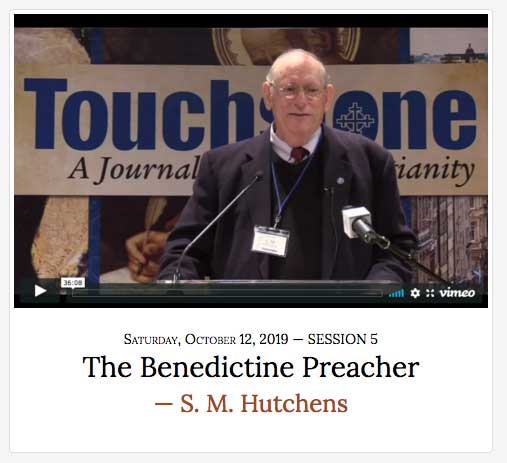
2019 Conference Talk
The Benedictine Preacher
When first I was invited to speak at this conference on Rod Dreher's Benedict Option, I purposed to say something of an earlier attempt within American Protestantism to face the problem of an encroaching and hostile secularizing religious modernism which threatened to, and has actually been successful in, vitiating the Christian witness wherever it has been permitted to operate. This spirit, addressed by Pope Pius X in the 1907 encyclical Pascendi Dominici Gregis, was being dealt with among Protestants of a number of denominations in 90 essays published between 1910 and 1915, gathered under the title The Fundamentals. Through the gift of two wealthy businessmen, an effort was made to send copies to every minister, missionary, professor of theology, YMCA and YWCA secretary, and Sunday school superintendent in the United States and other English-speaking countries.
In the early 1920s, those in sympathy with the conservative tracts were journalistically dubbed "fundamentalists," and within twenty years, fundamentalism itself divided into two mistrustful factions, the more separatistic of which continued to identify itself as fundamentalism while the more world-engaging group called itself "Evangelical," establishing the National Association of Evangelicals in 1942. My original intent was to present a commentary on this continuing division as representative of two natural but defective ways to proceed in the world and thus as a cautionary tale on the grounds of the Benedict Option—and the use of the concept of mere Christianity as a way to address pre-emptively problems of this sort, while noting its consonance with the spirit of the original fundamentalists.
While I have been particularly well-placed by my own history, study, and experience to comment on this division, I found writing about the conflict increasingly distasteful, for it is too personal. Watching the development of Evangelicalism during the course of my lifetime (my father was a charter subscriber to Christianity Today in 1956, and I read it from early youth) has been something like watching the slow death of a friend from a congenital disease. By "congenital" I refer to a powerfully formative anti-Catholicism that has made it immune to mere Christianity—despite the affinity for C. S. Lewis it claims—the strength of which I have only realized later in life, which has in turn led to the terminal immunological disorder of inability to recognize egalitarianism as a doctrine of demons. Fundamentalism is and has always been ecumenically inert by intention, which I doubt any Christian body can innocently be. It appears the fundamentalists and the Evangelicals were both right in their negative assessments of one another, and this is a woeful tale which I decided I did not wish to rehearse at any length here.
So I leave this topic, which I am using as a kind of prelude, noting that the essence of the fundamentalist-Evangelical disagreement on Christian engagement of the culture has resurfaced recently in the Ahmari-French debates, in which many of H. Richard Niebuhr's Christ and Culture observations are being mooted once again. On one side are those who, with Mr. Ahmari and the fundamentalists, whom I believe are right on this, regard modern culture as fundamentally anti-Christian, and propose thought and action in accordance with that understanding. On the other, with Mr. French, are those who believe in and promote a value-neutral public square in accordance with American constitutional principles. French's doubters regard this as mythological thinking, since they believe that the American public square is not, nor could it be, nor has it ever been, value-neutral (and so neutral with regard to Judeo-Christian faith and ethics) and that Christians should deport themselves in full cognizance of the hostile sea change brought in with the progressivist domination of culture.
I need hardly emphasize the significance of this debate to the questions raised by the Benedict Option, but have decided to leave it at that and move in this paper to one of the practical considerations that follows in this train, namely, the matter of Christian preaching in this new age during which we may reasonably expect an intensification of anti-Christian activity terminating in full-scale persecution, as it has in other places. For if the presidency of Mr. Trump is bringing us a respite from what I expected to be its beginnings under his opponents, I cannot see that it has encouraged anything like the moral reawakening that is needed. Indeed, Mr. Trump's confession that he has nothing to repent of removes him from both Judaism and Christianity and places him at the head of a morally static—at best—public square, which accounts, at least in part, for the division of opinion about him among Christians, evident even among the senior editors of Touchstone.
Getting Back to the Foolishness of Preaching
Having abandoned my original project, the mental machinery working on this conference project started up again when James Altena sent me an article by Hans Boersma titled "Fear of the Word" from the August 2019 First Things. Boersma, the St. Benedict Servants of Christ Professor in Ascetical Theology at Nashotah House, began by noting that his best students in particular were afraid to preach. This fear was not that of Moses or Isaiah, who felt inadequate to the task because he was sinful or ineloquent or otherwise unformed, but because what young pastors or priests are called upon to preach today seems to involve such a high degree of abstraction from reality as perceived by their hearers. They sense they cannot credibly bridge the apologetic gap involved in what Barth called "the strange new world in the Bible," which is now not merely strange but so profoundly alien that the apologetic dove has no place to alight.
If this is what they sense, they are right, for we are now at the end of the Age of Apologetics, which is something those preparing for Christian ministry must understand, lest they be surprised or spend time fretting about what has always been true. These students are feeling the shock of the destroying blast which has in a sense removed their limbs—they can no longer "explain things," and it is good they feel it full force now while still in their studies, for in the resulting weakness they will find strength.
By the end of Apologetics I don't mean the end of giving "an explanation for the hope that is within us," which every Christian must at all times be prepared to do, but Apologetics as the attempt to bypass the implications of what St. Paul called tēs mōrias tou kērygmatos, the foolishness of preaching, in the belief that those who turn from the gospel, whether cultured or not, simply need to have it explained to them in rational and attractive terms to make it available to their souls—a myth that has extraordinary powers of penetration, and is found wherever the mind is thought to have greater powers than it actually possesses. The religious academy, liberal or conservative, which almost invariably stands over against the Church as the principal source of interpretive authority, lies at the center of that particular temptation.
At the bottom of this is, I believe, an actual theological error, the belief that unbelievers do not know God. St. Paul tells us however, that they know him and "hold the Truth in unrighteousness," so that the fundamental problem is not noetic, the need for explanatory information in which the schoolmasters trade—evidence that demands a verdict—but the moral depravity the cure of which is found in the Church and its ability to deal with sin. Apologetics as I have experienced it has been ambiguous on this point and often sounds as though the cure is in the evangelist's explanation. No wonder intelligent men seduced by this idea are afraid to preach.
S. M. Hutchens is a senior editor and longtime writer for Touchstone.
A Journal of Mere Christianity—Delivered to Your Door
- Essays on theology, culture, and the Church
- Contributors from across the Christian traditions

Six print issues (one year) of Touchstone, plus full online access and PDF downloads for only $39.95.

Get a one-year full-access subscription to the Touchstone online archives for only $19.95.
bulk subscriptions
Order Touchstone subscriptions in bulk and save $10 per sub! Each subscription includes 6 issues of Touchstone plus full online access to touchstonemag.com—including archives, videos, and pdf downloads of recent issues for only $29.95 each! Great for churches or study groups.
Transactions will be processed on a secure server.
more on apologetics from the online archives
more from the online archives
calling all readers
Please Donate
"There are magazines worth reading but few worth saving . . . Touchstone is just such a magazine."
—Alice von Hildebrand
"Here we do not concede one square millimeter of territory to falsehood, folly, contemporary sentimentality, or fashion. We speak the truth, and let God be our judge. . . . Touchstone is the one committedly Christian conservative journal."
—Anthony Esolen, Touchstone senior editor