





View
A Storied Survivor
on Neta, Who Lived to Tell the Tale of Endurance
As the German army retreated from the Soviet Union during World War II, my grandmother fled west with her four young children. Anganeta Dyck Loewen (1912–2003) was a member of a German-Mennonite community that had farmed peaceably for generations in Ukraine's Dnieper Valley. Then came the Bolshevik Revolution. By 1943, Neta had already survived two famines that together had killed millions of Ukrainians. She had seen her three brothers deported to Siberia and had lost her husband in the war. So she and her children—including my mother, only five at the time—made their way across Eastern Europe. They traveled on wagon, train, and foot. They hid in cornfields and begged for food. They endured fierce cold, a lice infestation they had no means to treat, and the constant threat of capture and death thrumming at their heels like a threshing machine tearing up the ground.
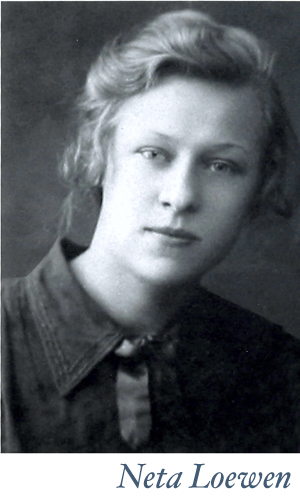
At war's end they found refuge in a boarding house in Austria, a single room with two beds for a family of five. In a nearby Catholic churchyard Neta was hired to dig graves. She was paid a loaf of bread for every grave. And in the window of their boarding house room, she planted flowers.
Decades later, when one of my aunts spoke at my grandmother's funeral and shared this memory of Neta planting flowers, I thought her extraordinary. The woman who had endured so much suffering, poverty, and loss, when given a bit of breathing room, looked for beauty. And where beauty was absent, she took pains to create it.
Beauty & Hope
I picture her flowers like those I've seen exploding out of window boxes in Europe: trailing geraniums, tendrils of pink, purple, red, and white cascading down, an effulgence of color signaling bounty, largesse. For a refugee who has fled a thousand miles, planting flowers is an act of hope—hope that you'll be in one place long enough to see them bloom.
Neta's life was marked by hope. Traveling through Poland, Czechoslovakia, and into Austria, begging in town squares, staying in strangers' homes and in refugee camps, she kept her family together. When she was told at war's end that, in keeping with the Yalta Agreement, she would have to return to the USSR, she refused. Knowing her fate would be the same as that of her brothers (who collectively suffered 46 years in the gulag), she told the American officer and the Austrian Bürgermeister, "Shoot me now if you want, but I will never return to Russia." Eventually a man from the Mennonite Central Committee located her and her children and offered them passage to Canada, where relatives had preceded them.
Neta possessed an ultimate hope, too, a simple faith in the God who rescues refugees and invites the outcast to his banqueting table. It was in part because of her faith that, by the time I knew her, when she was settled in a home of her own in British Columbia, her table was often filled with food and wine, family, friends, and neighbors.
Beauty and symbolism might seem trifling matters in light of the suffering Neta endured. But hers is a human story. Her need for beauty is a sign of God's image stamped on her soul.
In The Challenge of Jesus, N. T. Wright suggests that part of our calling as Christians is to restore the "humanness" of our vocations, to find creative ways of heralding the kingdom of God, the new order of things inaugurated at Christ's Resurrection, by "planting flags in hostile soil, setting up signposts that say there is a different way to be human."
Whether she knew it or not, my grandmother was doing this in postwar Austria. In her day job she contended with a world marked by death, securing her family's survival with each clump of dirt she hefted. And in her window she planted signposts announcing to every passer-by: Life and Hope live here.
Heather Ferngren Morton is a freelance writer based in Cheverly, Maryland, where she lives with her husband and three children. Read more of her work at heatherfmorton.com.
A Journal of Mere Christianity—Delivered to Your Door
- Essays on theology, culture, and the Church
- Contributors from across the Christian traditions

Six print issues (one year) of Touchstone, plus full online access and PDF downloads for only $39.95.

Get a one-year full-access subscription to the Touchstone online archives for only $19.95.
bulk subscriptions
Order Touchstone subscriptions in bulk and save $10 per sub! Each subscription includes 6 issues of Touchstone plus full online access to touchstonemag.com—including archives, videos, and pdf downloads of recent issues for only $29.95 each! Great for churches or study groups.
Transactions will be processed on a secure server.
more on biographical from the online archives
more from the online archives

27.6—Nov/Dec 2014
Tales of Forbidden Stereotypes
Real-Life Men & Women & the Tragic Loss of Human Comedy by Anthony Esolen
23.5—September/October 2010
The Loss of a Christian Understanding of Virginity Is Pure Tragedy by Eleanor Bourg Donlon

32.1—January/February 2019
on Down Syndrome & the Lives That Matter by David F. Watson
calling all readers
Please Donate
"There are magazines worth reading but few worth saving . . . Touchstone is just such a magazine."
—Alice von Hildebrand
"Here we do not concede one square millimeter of territory to falsehood, folly, contemporary sentimentality, or fashion. We speak the truth, and let God be our judge. . . . Touchstone is the one committedly Christian conservative journal."
—Anthony Esolen, Touchstone senior editor
