A THOUSAND WORDS
Albrecht Dürer's Noli Me Tangere
It is sometimes pleasing to an art historian of not very large stature to see how a small image can make a big impact and reverberate through the ages. Albrecht Dürer's Small Passion of 1511 is a series of 37 woodcuts, each measuring no more than four by five inches. Dürer published two other Passion series, one of eleven scenes and the other of fourteen, each depicting the events between the Agony in the Garden and the Resurrection. In the Small Passion, however, he sets his personal interpretation of the Passion drama into the whole history of salvation, from the Fall of Man to the Last Judgment.
Dürer's prints were designed to work in tandem with a series of clever (but frankly forgettable) Latin poems by the German Benedictine monk Benedict Schwalbe, each one a paraphrase of the relevant scriptural text. But Dürer's images are in no way forgettable. It is as if he has imagined himself as an eyewitness, picturing the impact Jesus has on followers and enemies alike.
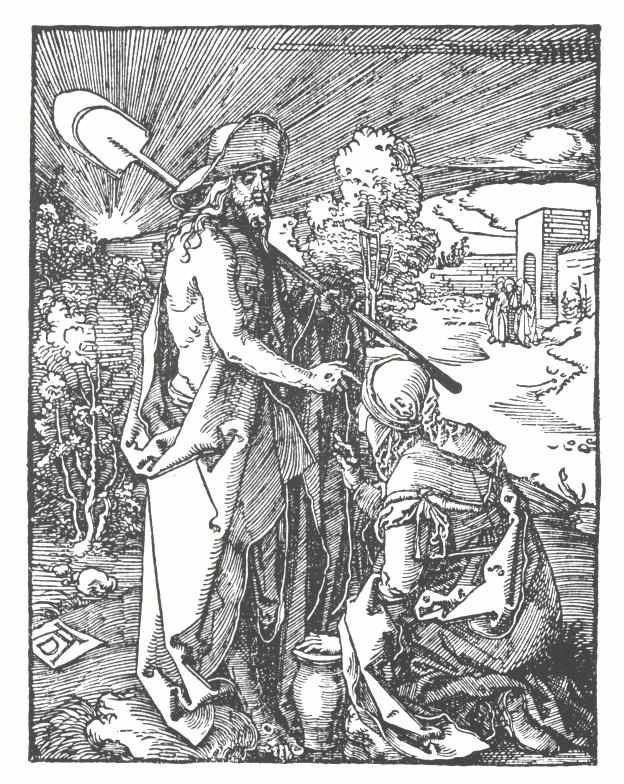
Consider, for example, the image called the Noli Me Tangere (Figure 1), in which the risen Christ appears to Mary Magdalene. Dürer sets the scene in the garden outside the walls of Jerusalem: at the right, we see the gates of the city and the three women who are Scripture's first witnesses to the Resurrection just setting out for the tomb. But the scene in the foreground is of a later moment: the weeping Magdalene has found Christ's body missing. He appears to her, but she mistakes him for the gardener. Only when he speaks to her and calls her by name does she recognize him. Although John (20:17) tells us that he tells her, "Do not hold me," he reaches his wounded hand toward her and she raises her own hand close to his own and they are united in a single silhouette. Their warmth and humanity, conveyed through expression and gesture, speak of a general warming in Dürer's art at this time that can only have its source in the warmer climate of Italy.
Compare Dürer's image to Titian's altarpiece of the same subject, done in the same year (Figure 2). Titian's Jesus does draw away from Mary as she reaches toward him in recognition, but with an expression of tenderness and a gesture of blessing. By the time the Small Passion was published, Dürer had made two trips to Venice and had absorbed the lessons of the Italian Renaissance, particularly the calm and majestic altarpieces of Bellini, Giorgione, and the young Titian. The bizarre imaginings and jagged linear style of his Apocalypse, say, have given way to a more Italianate manner, a smoother line, a firmer grasp of the human figure articulated in rational space, and a concentrated attention to the expression of human emotion.
The Good Gardener
While Titian may follow the scriptural account in a more literal narrative sense, Dürer follows its symbolic intent perhaps more deeply. Titian's Jesus carries a gardener's mattock almost as an incidental prop, but Dürer gives Jesus a hefty shovel and a broad-brimmed gardener's hat. He stands against the sun, and the hat would plausibly shade his face from Mary's view so that she would not know him.
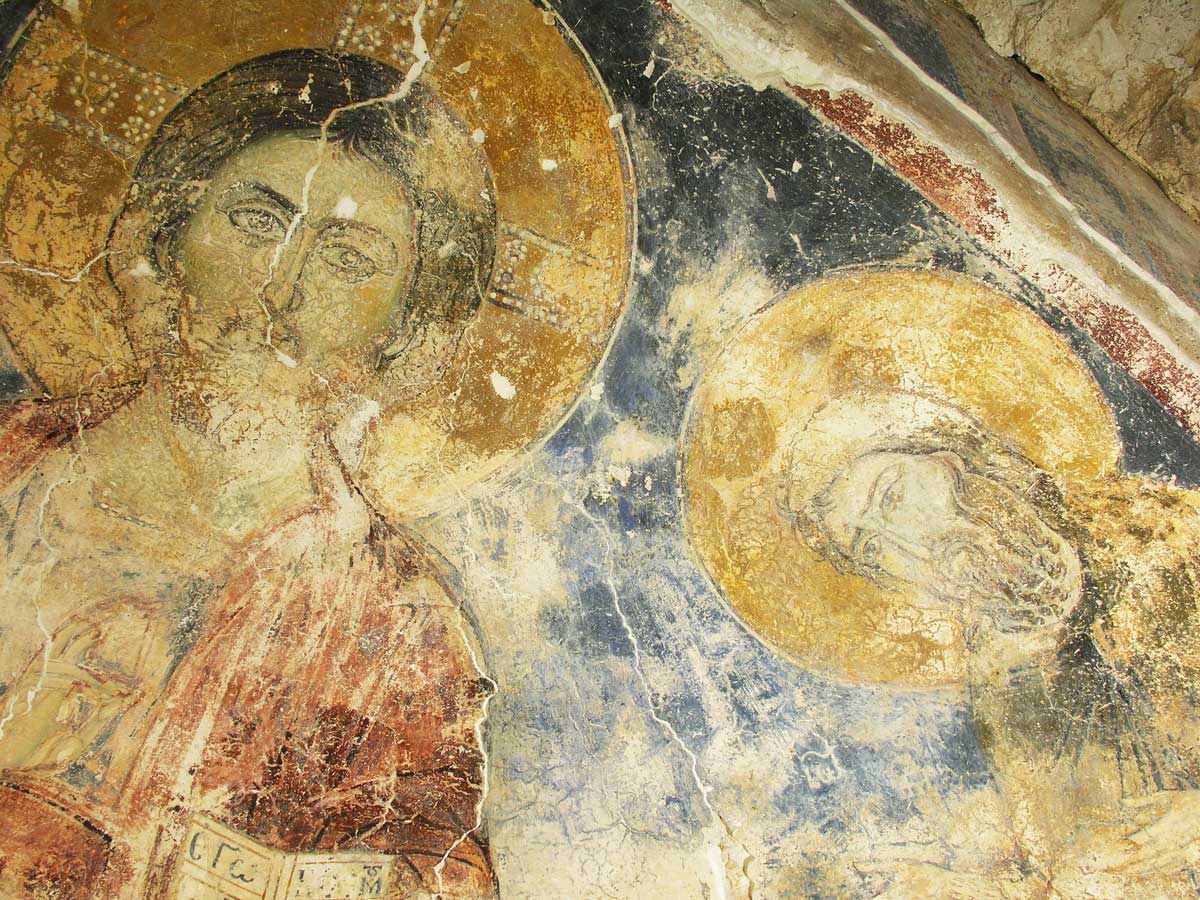
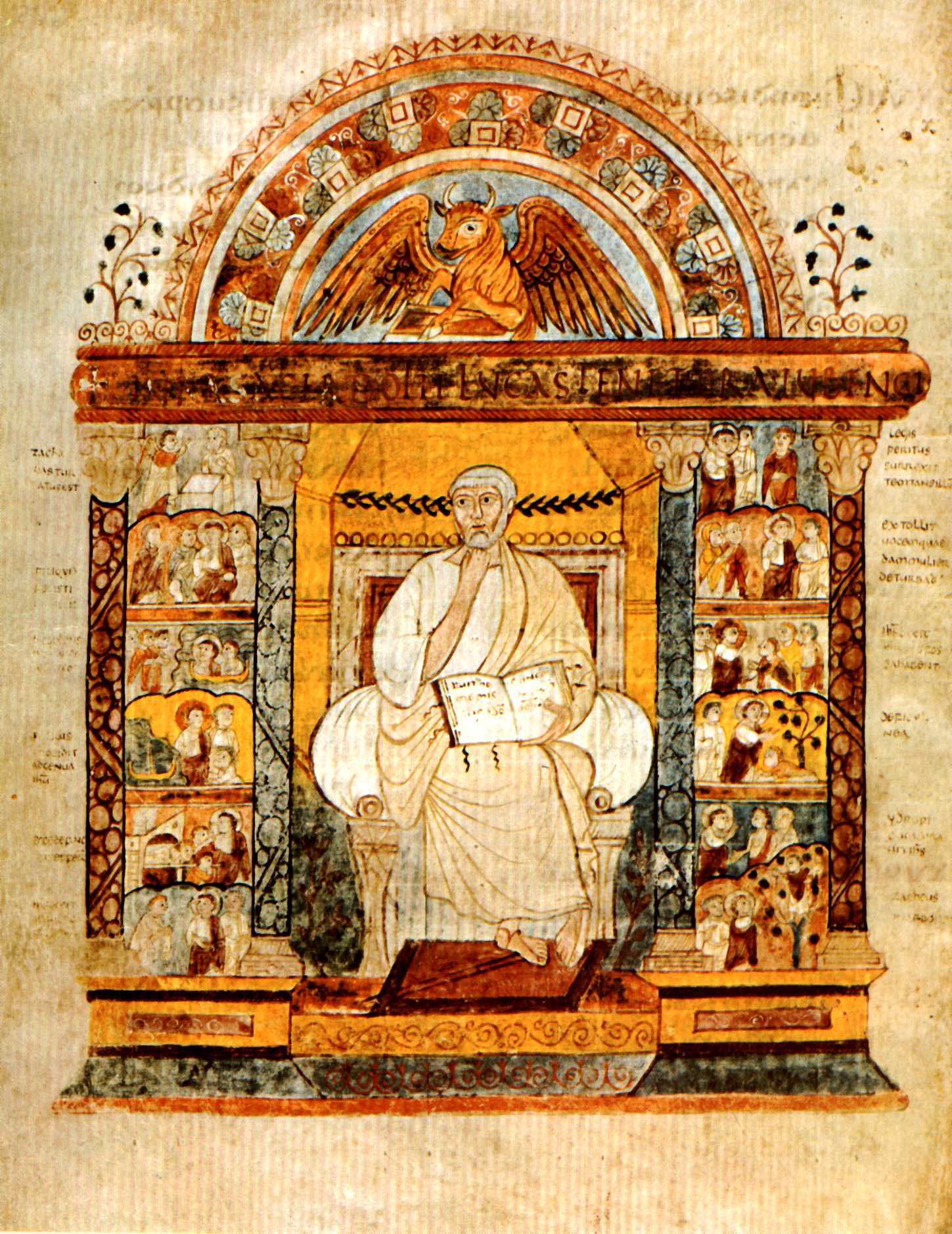
But there is more. The hat also hides the dazzling halo that Dürer gives to Jesus in his other post-Resurrection appearances (see, for example, Figure 3); here, Christ's halo is replaced by the rising sun, long a symbol of the Resurrection, and of the breaking through of the divine light into the darkness of the physical world. The sun would also have been recognized in this context as a reference to the Son of Justice: the woodcut series begins with the Fall, the source of man's woes; centers on the Passion, which offers us salvation (Dürer puts Christ's wounded hand dead center in this print); and ends with the final triumph of divine justice in the Last Judgment.
Dürer's literal gardener has a further symbolic reverberation. Here he draws upon the unconventional image of the Good Gardener from Scripture and later Christian iconography. Just as man's innocence was lost in the Garden of Eden, so was it regained in the Garden of Gethsemane. In the Old Testament, Israel was a vineyard and God the vinedresser; in the New, the Pharisees were enraged when Jesus appropriated that divine image to himself. And in Dürer's image, Jesus the divine gardener cultivates the individual soul: Mary's encounter with him is solitary and personal, and so, too, is her recognition of his divinity.
Serious & Lively, but Never Polemical
Dürer's own relationship to the Protestant Reformation is not fully documented. There is no record that he ever officially left the Catholic Church, but as a man of serious intellect and lively faith, he would surely have engaged with the issues of the day. He was active in German humanist circles: he engraved Luther's portrait and carried on a long and vivid correspondence with the classicist Willibald Pirckheimer. His collaborator on the Small Passion was a Benedictine Latinist. So, while we can find indications of Dürer's concern with concepts like salvation through faith and individual conversion in prints like the Noli Me Tangere, his art is never polemical and tends rather to emphasize the common tenets of the Christian churches.
Mary Elizabeth Podles is the retired curator of Renaissance and Baroque art at the Walters Art Museum in Baltimore, Maryland. She is the author of A Thousand Words: Reflections on Art and Christianity (St. James Press, 2023). She and her husband Leon, a Touchstone senior editor, have six children and live in Baltimore, Maryland. She is a contributing editor for Touchstone.
A Journal of Mere Christianity—Delivered to Your Door
- Essays on theology, culture, and the Church
- Contributors from across the Christian traditions
Six print issues (one year) of Touchstone, plus full online access and PDF downloads for only $39.95.
Get a one-year full-access subscription to the Touchstone online archives for only $19.95.
bulk subscriptions
Order Touchstone subscriptions in bulk and save $10 per sub! Each subscription includes 6 issues of Touchstone plus full online access to touchstonemag.com—including archives, videos, and pdf downloads of recent issues for only $29.95 each! Great for churches or study groups.
Transactions will be processed on a secure server.
more on art from the online archives
more from the online archives
calling all readers
Please Donate
"There are magazines worth reading but few worth saving . . . Touchstone is just such a magazine."
—Alice von Hildebrand
"Here we do not concede one square millimeter of territory to falsehood, folly, contemporary sentimentality, or fashion. We speak the truth, and let God be our judge. . . . Touchstone is the one committedly Christian conservative journal."
—Anthony Esolen, Touchstone senior editor