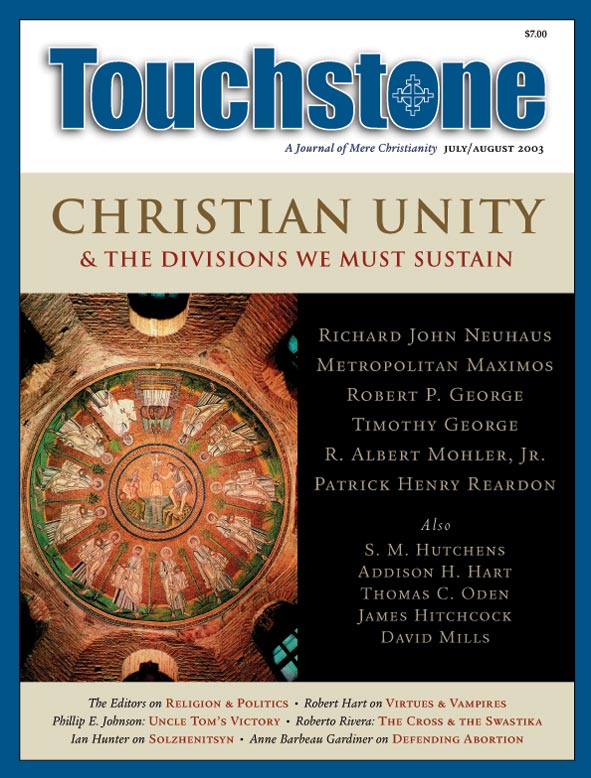
The Divisions We Must Sustain
Cultural Division & Christian Unity
by Robert P. George
Christian division is a scandal. It is contrary to the express will of Christ. Nothing more profoundly impedes the fulfillment of our Lord’s Great Commission to go forth into the world and make disciples of all nations. Division among Christians is a stumbling block to many people to whom the gospel is preached. They ask: “How can I know that the Christian gospel is true if Christians themselves cannot agree about the fundamental points of its meaning? Whose gospel shall I believe: that of the Catholics? the Eastern Orthodox? the Protestants?—which Protestants? the Anglicans? the Methodists?—which Methodists? the Lutherans?—which ones? the Presbyterians?—PCUSA or PCA? the Baptists?—Southern or American? On what authority am I being asked to choose? On what basis am I to decide?”
As we enter the third Christian millennium, the scandal of division persists. Yet today the Church is experiencing a partial fulfillment of Christ’s prayer that all may be one in him. Faithful Catholics, Eastern Orthodox Christians, and Evangelical and conservative Protestants have united in the pro-life movement and in other godly causes to protect the vulnerable and heal a wounded culture. In the process, Christians of different traditions have discovered the core of faith that we hold in common, and entered into forms of spiritual fellowship with one another that go far beyond mere strategic alliances in the culture war.
For Christians who are part of this new ecumenical alliance, ancient animosities and mutual suspicions have quite simply vanished. No longer do we view each other as “heretics” or “apostates,” much less as “infidels.” Many of us find it increasingly difficult to fathom how it could be that generations of Christians did perceive and speak of each other in these harsh terms. Despite our differences, we regard each other—effortlessly—as brothers and sisters in the Lord. We joyfully work together across the old lines of division; we pray together; we support and counsel one another; we listen to—and learn from—one another; we seek understanding and, much more often than not, are able to find or establish it. Together we pray for the “complete and visible” unity that would truly be the fulfillment of Christ’s prayer.
An Impossible Task?
Of course, this new ecumenism—this “ecumenism of the trenches,” in Timothy George’s evocative phrase—has not found universal favor. There are Christians—Protestants, Orthodox, and Catholics alike—who fear that it risks compromising fundamental truths of faith. So they oppose projects such as the Evangelicals and Catholics Together (ECT) initiative launched by Chuck Colson and Fr. Richard John Neuhaus, and they are dubious about enterprises such as Touchstone magazine.
Now, I think their opposition is misguided. But I respect and share their concern for the integrity of Christian doctrine. Truth is not negotiable. Our efforts to overcome division must not be made at the expense of truth. A unity worth having is unity in truth. Regard for truth must, therefore, shape, and will necessarily limit, what we can do in the cause of Christian unity. It is for the sake of truth that we must continue to accept, for now, a painful measure of division even among Christians who affirm the core doctrines of Christian faith that are the tenets of “mere Christianity.”
And it is painful. Catholic, Protestant, and Eastern Orthodox Christians who work and pray together, who love and admire each other, and who understand themselves as brothers and sisters in the Lord, truly hunger for complete and visible unity. In particular, we long to share the communion of the Lord’s table. But in the absence of the full unity that such sharing betokens, it would, in my judgment, be a sin against truth. As painful as it is, our divisions as Protestants and Catholics (or Protestants and Orthodox) must be accepted until by God’s grace we are led to a more perfect unity of mind and spirit.
But can such unity ever be achieved? How could differences of conscientious judgment on important doctrinal matters in dispute between Protestants and Catholics, for example, ever be resolved? Looked at from the purely human point of view, the problem appears to be insuperable. In the best of faith, Protestants differ with Catholics and Orthodox (and, to a lesser extent, Catholics and Orthodox differ between themselves) on some very important matters.
It is true that the clearing away of misunderstandings has significantly narrowed differences in certain areas, such as the differences between Catholics and Lutherans regarding justification. Still, when it comes to papal authority, the Marian dogmas, priestly ordination, sacraments, and so forth, important differences remain. Short of one side or the other becoming convinced of the error of its beliefs, there is no way to manufacture unity. But, fortunately, Christians need not, and should not, look at the matter from the merely human viewpoint; for as the Lord said in reference to the camel passing through the eye of a needle, “nothing is impossible with God.”
Robert P. George is McCormick Professor of Jurisprudence and Director of the James Madison Program in American Ideals and Institutions at Princeton University (web.princeton.edu/sites/jmadison). His books include In Defense of Natural Law (Oxford University Press) and Conscience and Its Enemies (ISI Books). He has served as chairman of the U.S. Commission on International Religious Freedom. He is a senior editor of Touchstone.

A Journal of Mere Christianity—Delivered to Your Door
- Essays on theology, culture, and the Church
- Contributors from across the Christian traditions
Six print issues (one year) of Touchstone, plus full online access and PDF downloads for only $39.95.
Get a one-year full-access subscription to the Touchstone online archives for only $19.95.
bulk subscriptions
Order Touchstone subscriptions in bulk and save $10 per sub! Each subscription includes 6 issues of Touchstone plus full online access to touchstonemag.com—including archives, videos, and pdf downloads of recent issues for only $29.95 each! Great for churches or study groups.
Transactions will be processed on a secure server.
more from the online archives

calling all readers
Please Donate
"There are magazines worth reading but few worth saving . . . Touchstone is just such a magazine."
—Alice von Hildebrand
"Here we do not concede one square millimeter of territory to falsehood, folly, contemporary sentimentality, or fashion. We speak the truth, and let God be our judge. . . . Touchstone is the one committedly Christian conservative journal."
—Anthony Esolen, Touchstone senior editor