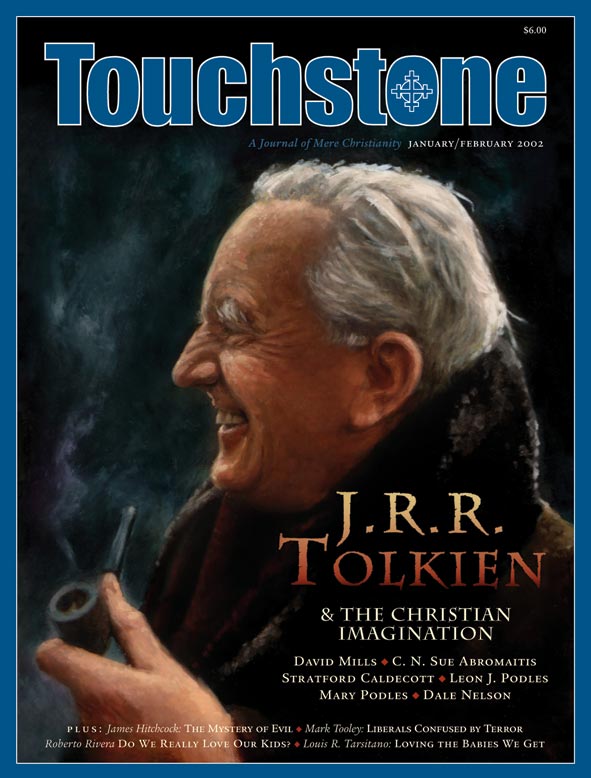
Reading Tolkien by David Mills

Reading Tolkien

Tolkien: A Celebration
edited by Joseph Pearce
San Francisco: Ignatius Press, 2001
(210 pages; $12.95, paper)

reviewed by David Mills

Although the average Christian reading The Hobbit and especially The Lord of the Rings knows that they are Christian works, and with good reason, the hundreds and hundreds of people who have written serious studies of the books disagree widely on the nature and place of religion in them. No God ever appears in them, and despite Tolkien’s own belief that they are not only religious but Christian works, the absence of God has let many critics say that Tolkien is wrong.

A startling number of them do not realize or (I suspect) do not want to see that the books are essentially religious. I sometimes get the feeling that this kind of reader prefers the apparently godless world of Middle-earth and wants adventure and heroism without the moral order that makes heroism meaningful. Others argue that the books are religious but that the religion is not Christianity but the paganism of the ancient north. This is an interesting idea, though I think it much truer to say that the northern legends Tolkien loved reflected the kind of Christianity he favored.

Still others see that the books are Christian works but hold this a weakness. These critics tend to think Tolkien’s type of Christianity—doctrinally orthodox Christianity expressed in a morally and socially ordered world—to be an instrument of social and sexual oppression.

Tolkien’s work has such cultural importance and influence that a certain sort of academic critic will find in it a summary of everything he thinks wrong with Western culture and especially with Christianity. The books have sold too many copies to be ignored by the sort of scholar who believes popularity a sign that the work supports the oppressive beliefs of the mass of men.

Celebrating Tolkien

Against this kind of negative reading, which is more common than you might expect—it started with the first reviews of The Fellowship of the Ring—many writers have explained the Christianity of Tolkien’s works, but their work has been scattered about in journals and books, most of them hard for the average reader to find. Tolkien: A Celebration collects several very good essays on the subject (and some weak ones), which together will give the average reader—everyone but the scholar and the fanatic—as much on the subject as he is likely to need. Seven are reprints, and eight are original.

It is an ecumenical collection, and the writers range from Stratford Caldecott of the Centre for Faith and Culture in Oxford, a Catholic, to the Reformed theologian Colin Gunton of King’s College, London, to the author of Defending Middle Earth, Patrick Curry, who does not seem to be a Christian. The writers also include two Jesuits, James Schall and Tolkien’s friend Robert Murray; another friend of Tolkien’s, Richard Jeffery; the Evangelical fantasy writer Stephen Lawhead; Walter Hooper; and the editor himself.

The editor, Joseph Pearce, now the writer in residence at Ave Maria University, has written several books, including Literary Converts and Wisdom and Innocence, a biography of G. K. Chesterton that is one of the two I recommend. Both books are published in this country by Ignatius Press, and both have the marks of Pearce’s writing: extensive research, a care to make only the most justified and judicious of judgments about his subjects, a somewhat partisan defense of his subjects, and extensive quotation from primary and secondary sources.

Pearce also wrote a biography of Tolkien, Tolkien: Man and Myth, published by Ignatius in 1998. (The reprinted essays in Tolkien: A Celebration are those he came across while researching the biography and thought needed to be offered to new readers.) It does not replace Humphrey Carpenter’s authorized biography, J. R. R. Tolkien, first published in 1977 and still in print, and in fact seems to draw almost all the details of Tolkien’s life from Carpenter’s work, padded out with long quotes from secondary sources and the writer’s own commentary, which is not always precise enough to be helpful.


David Mills has been editor of Touchstone and executive editor of First Things. He edits the opinion page of the Pittsburgh Post-Gazette.

A Journal of Mere Christianity—Delivered to Your Door

  • Essays on theology, culture, and the Church
  • Contributors from across the Christian traditions
Subscribe (Print + Online)

Six print issues (one year) of Touchstone, plus full online access and PDF downloads for only $39.95.

Subscribe (Online Only)

Get a one-year full-access subscription to the Touchstone online archives for only $19.95.


bulk subscriptions

Order Touchstone subscriptions in bulk and save $10 per sub! Each subscription includes 6 issues of Touchstone plus full online access to touchstonemag.com—including archives, videos, and pdf downloads of recent issues for only $29.95 each! Great for churches or study groups.

Transactions will be processed on a secure server.


more on J. R. R. Tolkien from the online archives
34.6—Nov/Dec 2021

The Morgul Blade

on Experiencing Grief at Christmastime by Keith Lowery


more from the online archives

29.5—Sept/Oct 2016

Dying of Despair

on the Loss of True Community & Rising Political Desperation by Karl D. Stephan

32.2—March/April 2019

That Hideous Food

on Preserving Physical & Spiritual Nourishment by Nathanael Devlin

34.1—January/February 2021

Jeremiah Revisited

Live Not by Lies: A Manual for Christian Dissidents by Rod Dreher by Hans Boersma

calling all readers

Please Donate

"There are magazines worth reading but few worth saving . . . Touchstone is just such a magazine."
—Alice von Hildebrand

"Here we do not concede one square millimeter of territory to falsehood, folly, contemporary sentimentality, or fashion. We speak the truth, and let God be our judge. . . . Touchstone is the one committedly Christian conservative journal."
—Anthony Esolen, Touchstone senior editor

Support Touchstone

00