May 11 – May 18

Friday, May 11

Ezekiel 32: This chapter contains Ezekiel’s final two oracles against Egypt:

The first of these (though given later than the one that follows it), is dated on March 3, 585 (verse 1). Although it was delivered during the winter that followed the downfall of Jerusalem to the Babylonians, no reference is made to that event. Some of the imagery of this oracle recalls the plagues with which the Lord had long before struck the land of Egypt: the floods of blood and the great darkness (the first and ninth plagues). The great sin of Egypt declared in this oracle was pride.

The second (and earlier) of these two oracles was delivered on April 27, 586, prior to Jerusalem’s downfall. In his massive and detailed description of the nether world, Ezekiel sounds a theme from classical literature; the attentive reader can hardly fail to notice the similarities that this oracle has to the nether world descriptions in the Odyssey and the Aeneid.

Ezekiel’s description is similarly preoccupied with the thought of warfare and conquest. As Homer and Virgil portrayed the netherworld in the context of the fall of Troy, Ezekiel portrays it in the context of the fall of Jerusalem. Thus, it is in the netherworld, the realm of death, that the prophet finishes his oracles against those nations that rose up in rebellion against God’s authority over history. This second part of the Book of Ezekiel comes to an end.

First Samuel 1: It would be a comfort to think that all those who go up to the house of the Lord are led there by the Holy Spirit. It would also be an illusion. Even if experience did not testify that people sometimes attend worship with the most deplorable attitudes and for the worst possible reasons, Holy Scripture itself would caution us to realism on the point.

An early example is Peninnah, Elkanah’s “other wife,” who used the annual pilgrimage to Shiloh as an opportunity to render life miserable for barren Hannah. This latter she provoked severely, says the Sacred Text, “to make her miserable.” The provocation was not unintentional, we are assured, nor did it happen only once: “So it was, year by year, when she went up to the house of the Lord, that she provoked her; therefore she wept and did not eat” (1 Samuel 1:6-7). It is easy to picture Peninnah looking forward to that annual pilgrimage with the family; it was perhaps her favorite time of the year, providing her the forum for feeling superior and spreading discouragement.

Now, as it happened, the God who brings good out of evil caused everything to work out well for Hannah, and the story soon turns into an account of grace and divine visitation. Still, there was a serious pastoral problem at Shiloh, and I suspect more than one worshipper at the time wished the priest Eli, pointing to Peninnah, would suggest to Elkanah, “When your family comes next year, brother, why not leave Miss Picklepuss at home?” Perhaps his failure to do so should be counted among Eli’s pastoral shortcomings.

Saturday, May 12

Ezekiel 33: This chapter has four parts: In the first (verses 1-9) the prophet is portrayed as a watchman keeping vigil over a city, responsible for warning the citizens of any impending peril. It is not the concern of the watchman whether or not the citizens pay him any heed; his responsibility is simply to sound the warning. The remaining responsibility belongs to the citizens themselves. The dominant images in this part are the sword and the trumpet.

This theme of warning is what joins the first part to the second (verses 10-20). In biblical prophecy there is often an implied hypothesis: “Such-and-such will happen, unless . . .” Many prophetic predictions contain, by implication, a conditional clause: “If . . . then . . .”

In this second part of the chapter Ezekiel repeats much of the message that we saw in Chapter 18 — namely, it is not what a man was that is important, but what he becomes. Consequently, neither former good nor former evil will be credited to a man who has changed his ways.

The third part of this chapter (verses 21-22) takes up the narrative of Ezekiel’s life, broken off after Chapter 24 by the insertion of the oracles against the nations (Chapters 25-32). We recall that Ezekiel’s wife had died, leaving him struck dumb with grief. At that time the Lord foretold to him that he would recover his speech when a messenger arrived to tell of Jerusalem’s downfall (24:25-27).

This third part of Chapter 33 now tells of the arrival of that messenger on January 8, 585, narrating Jerusalem’s fall the previous summer. The walls of Jerusalem had been breached in July (cf. Jeremiah 39:2; 52:6f), and a month later the temple had been deliberately destroyed (2 Kings 25:8f; Jeremiah 52:12). When this news reaches him, Ezekiel’s tongue is loosened, and he is once again ready to be God’s spokesman.

Therewith follows the fourth part of this chapter (verses 23-33), which blames the desolation of the Holy Land on the sins of its inhabitants. Ezekiel’s fellow hostages in Babylon love to hear him for his eloquence, and they come often to listen to him. But it will do them no good, for they refuse to repent. Too late will they learn what they missed.

First Samuel 2:1-21: It is worth observing that Hannah’s prayer serves a significant purpose in the literary structure of that book. Bearing in mind that the Books of Samuel were originally a single book, not two, we readily discern that both the opening and closing scenes of that book have to do with worship.

Thus, chapter 1 of First Samuel describes the regular pilgrimages that Elkanah’s family made to the ancient shrine at Shiloh, while the last chapter of Second Samuel finishes with David’s purchase of the site of the future temple at Jerusalem. At the beginning of the book, the Ark of the Covenant is in Shiloh, but the Ark has been moved to the new site as the book ends. Sacrifices are offered in each place, whether by the priest Eli or by David.

In both places, likewise, there is a description of prayer. First Samuel starts with two prayers of Hannah, and Second Samuel closes with two prayers of David (24:10, 25).

Moreover, these prayers themselves are similar. Hannah’s petition, inspired by her great distress, takes the form of a vow; if the Lord should give her a son, she promises, she will dedicate him to the Lord. And at the end of the book, David’s prayer, made in response to the plague that afflicts the people through his own sin, takes the form of resolve to dedicate a new temple to the Lord. David’s resolve, implicit in 2 Samuel 24, is elaborated in 1 Chronicles 21 and Psalm 131(132). Thus, the Book of Samuel begins and ends with similar prayers, in the context of sacrifice.

Sunday, May 13

Ezekiel 34: Ezekiel knows that the recent disaster at Jerusalem and its dire consequences, such as the scattering of God’s people, were in large measure the fault of those appointed to care for them: the royal house and the government, the priesthood, the teachers. All of these were Israel’s shepherds, commissioned by God to tend, govern, and feed the sheep. Not only did they fail to do so, but also they used their relationship to God’s people in order to serve themselves.

Thus, unfed and without guidance, the flock had “been scattered on a day of clouds and thick darkness.” God Himself, however, will come to shepherd them, and He will do so through His Anointed One—the new David—who will inherit the promises made to his ancient forebear (2 Samuel 7; Psalm 89 [88]). This imagery and its promise will in due course be taken up by that new David who, in John 10, describes Himself as the Good Shepherd.

Ezekiel then (verses 17-22) criticizes some of the sheep themselves, who have exploited and ill-treated one another. God will judge them, not by classes, but as individuals (“sheep by sheep”) responsible for their decisions and their behavior.

The final section of this chapter (verses 25-30) describes the coming care of the Good Shepherd in terms reminiscent of paradise.

First Samuel 2:22-36: The offenses of Hophni and Phineas were not common moral failings, such as drunkenness; they were directly related, rather, to the ministry itself. That is to say, these two scoundrels used their priestly authority and position to take advantage of the very people for whom they were ordained (Hebrews 5:1). Their sins were particularly heinous. Holy Scripture mentions two abuses of Hophni and Phineas:

For one thing, they violated the trust of “the women who assembled at the door of the tabernacle” (1 Samuel 2:22). It was a sin of raw and crude exploitation: For the purpose of sexual gratification, they betrayed the confidence and exploited the vulnerabilities of those religious women, whom it was their responsibility to serve and care for. That is to say, their ministry in the Lord’s house provided the very means and context of their infidelity.

The other offense of Hophni and Phineas involved the act of sacrifice itself. Disdaining that part of the sacrificial victim assigned to the priest, these two scoundrels insisted on taking a “choice cut” from the offered meat prior to the sacrifice itself (2:12-16). Thus, instead of serving the Lord’s house, they made sure the Lord’s house served them. This will always be the mark of an unworthy priest.

Following the lead of Venerable Bede’s commentary on this story, we should regard those unworthy priests at Shiloh as foreshadowings of the later priests—chiefly Caiaphas—who condemned Jesus in the Sanhedrin and then accused Him before the judgment seat of Pontius Pilate. Indeed, it was at the home of Caiaphas that the whole plot was planned (Matthew 26:3-4). This supreme representative of the Jewish people used the very office of his ministry—the worship of God—to murder God’s Son. Even Pilate read the motive as envy (27:18; cf. 21:38).

Thus, Caiaphas remains for all time the egregious example of a genuinely rotten priest.

At the same time, the Gospel writers were aware of the irony involved in that singular betrayal of the priestly office: By condemning Jesus to death (26:63-66), this unworthy priest unwittingly provided the means of God’s perfect worship, the unique and supreme sacrifice to take away the sins of the world.

Given even the minimum standards for the ministry—” blameless, the husband of one wife, temperate, sober-minded, of good behavior, hospitable, able to teach; not given to wine, not violent but gentle, not quarrelsome, not covetous”—it is not surprising that we find the occasional minister who doesn’t measure up.

Far worse, certainly, are those offenses associated with the very exercise of the priesthood, sins directly concerned with the setting and context of the ministry, such as the quest of power and absolute control: the violation of trust in matters of conscience, the cultivation of malice in place of mercy, the disposition to answer criticism with revenge, and the abuse of authority to tyrannize the hearts and minds of the Lord’s flock. Such offenses come closer to the sins of Eli’s sons, and, more ominously, the unspeakable crime of Caiaphas.

Monday, May 14

Ezekiel 35: In this chapter we find expressed toward the Edomites, symbolized in Mount Seir, that same spirit of bitter condemnation that inspired the entire prophecy of Obadiah and the last several verses of Psalm 137 (136).

The material here expands on ideas found in a seminal form in Ezekiel 25:12-14. Edom has assisted and cheered on the Babylonians in their wanton destruction of the temple (cf. 1 Esdras 4:45). Ezekiel is our witness that the Edomites hoped to annex territory left open by the destruction of the kingdoms of Israel and Judah (verse 10), but they will not do so, he tells us, because God has other plans for that land. Those plans of God form the substance of the next chapter.

The Edomites in the Bible comprised what we may call . . . well, a special case. Israel did not like them very much. Indeed, the Lord had to command Israel not to despise the Edomites (Deuteronomy 23:7), a thing they were prompted to do, perhaps, on the excuse that the Lord Himself was said to hate Esau, the father of the Edomites (Malachi 1:2; Romans 9:13). Truth to tell, the Edomites were not easy to love. They had obstructed Israel’s path from Egypt during the days of Moses (Numbers 20:21). They were known to be without pity (Amos 1:11) and engaged in international slave trade (1:6,9). For Ezekiel, as for Obadiah, however, the major sin was their attempt to exploit Babylon’s destruction of Judah.

First Samuel 3:1-21: Samuel’s lifetime–mostly the second half of the eleventh century before Christ—-was an age of transitions, in two of which Samuel himself was directly involved. These were the destruction of the shrine at Shiloh in his youth, and Israel’s establishment of the monarchy during his declining years. In both cases Samuel, the last of Israel’s Judges, was obliged to be the bearer of bad news.

He was a mere boy when, shortly before 1050 BC, Samuel was taken to Shiloh, consecrated to God, and placed under the guidance of that shrine’s last priest, Eli (1 Samuel 1:24–28; 2:11,18–20). Shiloh had been a central shrine of Israel for about a century and a half, ever since Joshua fixed it as the meeting place of the twelve tribes (Joshua 18:1). It was from there that the tribal representatives went forth to survey the Promised Land, and back to Shiloh they returned to cast lots for the division of the land (18:8–10; 19:51).

During the ensuing period of Israel’s Judges—1200 to 1050—Shiloh remained a regular place of pilgrimage (Judges 21:19; 1 Samuel 1:3, 7). At some point during that period, the Ark of the Covenant, previously placed at Bethel (Judges 20:26–27), was moved to Shiloh. It was near the Ark, within the shrine, that the boy Samuel slept, at least sometimes (1 Samuel 3:3).

One such night, indeed, provided what is perhaps the best-known scene in Samuel’s life. Three times the sleeping lad, hearing his name called out in the night, rose and went to learn what Eli wanted of him.

Eli, however, had not called him. Finally, this aged priest, suspecting the truth, instructed Samuel, should he hear his name invoked again, to answer, “Speak, Lord, for Your servant hears” (3:3–9). Samuel, yet abiding near the Ark, did so, and the Lord did speak to him, giving the boy his first experience of prophecy. It concerned the coming destruction of Shiloh and the end of Eli’s priesthood (3:11–14). Samuel was obliged to bear the bad news (3:17–18).

Tuesday, May 15

Ezekiel 36: As the previous oracle was addressed to Mount Seir in Edom, so this one (verses 1-15) is addressed to the mountains of Israel. It condemns all the nations that have set themselves against God’s people, but special attention is given, once again, to the Edomites (verse 5).

In verse 8 Ezekiel begins a series of several prophecies of the Israelites’ return to their homes. Whereas in Chapter 6 he had infallibly foretold to these same mountains the many sufferings that have since ensued, he now tells them, again infallibly, of the joys that lie ahead.

And why should God perform these mercies, in view of the fact that Israel has deserved all that it has suffered (verses 16-20)? Because of His own gracious election (verses 21-38). God will pour out all these new blessings on His people in order to testify to the gratuity and steadfastness of His choice. God will be faithful, even though Israel has not been faithful.

The most famous lines of this section are in verses 26-28, repetitious of 11:19-20 and reminiscent of Jeremiah 31:31-34. God will restore Israel, not because of the merits of Israel, but to vindicate His covenant fidelity. The gift of cleansing and a new heart is entirely God’s, but it will not be given except in the context of repentance (verse 31).

First Samuel 4:1-22: Breaking off the story of Samuel, these next three chapters are devoted to the “exile” of the Ark of the Covenant: its capture on the battlefield (chapter 4), its “captivity” among the pagans in an alien land (chapter 5), and its return to the Chosen People (chapter 6). Since its important presence at the crossing of the Jordan and the Battle of Jericho (Joshua 6—8), the Ark has been little mentioned in the biblical narrative. Nor, apparently, has it always resided in the same place. We know that it was kept for a while at Bethel (Judges 27), and now we find it at Shiloh (3:3; 4:4).

The present chapters indicate how the Ark came to be at Kiriath Jearim (6:20—7:2), whence David will move it to Jerusalem in 2 Samuel 6. (The reference to the Ark in the Hebrew text of 1 Samuel 14:18 is surely wrong. With the Septuagint, we should read that passage as referring to the oracular “ephod.”)

There are two parts to the present chapter: first, the loss of the Ark to the Philistines (verses 1-11); second, the death of Eli and the birth of Ichabod (verses 12-22).

After an initial defeat at the hands of their enemy (verses 1-2), the Israelite elders imagine that the Ark’s bare presence on the battlefield will assure the army of divine help in the next encounter (verse 3). Their reasoning on this point is doubtless inspired by the memory of the Ark’s significant role in the Battle of Jericho.

However, those warriors commanded by Joshua at Jericho were assured of victory by the Lord Himself (Joshua 6:2-5), and they bore the Ark, not as a lucky charm or a magic talisman, but as an expression of their faith (6:6-8). In contrast, the elders in the present text forget that the Lord bases His judgments on the content of hearts. How can they imagine that the Lord does not regard the hearts of the two scoundrels who currently carry the Ark? Ironically, the Philistines seem to have more respect for the Ark than do the Israelites (verses 7-9). In the end, Israel’s losses in the second battle (verse 10) greatly outnumber those in the first.

The second scene of this chapter (verses 12-22) opens with the arrival of the messenger who runs 18 miles from the battlefield to the city of Shiloh, bringing tidings of the disaster (verse 12). Eli, apparently waiting at a gate different from the one entered by the messenger, becomes the last person to hear the message. The scene grows in drama: blind Eli, hearing the uproar and lamentation in the city, demands to know the reason (verses 13-16). We learn much of the soul of the old man from the fact that he is anxious less for the safety of his sons than for the fate of the Ark. Hence, the full effect of the message seizes him only when he learns of the seizure of the Ark: Falling backward from a stool, he dies of a broken neck (verse 17-18).

The ironic climax of the tragedy arrives when the pregnant wife of Phineas suddenly goes into labor, in reaction to learning of the loss of her husband and father-in-law, along with the defeat of the army and the capture of the Ark. She dies after giving birth to a boy, on whom she confers the symbolic name Ichabod, “glory gone.”

This name is based on the important Hebrew noun kavod, “glory.” This is the glory associated with God’s presence with the Ark. This child, then, born on the day of Ark’s capture, will be a living reminder of the Lord’s judgment on the priestly family of Shiloh. Although some prophets continued to dwell at Shiloh (cf. 1 Kings 14:2, 4), its priesthood settled at Nob (1 Samuel 14:3; 22:11).

Samuel moves back to Ramah (7:17), his birthplace, and the Ark, though returned to Israel, will never again be installed at Shiloh. The Lord has abandoned the site, making it a symbol of the fate awaiting any city that forsakes His covenant (Jeremiah 7:12, 14).

Wednesday, May 16

Ezekiel 37: We come now to Ezekiel’s vision of the valley of the dry bones, unarguably the best known part of this book. It consists of a Spirit-given experience (verses 1-10), followed by an interpretation (verses 11-14). In its immediate historical sense, the valley of the dry bones represents Israel after Jerusalem’s destruction in 586.

As a prophecy to be fulfilled in the fullness of time, it refers to the resurrection of the dead, of which the principle and first-fruit is the Resurrection of Christ. (Hence it is most appropriate for us to be reading this text on the eve of Ascension Thursday, the feast celebrating the heavenly exaltation of Christ’s risen flesh.)

In this vision the dynamic principle in the resurrection of the dead is the same Spirit who brought the prophet to the valley (verse 1).

The reader should bear in mind that, all through this chapter, a single Hebrew word (ruah) is translated in different ways (“Spirit,” “breath,” “wind”), simply because no one English word expresses the fullness of its meaning (Cf. also Genesis 1:2).

This section is followed by another prophetic pantomime (verses 15-17), accompanied by an interpretation (verses 18-23), according to which all of God’s people will be rejoined, with the new David to shepherd them (verses 24-28).

First Samuel 5:1-12: The victorious Philistines now take the captured Ark of the Covenant and place it, as a votive offering, in the temple of their god, Dagon, in the city of Ashdod. Although they intended this ritual to signify the subjection of Israel’s God to Dagon, the latter does not fare well in the encounter (verses 1-5).

Dagon was a local Syrian divinity adopted by the Philistines on their arrival in the region, roughly 1200 B.C. Although the exact derivation of his name is disputed, it is generally agreed that Dagon was a god of fertility, and local legend made him the father of Baal. He had more than one temple in the region (cf. Judges 16:23; 1 Chronicles 10:10). Jonathan Maccabaeus destroyed his temple at Ashdod in 147 B.C. (1 Maccabees 10:83-84; 11:4).

The details of this story—particularly Dagon’s hands—render it curiously similar to the account of the ravished and slain woman in Judges 19:22-29). When her body is found, the woman lies at the door of the house, with her hands on the threshold, similar to the hands of the prostrate Dagon. The woman is subsequently dismembered.

The Lord of the Ark, having disposed of the Philistine god, now turns to deal with the Philistines, wreaking havoc in three cities of their pentapolis (verses 8-12). The reader is reminded of the plagues visited on Egypt—both animal pests (Exodus 7:26—8:27; 10:1-15) and bodily afflictions (Exodus 9:8-12), including death (Exodus 12:29-36). As the Ark is moved from city to city, Philistine panic intensifies. Its mere arrival at Ekron is sufficient to cause consternation, prior to any actual damage! In these descriptions, the biblical author is enjoying himself immensely.

Historians have variously identified the pestilence described here, the most severe suggestion being bubonic plague. Although interpretation would account for the rodents and the physical symptoms (buboes or glandular swellings), we should not permit a preoccupation with diagnosis to obscure the author’s literary and rhetorical intention—to portray the affliction in terms of extreme discomfort and embarrassment. The King James Version, grasping this intention, identified the swellings as hemorrhoids. That is to say, the emphasis in this account is on anal distress.

Modern readers of this passage have presumed that the victims died on a bubonic infection. However, our earliest commentator on the story, Josephus (Antiquities 6.1.3), believed that death came from “dysentery.” (Let us forego his description.)

The theological message of this chapter rests on the common biblical theme of victory arising out of defeat. The Philistines had barely time to celebrate their supposed triumph before they began to suspect their mistake: They had swallowed what they could not digest. After a single night they found their god humiliated—and after a second night dismembered— by the object they had captured. Dagon was now unsafe in his own shrine. Israel’s Lord began to show Himself the conqueror of the prematurely partying Philistines. The tables were turned. Instead of parading the Ark as the spoils in a victory parade, its transport becomes the Lord’s own victory march. The Philistines began to know how ancient Pharaoh felt, when the full force of the ten plagues made him eager for Israel to leave Egypt.

The triumph of the “defeated” Ark within Philistia was a prophecy of the victory of “defeated” Jesus over the forces of the nether world. Like the Philistines, Death had swallowed what it could not digest. St. John Chrysostom said it best: “The Savior’s death has set us free. ? He that was held prisoner of it has annihilated it. By descending into Hell, He made Hell captive. He embittered it when it tasted of His flesh . . .. It took a body, and met God face to face. It took earth, and encountered Heaven.”

Thursday, May 17

Ezekiel 38: When the obscure kingdom of Lydia (in Asia Minor) came to geopolitical notoriety in the seventh century before Christ, the man responsible for its rise was a ruthless, warring king named Gugu (c. 680—c. 648).

“Gugu” was, at least, the name by which the Assyrians called him. Indeed, the earliest extant texts mentioning this Lydian king are found in the clay archives of the Assyrian emperor Ashurbanipal (668-633), who was for a while Gugu’s suzerain lord. Now it is surely significant of Gugu’s political and military importance that a fragment of earthen tablet in distant Mesopotamia contains our first inscription of his name.

In Mesopotamian memory, in fact, the name of Gugu lingered on. Ezekiel, writing his prophecies in that area during the next century (chapters 38-39), remembered the famous Lydian king as “Gug” or “Gog” (the two forms being identical in unmarked Hebrew).

Because of Lydia’s inclusion in the greater world of the Greeks, it is no wonder that these latter also spoke of Gugu (whose name they Hellenized to “Gyges,” our own “y” and the “u” being identical in Greek). In extant sources, the first Greek to mention Gugu was his contemporary, the poet Archilochus, who referred especially to the Lydian’s great wealth. Aristotle quotes a line of Archilochus, Ou moi ta Gugeo tou polychrysou melei, oud’ heile po me zelos—“I am not bothered by the wealth of Gugu, nor did I ever envy him” (Rhetoric 1418.42b).

Gugu’s fame refused to fade. A full two centuries after his death Herodotus (c. 482—c. 425) recorded memorable tales about him. In a rather involved story, for instance, he described how the wife of Gugu’s predecessor persuaded him to kill her husband and seize the throne (Histories 1.8-12). Other versions of this narrative (for example, Plato, Republic 2.3 359C-360B) differ in the details, but most agree that Gugu murdered his predecessor and married the widow.

Gugu’s violent seizure of the Lydian throne would have led to a civil war, says Herodotus (1.13), except that the Delphic oracle confirmed the usurper in his new position. In gratitude whereof, Gugu devoted many gifts to the Delphic shrine (1.14).

No sooner had Gugu taken the throne than he began to wage war on all his neighbors. In fact, says Herodotus, “he accomplished nothing else of note (ouden gar mega) in his reign of thirty-eight years” (1.15).

Gugu’s great military success was partly purchased by his alliance with the Assyrians, nor could it long outlive that alliance. When, sometime about 648, Gugu sent forces to Egypt to help Pharaoh Psamtik I (664-610) in his rebellion against Ashurbanipal, the latter abandoned him to his local enemies in Asia Minor. That was the end of Gugu.

As we have seen, however, something about Gugu declined to die. In popular imagination he remained the very type of the barbarian warrior.

Thus, when the prophet Ezekiel, exiled in Mesopotamia a hundred years later, wanted to describe for own his contemporaries the coming judgment of God in the tumultuous events of history, all he had to do was invoke the name of Gugu, or Gog, to describe a menacing barbarian army. This coming Gog holds sway in the land of Magog, a name meaning “(derived) from Gog” (Hebrew min-Gog). He is “the head (rosh) of Meshech and Tubal” (38:2), the two sons of Japheth and the fathers of most of the world’s nations (Genesis 16:2; 1 Chronicles 1:5; cf. Ezekiel 27:13; 32:26; 39:1). This barbarian Gog represents, therefore, the hostile world arrayed for the invasion of God’s people.

Six hundred years after Ezekiel, St. John wrote another prophetic book, which he sent to-among other places-Sardis (Revelation 3:1), the ancient capital of Lydia, the very place where Gugu had seized the throne and married the queen. In this book, too, John prophesied that old Gog, along with Magog, was coming back after a thousand years, to visit devastation on the earth: “Satan will be released from his prison and will go out to deceive the nations which are in the four corners of the earth, Gog and Magog, to gather them together to battle, whose number is as the sand of the sea (Revelation 20:7-8).

Whereas the pagan world recalled Gugu mainly as the type of a ruthless warrior, the Bible sees him more as an enemy of God and an abiding threat to God’s people. Gugu remains in this world, in either case, a very real problem.

Friday, May 18

Ezekiel 39: This continuation of the previous chapter uses the mystic number seven (the inference reached by the addition of the divine number three and the human number four [and if you multiply them, you arrive at the other mystic number, twelve]) to designate the number of years that the burning of the discarded weapons will supply the need for fuel. Seven, too, will be the number of months required to bury all the dead from Gog’s great army.

In this section, verses 11-16, we see Ezekiel’s priestly preoccupation with ritual purity (cf. Numbers 5:2; 19:16; 35:33f). So great will be the battle’s carnage that the beasts and carrion birds will be glutted with the corpses (verses 17-20; cf. Revelation 19:17-21). The chapter ends with a summary of God’s restoration of Israel, which brings this third part of Ezekiel to a close.

1 Samuel 6: This chapter chronicles the return of the Ark to Israel and the aftermath of that return.

In view of the havoc and consternation caused among the Philistines, as described in the previous chapter, its captors determine to send the Ark back to Israel. Seven months of torture have proved quite enough (verse 1).

Sensing they are out of their depth, these political leaders of Philistia—the heads of the five cities—resolve to find a religious solution to their problem. They are wary. Accordingly, they seek the guidance of the local religious experts: priests and shamans (verse 2). We recall that Pharaoh sought the counsel of such men, back in the days when Moses was a problem.

The counsel given by the priests and shamans is complex. There are two stages in the instruction:

First, a sort of reparation offering must accompany the return of the Ark. The need for this ritual gesture was perceived from the fact that the Philistines continued to be tormented by rodents and the physical malady described in the previous chapter. The Philistines fear that these problems may continue even after the Ark is returned, unless they effect some kind of reconciliation with Israel’s God (verse 3). They are advised, therefore, to fashion small sculptures—ornaments, as it were—to represent the hemorrhoids and the rodents (verses 4-5).

The narrator of this scene obviously enjoys its irony: Having endured dysentery and hemorrhoids for seven months, these Philistines now suffer from an anal fixation so severe they imagine that Israel’s God might be placated by a gift of golden hemorrhoids!

The obvious parallel here is with the account in Exodus, according to which the Israelites, when Pharaoh finally compelled them to leave Egypt, took gold and jewelry with them (Exodus 3:21; 11:2; 12:35-36; Psalms 105 [104]:37). This parallel serves mainly to heighten the improbability of jewelry shaped like hemorrhoids and mice.

The Philistines are certainly “winging it” here. They are totally confused, and they have no idea how the true God is to be honored. Their improvised liturgical experiment reminds the reader of the Ninevites, a few centuries later, who proclaim a citywide season of fasting in order to placate the wrath of Israel’s God. In this latter instance, we recall, even the livestock are forced to fast (Jonah 3:7; 4:11). Both biblical writers revel in ridiculing the clueless Gentiles—Philistines and Ninevites—who have benefited from no proper liturgical instruction. They must guess what to do: “Perhaps” (verse 5), “Who knows?” (Jonah 3:9)

The Philistines, for their part, compare their plight to that of Pharaoh and the Egyptians. In both cases, hardness of heart is the great danger, and the Philistines are resolved to take instruction from Pharaoh’s mistake (verse 6; Exodus 8:15,32; 9:34).

Second, great care must be taken in the transport of the Ark back to Israel. Indeed, this transport becomes a sort of trial to determine whether or not the Philistines are really dealing with Israel’s God or simply circumstances of chance. Accordingly, the religious authorities advise, a brand new cart must be constructed, one never used for ordinary work. This cart must be drawn by nursing cows that have never been yoked. These must be separated from their suckling calves and, of their own accord, take the correct road to the nearest Israelite town. This complicated process, the Philistines reason, will guarantee that mere chance is not involved in the outcome. It is a sort of trial by ordeal.

When the Ark arrives at Bethshemesh, however, it proves to be no less dangerous to the Israelites than it was to the Philistines. The rejoicing citizens of the place, apparently curious to learn if the contents of the Ark had been disturbed, unwisely open it and look inside. Being Levites (Joshua 21:16; 1 Chronicles 6:44), they should know better (Numbers 4:20), and they pay a heavy price for their presumption.

The tragedy at Bethshemesh is the climax in this story of the Ark’s power, which is felt by Israelite and Philistine alike. Both groups received the Ark with joy, but they are equally eager to be rid of it, once they experience their inability to control it.

The Bethshemites plead with their brethren at Kiriath-Jearim, some nine miles northeast, to come and relieve them of the Ark. To care for it, Eliezar ben Abinadab (cf. 2 Samuel 6:3) is consecrated.

The Ark’s history will be picked up again in 2 Samuel 6, where David arranges its transfer to Jerusalem. Its presence there will confer on the latter city, David’s capital, a historical connection, not only with Shiloh, but also with Bethel (Judges 20:27) and Shechem (Joshua 8:33). In the overview of the Deuteronomic editor, the Ark is the link of continuity joining Israel’s judges and kings.


May 4 – May 11

Friday, May 4

Ezekiel 25: Chapters 25 through 32 of Ezekiel contain oracles directed against the other nations with whom the Lord has reason to be displeased: Israel’s neighbors to the east and west (Chapter 25), the north (Chapters 26 to 28), and the south (Chapters 29 to 32). Chapter 25 is critical of the neighbors to the east (the Ammonites, Moabites, Edomites) and to the west (Philistines).

Those to the east are criticized in order, going from north to south. Since the oracles refer to the unseemly and unconscionable rejoicing of these nations at Jerusalem’s destruction, they should be dated no earlier than the summer of 586. Otherwise, the oracles in this chapter are not dated.

Oracles of this sort, scathing moral criticisms of Israel’s neighbors, go back to the earliest of Israel’s literary prophets, Amos, in the eighth century before Christ. Ezekiel’s references to the “people of the East,” who will punish these offending nations, may refer to the Babylonians, but the reference is perhaps more probably to the marauding Bedouin tribes that frequently attacked from the Arabian Desert.

Psalms 40 (Greek & Latin 39): The correct “voice” for Psalm 39 (Hebrew 40) is not in doubt. We know from Hebrews 10 that these are words springing from the heart of Christ our Lord and have reference to the sacrificial obedience of His Passion and death.

We may begin, then, by examining that interpretive context in Hebrews, which comes in the section where the author is contrasting the Sacrifice of the Cross with the many cultic oblations prescribed in the Old Testament. These prescriptions of the Mosaic Law, says Hebrews, possessed only “a shadow of the good things to come.” Offered “continually year by year,” they were not able to “make those who approach perfect” (10:1). That is to say, those sacrifices did not really take away sins, and their effectiveness depended entirely on the Sacrifice of the Cross, of which they were only a foreshadowing. Indeed, “it is not possible that the blood of bulls and goats could take away sins” (v. 4).

In support of this thesis, the author of Hebrews quotes our psalm: “Sacrifice and offering You did not desire / . . . In burnt offerings and sacrifices for sin / You had no pleasure” (vv. 5, 6). In fact, this theme appears rather often in the Old Testament itself. Isaiah, for example, and other prophets frequently attempted to disillusion those of their countrymen who imagined that the mere offering of cultic worship, with no faith, no obedience, no change of heart, could be acceptable to God.

The author of Hebrews, therefore, is simply drawing the proper theological conclusion when he writes: “And every priest stands ministering daily and offering repeatedly the same sacrifices, which can never take away sins” (v. 11). What God seeks, rather, is the perfect obedience of faith, and such an obedience means the total gift of self, not the mere sacrificial slaughter of some beast.

Saturday, May 5

Ezekiel 26: The dating of this first oracle against the Phoenicians is obviously incomplete; it tells us the year (during the reign of Jehoiakin) and the day of the month, but not the month! Clearly the text has suffered in transmission. That is, some copyist made an error on this text when he transcribed it many centuries ago.

In spite of this circumstance, we can fix the date of this oracle fairly closely, at least within a month or two. Since it indicates that Jerusalem has already fallen (verse 2), we do have an earliest possible period, the summer of 586, when Jerusalem fell to the Babylonians. Nonetheless, we should bear in mind that the news of Jerusalem’s fall did not reach the exiles in Babylon until the following December (cf. 33:21). Therefore, we should date this text sometime shortly afterwards, between January and March of 585.

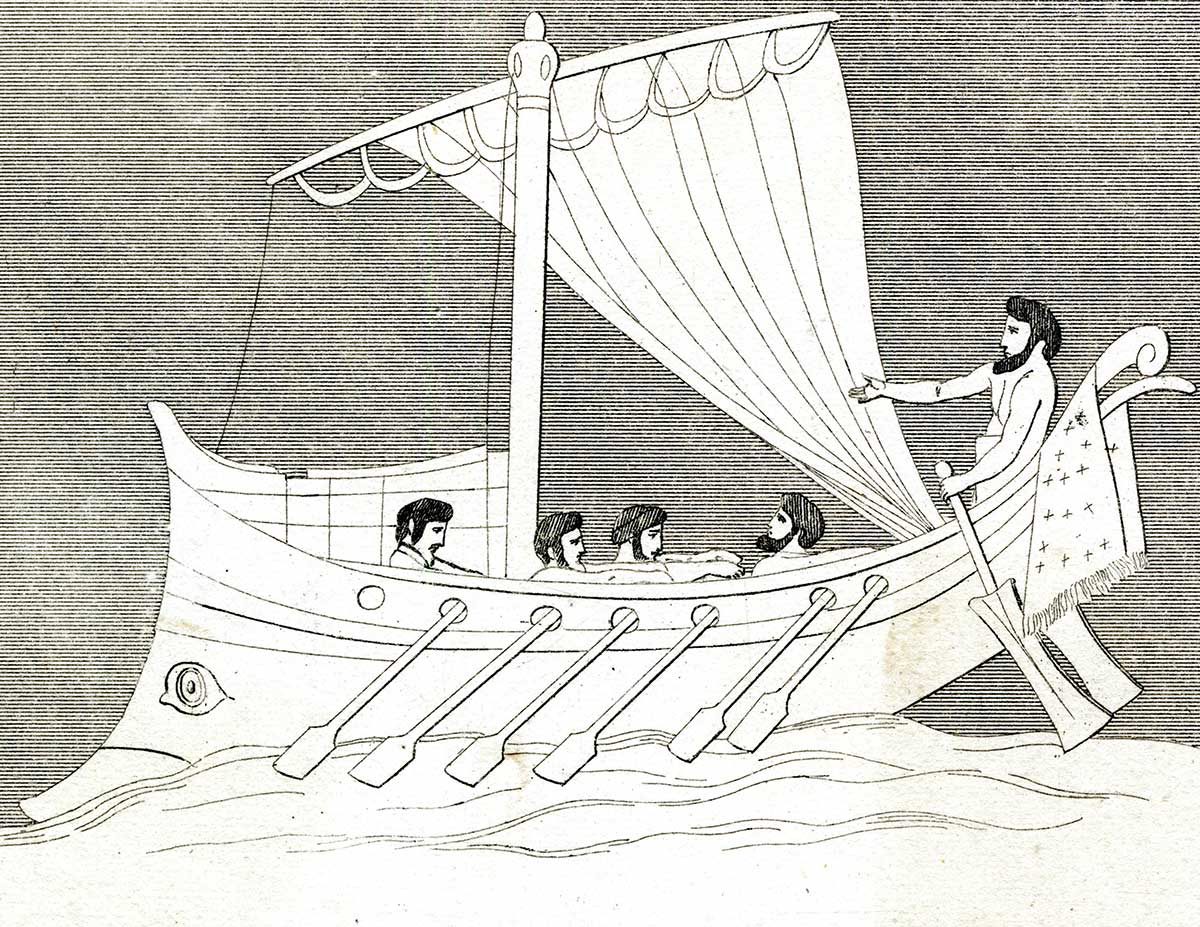
Tyre, an ancient capital of the seafaring merchant Phoenicians, was an island off the coast that we now know as Lebanon. The Phoenicians were of far greater mercantile and geopolitical stature than the little nations condemned in the previous chapter. The merchant ships and protecting navy plied all over the Mediterranean and adjoining seas. She placed her colonies (including Carthage) on every coast. Two thousand years before Vasco da Gama, Phoenician ships had passed through the Strait of Gibraltar, turned south, and explored the entire west coast of Africa, down to and around the cape.

Secure on its island, Tyre was not easily threatened by land attack, nor did the Babylonians have a navy on the Mediterranean. (Indeed, Tyre would not be successfully reduced by siege until 332, when Alexander the Great, having already dismissed his expensive mercenary navy, constructed a causeway to Tyre from the mainland, moving his army to besiege the city. That causeway has gradually accumulated a good deal of silt over the years, so that Tyre now sits on the end of a thin peninsula.)

Ezekiel’s complaint against Tyre is this: When Jerusalem fell in the summer of 586, the citizens of Tyre used the occasion to ask themselves a single question: “How can we make money from this situation?” Their reduction of a moral event to a purely economic concern was the substance of their sin.

Moral questions are always “of what sort”: right or wrong, true or false? Moral questions are qualitative. The Phoenicians, however, had become a “quantitative” people, interested only in “how much?” In due course, said Ezekiel, they will pay for it, and the price — the “how much?” — will be very dear.

Although Tyre did not weep for the fall of Jerusalem, other nations will certainly weep for the fall of Tyre. This is the first of several oracles against the Phoenicians, and St. John will later cite some of this material in the Book of Revelation, where he prophesies against the major military and economic power of his own time, Rome.

Sunday May 6

Ezekiel 27: This chapter continues the theme of Chapter 26. Ezekiel is told to “lament” as though Tyre had already fallen, because it most certainly will fall. Indeed, Ezekiel’s imagery of the fall of Tyre will be taken up in the New Testament to describe the final fall of the “world” itself, that “world” for which Jesus refused to pray (John 17:9), the immense geopolitical and economic empire of man and materialism in intellectual and moral rebellion against God. The final times themselves, then, are prefigured in the fall of Tyre.

A thousand industries and tens of thousands of farms depended on Tyre for their prosperity. Tyre drew the wood for its shipwrights from its native forests of Lebanon and from nearby Cyprus. The textile industry of Egypt and elsewhere supplied its sails. Its mariners were recruited from every coastal city of the Mediterranean, Adriatic, Black, and Aegean seas, and all the waterways from Sudan to India. Direct Phoenician trade held together a vast economic system that extended from the Persian Gulf to as far west as Cadiz (Tarshish) on the distant side of the Strait of Gibraltar. Thanks to Tyre and the Phoenician fleets, the coastal cities of southern Europe received the exports of Arabia and sub-Saharan Africa.

Fittingly, the fall of Tyre is likened to a shipwreck (27:27). When the ship sinks, all of its accumulated wealth is lost. So, when Tyre comes to ruin, it will mean economic disaster for all the many industries that depended on Phoenician shipping. Deeply affected by this catastrophe will be such places as Javan (Ionia, on the Aegean Sea—27:3), Put (Libya, in northern Africa—27:10), Lud (Lydia, in what is now the Turkish peninsula), and distant Persia at the other end of the Fertile Crescent. Because Phoenicia represents the financial unity of three continents, its collapse will have a devastating effect on masses of people who live far from Tyre.

Ephesians 4:7-16: This text speaks of the gift of Christ to each of us.
Concerning this, St. Paul says, “But to each one of us grace was given according to the measure of the gift of Christ.” We should note that Paul does not speak simply of the generosity of God but of the “gift of Christ.” He is thinking less of the infinite bounty of God than of the redemptive work by which Christ Himself purchased what He gives us.

Everything that we have is from the gift of Christ; our lives are full of the gift of Christ, which means that at each point in our existence we come in personal contact with the price by which that gift was purchased. At no point in our lives are we independent operators, left on our own, abandoned to our individual resources. Surrounded at all times by the gift of Christ, we are constantly in touch with motives for thanksgiving and praise.

Paul describes this gift of Christ in terms of measure or proportion: “But to each one of us grace was given according to the measure of the gift of Christ”—kata ton metron tes doreas tou Christou. This is to say that the gift of Christ is intentional and deliberate, not random and indiscriminate. The gift is consciously picked out and personally chosen by Christ.

Monday, May 7

Ezekiel 28: This chapter contains two oracles: one against Tyre, the other against the Phoenician city of Sidon. In the first, no particular king of Tyre is indicated; the message is directed, rather, at that monarchy itself, as an embodiment of wealth and power in idolatrous rebellion against God. Idolatries of wealth invariably become idolatries of power, and in this respect it is significant that the king of Tyre is also indicted for cruelty.

The king, in addition, represented the nation itself, given over to economic aggrandizement and the love of power. As in individuals, so in nations, economic prosperity tends to breed pride, and Tyre, as we have seen, was very prosperous. Quite self-satisfied, it was no longer subject to the Divine Authority that rightly holds sway over the nations, whose eternal law is written into the structure of the world as binding on all men, and before whose Throne the peoples of the earth will in due course be summoned for judgment.

Tyre, in short, thought of itself as a god, and in this respect it was a political form of man’s initial rebellion in Eden. Satan had tempted Tyre as he had tempted Eve, and Tyre, succumbing to the temptation, now thought itself a god. Fallen like Adam, Tyre must now be expelled from the rock garden of Eden. “Stones of fire” (28:13f)—a most striking image—pictures the gold and precious stones of Genesis 2:11f as still being in their molten stage, still radiant with the heat that formed them. (Those stones will appear again in the final chapters of the Book of Revelation.)

The second oracle in this chapter, directed against the Phoenicians’ alternate capital of Sidon, is supplemented by a prose message of hope, renewal, and restoration for Israel. The editorial juxtaposition of these texts creates a literary irony that opposes Tyre’s expulsion from the garden of Eden with Israel’s restoration to its land to plant and care for its vines (verse 26). No longer will Israel be obliged to contend with the thorns and briars of Adam’s fall (verse 24).

Psalm 65 (Greek and Latin 64): Much of this psalm revels in the wonder of nature, the strength of the mountains, the raging of the seas, and the rain falling “into the little valleys.” Unlike so many of the “nature psalms,” however, Psalm 65 begins indoors, so to speak—under the porticos of the temple. The psalmist commences, not out on the mountaintop—”Who in his strength setteth fast the mountains”—but in the holy place at Jerusalem.

Tuesday, May 8

Ezekiel 29: The prophet’s attention is now turned southward, to Egypt, the land where Israel of old had first learned the ways of idolatry. In Ezekiel’s eyes Egypt is worthy of special blame for enticing Judah into rebellion against Babylon (verse 16).

This first oracle (29:1-16) was delivered on January 7, 587 (verse 1), when the siege against Jerusalem was in progress. Two years earlier, in 589, King Zedekiah of Judah had turned to Egypt for help against Babylon. In response, Pharaoh Hophra (known outside the Bible as Apries, 589-570) sent an army, which had temporarily driven off the Babylonians and made Jerusalem feel safe. But when the Babylonians came back in force, the Egyptian army fled, and the siege was renewed in earnest (cf. Jeremiah 37:5-10). Such were the events that prompted the present condemnation of Egypt, a nation that proved to be a broken reed. (To complete our story of him, Hophra was not fortunate in his attempts to help his allies. The Greeks at Cyrene later defeated him when he tried to come to the aid of his friends the Libyans. In 570 he was deposed by Amasis [’Ahmose-si-neit], who replaced him as pharaoh and reigned from 570-526.)

In Ezekiel’s present oracle, the pharaoh embodies the nation, just as the king of Tyre represented the Phoenicians in the previous chapter and, like the king of Tyre, the pharaoh, too, is condemned for his arrogance. The dragon of the Nile, the crocodile, is the pharaoh’s mythic symbol, which also represents the ancient serpent of Eden (cf. Revelation 12). As the kingdom of Judah was beginning to sink, it had unwisely reached out and grabbed this reed to keep from drowning, but the reed broke at once.

For Egypt’s sin Ezekiel prophesies forty years of suffering, including refugee status for many of its citizens. Never again, says Ezekiel, will Egypt be a great political power.

This chapter’s second oracle, much shorter (verses 17-21), was delivered much later, on April 26, 571. Indeed, this is the latest of all the oracles for which Ezekiel provides a specific date. According to the historian Josephus, the Babylonians had maintained a siege of thirteen years against Tyre, and by 571 the siege had ended without Ezekiel’s predicted fall of Tyre (verse 18). We may imagine what this circumstance did to Ezekiel’s reputation as a prophet. Had not Deuteronomy commanded that a prophet be stoned to death if his prophecy did not come to pass?

Ezekiel addresses these concerns in the present oracle, arguing that the Lord will give Egypt to the Babylonians in recompense for their failure to take Tyre (verses 19-20). In short, the Lord is free to change His mind. In this instance the evils prophesied against Tyre have been transferred to Egypt. Prophecy, which is, after all, a great deal more than factual prediction, is often founded on an hypothesis—an “if”—even though that “if” may be only implicit. We recall that Jonah learned this lesson in his dealings with the Ninevites.

Wednesday, May 9

Ezekiel 30: There are two parts in this chapter, the first of which (verses 1-19) is a series of short oracles directed against the cities of Egypt and Sudan (Kush, which is inaccurately translated as Ethiopia in several modern versions), to regions with close political and economic ties.

The second part (30:20-26) is an oracle delivered on April 29, 587 (verse 20). The “broken arm” of the pharaoh refers to the recent defeat of the Egyptian army near Jerusalem when that army was driven away by the Babylonians who had returned to renew their siege of the city. Egypt, Ezekiel foresees, will share in Judah’s exile in some measure.

It is not surprising that some ancient Christian liturgical texts took inspiration from this chapter, especially verse 13, to speak of Jesus’ flight into Egypt as narrated by St. Matthew.

John 6:6-71: A true crisis in Jesus’ work seems to have developed near the beginning of its second year. It was at the halfway point in his ministry—its second Passover (John 6:4), one year before his execution—that “many of his disciples backed off and walked with him no more” (6:66). Also, it was at that time, John tells us, that Jesus foresaw which of the disciples would be his betrayer (6:70-71).

It is reasonable to date, at this period, the first two of Jesus’ predictions of those things that would, in the end, befall him in Jerusalem. It was then that Jesus “began” to talk about the terrible things that would befall him (Mark 8:31; 9:30-31).

Psalm 72 (Greek & Latin 71): This psalm is often referred to as a “messianic” psalm, in the sense that it is concerned with God’s “anointed” king. Considering only the simplest reading of this psalm, it is difficult to escape the impression that it was composed for use at the ceremonies of royal coronation, the ritual point of dynastic transition: “Grant Your justice to the king, O God, and Your righteousness to the king’s son.” The title added to this psalm does, in fact, ascribe it to Solomon, the first successor to the Davidic throne.

Two narrative sections of Holy Scripture readily come to mind in connection with the themes of Psalm 71. The first text is 2 Samuel 7, containing Nathan’s great prophecy about the royal house of David, which now became the beneficiary of a special covenant to guarantee that his descendants would reign forever over his kingdom. A number of lines of our psalm, especially those pertaining to the permanence and extension of David’s royal house, reflect that historical text.

The second pertinent passage is 1 Kings 3, which describes Solomon’s prayer for the “wise heart” that would enable him to govern God’s people justly. Repeatedly throughout this psalm mention is made of the justice and wisdom that would characterize God’s true anointed one.

Thursday, May 10

Ezekiel 31: The oracle in this chapter is dated June 21, 587 B.C. (verse 1). It is constructed of a lengthy and highly detailed poem describing Egypt as a large, imperial tree, dominating the landscape and offering shelter to all the nations (31:1-9). In his portrayal of this tree, Ezekiel once again resorts to the imagery of paradise (verses 8-9).

This poem is followed by a commentary in prose (verses 10-18), prophesying the downfall of Egypt. The great height of the tree, reaching up into the clouds, symbolizes man’s political and economic endeavors to attain heaven on earth by his own resources. To Ezekiel it is a symbol of arrogance, which he describes in terms reminiscent of the Tower of Babel. The cedar, which in olden times was symbolic of great longevity, represents man’s quest for a utopian permanence, a quest common to political idolatry.

Throughout the entire chapter the reader will observe in particular the image of water, bearing in mind Egypt’s long-time reliance on the Nile River and its highly developed system of irrigation.

Psalm 74 (Greek & Latin 73): This psalm provides a challenge to the modern theory which explains the world as the product of a random evolution. In such a view, intelligibility is not a characteristic of the world itself, but only of the human mind. Intelligibility, or “sense,” implies structure, or knowable form. In contrast, the “random” is that which has no intelligible structure. This is why we say that accidents are “senseless.” A random world, then, is necessarily a world without sense, a world devoid of knowable forms.

The God of this psalm is the world’s Creator, and His act of creation implies the imposition of limits: “You have fixed all the boundaries of the earth.” To create a knowable world is to pattern it according to intelligible forms, and limit is essential to the very notion of form (limit being “this” and not “that”). To say that God has “fixed all the boundaries, the determined limits, of the earth” is to say that God has already attached meaning to the structure of the world. Truth is already in the world, awaiting man’s discovery. The world already speaks the mind of God; man’s task is to listen to what it says.

Friday, May 11

Ezekiel 32: This chapter contains Ezekiel’s final two oracles against Egypt:

The first of these (though given later than the one that follows it), is dated on March 3, 585 (verse 1). Although it was delivered during the winter that followed the downfall of Jerusalem to the Babylonians, no reference is made to that event. Some of the imagery of this oracle recalls the plagues with which the Lord had long before struck the land of Egypt: the floods of blood and the great darkness (the first and ninth plagues). The great sin of Egypt declared in this oracle was pride.

The second (and earlier) of these two oracles was delivered on April 27, 586, prior to Jerusalem’s downfall. In his massive and detailed description of the nether world, Ezekiel sounds a theme from classical literature; the attentive reader can hardly fail to notice the similarities that this oracle has to the nether world descriptions in the Odyssey and the Aeneid.

Ezekiel’s description is similarly preoccupied with the thought of warfare and conquest. As Homer and Virgil portrayed the netherworld in the context of the fall of Troy, Ezekiel portrays it in the context of the fall of Jerusalem. Thus, it is in the netherworld, the realm of death, that the prophet finishes his oracles against those nations that rose up in rebellion against God’s authority over history. This second part of the Book of Ezekiel comes to an end.

First Samuel 1: It would be a comfort to think that all those who go up to the house of the Lord are led there by the Holy Spirit. It would also be an illusion. Even if experience did not testify that people sometimes attend worship with the most deplorable attitudes and for the worst possible reasons, Holy Scripture itself would caution us to realism on the point.

An early example is Peninnah, Elkanah’s “other wife,” who used the annual pilgrimage to Shiloh as an opportunity to render life miserable for barren Hannah. This latter she provoked severely, says the Sacred Text, “to make her miserable.” The provocation was not unintentional, we are assured, nor did it happen only once: “So it was, year by year, when she went up to the house of the Lord, that she provoked her; therefore she wept and did not eat” (1 Samuel 1:6-7). It is easy to picture Peninnah looking forward to that annual pilgrimage with the family; it was perhaps her favorite time of the year, providing her the forum for feeling superior and spreading discouragement.

Now, as it happened, the God who brings good out of evil caused everything to work out well for Hannah, and the story soon turns into an account of grace and divine visitation. Still, there was a serious pastoral problem at Shiloh, and I suspect more than one worshipper at the time wished the priest Eli, pointing to Peninnah, would suggest to Elkanah, “When your family comes next year, brother, why not leave Miss Picklepuss at home?” Perhaps his failure to do so should be counted among Eli’s pastoral shortcomings.


April 27 – May 4

Friday, April 27

Ezekiel 18: This is an oracle about personal responsibility, a matter on which the mind of Ezekiel may be contrasted with modern sensibilities. Modern ideas of individual moral responsibility often run along such lines as, “You must not do anything you can’t live with.” According to this perspective, moral norms are established by the limits of a person’s psychological comfort; what is evil or good is determined by whether or not a person can endure having done it.

Ezekiel knows nothing of such nonsense. For him personal moral responsibility means that a man must ultimately be responsible, not to the dubious dispositions of his own conscience, but to the all-righteous God who gave the law.

Each man must respond for himself, however, not for either his ancestors or his progeny. The people at Jerusalem needed to hear such a message, because some of them contended that they were being punished—with doubtful justice!—for the sins of their fathers. Ezekiel was charged to set them straight on this matter.

Although the social and even psychological effects of sin are handed down from one generation to the next, the moral burden of sin is not. Each man will answer for himself and his own moral decisions, not for those of his grandparents. The retributive principle is always: “The soul that sins shall die.”

Meanwhile, the possibility of moral change remains for each of us as long as we are alive. A bad man can become good, and a good man can become bad. Our moral fate depends on what we become, not on what we were before.

The closing part of this oracle stands as a strong witness against any religious theory claiming that God is glorified even by someone’s eternal loss. No, eternal loss is a pure waste of proffered salvation. God is not glorified by anyone’s going to hell.

First Peter 4:1-11: Once gain the Apostle turns to the theme of Christ’s sufferings (cf. 2:21-24; 3:18) in order to draw out the practical implications of the Cross in the life of Christians (verse 1). Considering the Passion of Christ, believers are to arm themselves (hoplisasthe with “the same way thinking” (ennoian). That is to say, they are to take the remembrance of Christ’s sufferings as the guide to their thoughts and sentiments.

Saturday, April 28

Ezekiel 19: This passage is a “lamentation” (verses 1,14), descriptive of Jerusalem’s recent history, in a tripartite allegory. The lioness, Judah, gave birth to two kings—-the two lions—whose stories are told in the first two parts of this allegory.

The first king (verses 3-4) is Jehoahaz, who took the throne when the great Josiah was killed in 609 at the Battle of Megiddo. His very short reign (only two verses here) came to an end that same year, because he was deposed by Pharaoh Neco and taken in bondage to Egypt (2 Kings 23:31-34).

The second king (verses 5-9) is Jehoiakin, deposed by the Babylonians in 597 after an unsuccessful rebellion on his part, and carried away to exile in Babylon, along with the cream of Judah’s leadership, a group including Ezekiel himself (2 Kings 24:8-16).

At the time of this oracle, both of these deposed “lions” are still alive—one in Egypt, the other in Babylon—but they are impotent to help their mother, Judah. This mother is then portrayed as a vine in the third and final section of the oracle (verses 10-14), which describes the devastation attendant on the inept and irresponsible government of Judah’s last king, Zedekiah.

First Peter 4:12-19: Outside of the Acts of the Apostles, this section contains the only place in the New Testament where we find the word “Christian”: “Yet if anyone suffers as a Christian, let him not be ashamed” (verse 16).

Two observations may be made in regard to Peter’s use of the term “Christian” here.

First, Peter himself had been active in the founding of the Church at Antioch, where this term was first used (Acts 11:26; Galatians 2:11). It was from Antiochian usage that he adopted the term.

Second, it is significant that this name “Christian,” first used by non-Christians to describe the new group at Antioch, tended to be used in the context of persecution, as is clearly the case here in 1 Peter (verses 14-16). This context is identical to that of the only other place where we find the word “Christian,” the trial of Paul before Agrippa (where it is also heard from the lips of a non-Christian: “Then Agrippa said to Paul, ‘You almost persuade me to become a Christian’” (Acts 26:28).

It is useful for Christians to bear in mind, when they call themselves by this name, that original context of enmity and even persecution. Indeed, there is good reason to believe that the name was first used by those who actually hated Christians. Consequently, it should not surprise us if even today the word is used as an epithet of contempt, as is fairly often the case in the secular media and some political discourse.

At the same time, the impending judgment of God, says Peter, begins “at the house of God” (verse 17). This fact is important, because there abides the temptation for Christians to imagine that they will somehow be exempted (either by a rapture or in some other way) from God’s final judgment on history. This is emphatically not the case. The Book of Revelation, which so vividly describes the final judgment of the world, begins with His judgment of the churches (chapters 2-3).

Sunday, April 29

Ezekiel 20: This oracle, delivered on August 14, 591 B.C., was occasioned by an inquiry made to Ezekiel by a group of exiled Jewish elders, apparently undeterred by their earlier failure in 14:1-11.

So Ezekiel answers them: Beginning with Israel’s ancient sojourn in Egypt, prior to the Exodus, idolatry has been an abiding sin of God’s Chosen People. That rebellion against the Lord in Egypt was simply continued during the people’s wandering in the desert of Sinai. During both of those periods God spared His people, so that their enemies (and His) might not take comfort from their destruction.

Indeed, because Israel constantly violated the Lord’s ordinances, these ordinances proved not to be good for them, inasmuch as the very disobedience rendered the people morally vulnerable (verses 23-26). (This is a motif, of course, that St. Paul will later develop in his Epistles: the futility of the Law to bring about salvation.) Then, even after their settlement in the Promised Land, the people continued their ancient infidelities.

Now, after all this, do these elders dare to come and “inquire of the Lord”? They are told that this inquiry amounts to a mockery. They have always known God’s will, yet they have decided to disobey it. Why should the Lord have anything further to say to them? (We should particularly observe here that, among the sins of Israel specifically named, child sacrifice is very prominent. Since the murder of unborn children is one of the most serious offenses of our own society, this oracle seems especially relevant today.)

Even after conveying this oracle, however, Ezekiel goes on in verses 32 to 44 to deliver a prophecy of Israel’s eventual restoration. Although Israel’s kings have brought the nation low, God is still Israel’s true king (20:33).

First Peter 5:1-14: There are two things that may be noted about Christian humility:

First, the mutual humility that Christians are to cultivate with respect to one another is rooted in each person’s humility before God. That is to say, to be properly humble to one another, it is necessary that each of us be humbled under the mighty hand of God. Our spirit humbled before God is the source of our proper relationship to one another. A person habitually humbled in God’s presence is not a person who will be haughty or proud toward anyone else.

Second, the person who lives in this humble disposition will be without anxieties: “Therefore humble yourselves under the mighty hand of God, that He may exalt you in due time, casting all your care upon Him, for He cares for you” (verses 6-7). Pride, after all, is the source of many of our anxieties. We become anxious in large measure because we have some status to maintain or some image of ourselves to be advanced.

Only the truly humble person, therefore, can really cast all his anxieties on the Lord, because the Lord really does look out for the humble. The proud, on the contrary, are the objects of God’s active resistance (verse 5). The proud cannot rely on the care of God, for the simple reason that God does not take care of the proud.

Humility and freedom from anxiety are two sides of the same coin, each necessary to the other. The habit of humbling ourselves under the mighty hand of God is inseparable from casting all our anxieties on Him.

Monday, April 30

Ezekiel 21: The deep, very personal lamentation in this text will remind the reader of Ezekiel’s older contemporary, Jeremiah, who expressed very much the same sentiments during that decade immediately preceding the fall of Jerusalem in 586.

There are four oracles in this chapter (the first oracle actually beginning in 20:45), three of them against Jerusalem, and the fourth against the Ammonite capital of Rabbah (the present city Amman, capital of the modern country of Jordan). Even as Ezekiel speaks, the Babylonian army, with its “well polished sword,” is already on the march toward those two cities.

The imagery alternates between fire (particularly a forest fire, with Jerusalem being the timber) and sword, both images combined in that of the lightning.

The references to the “Negev” in the first oracle (20:45—21:7) should be understood simply as “the south,” which is often the case in Ezekiel. The invading army, marching from Babylon, did not go directly westward toward Jerusalem, a march through the Arabian Desert being quite prohibitive. Instead, it marched up and around the Fertile Crescent, following the course of the Mesopotamian and Syrian rivers, so that now it has turned southward, in the direction of the Negev Desert, tramping toward Jerusalem and Rabbah.

In the second oracle (verses 8-17) Ezekiel addresses the Babylonian sword itself, which is the instrument of God’s vindication. The Babylonians, though they are acting as God’s instrument in history, do not know this, no more than a sword recognizes who wields it.

The third oracle (verses 18-27), continuing the image of the Babylonian sword, portrays another of Ezekiel’s symbolic actions, which must be explained to those who witness it. It pantomimes a fork in the road; which city, Jerusalem or Rabbah, will Nebuchadnezzar strike first?

The final oracle (verses 28-32) addresses to Rabbah the same threats that have been spoken to Jerusalem.

Ephesians 1:1-14: Who were these original “saints who are faithful in Christ Jesus”? Most of the extant manuscripts identify them as Ephesian Christians, but this identification appears improbable. Certain considerations indicate the improbability:

First, the designation “in Ephesus” is not supported in the oldest and most reliable manuscripts, such as Papyrus 46 and the original hands in the manuscripts Sinaiticus and Vaticanus, both from the early fourth century.

Second, our earliest witness to this epistle, Marcion (early second century), knew it as the “Epistle to the Laodiceans.”

Third, there is no indication in the body of this work that Paul was addressing a congregation he had ever visited, much less that he was writing to a place at which he had lived for most of three years (cf. Acts 20:31). There are no greetings to particular persons, no mention of problems or circumstances in a specific community, nothing to suggest that Paul was at familiar with those whom he addressed.

The present epistle is virtually unique in this “impersonal” quality. In fact, it is more impersonal than Paul’s letters to the Romans and the Colossians, two churches that he had not visited at the time he wrote to them. In short, of all Paul’s epistles the present work is the least tied to a particular congregation.

Tuesday, May 1

Ezekiel 22: This chapter contains three oracular prophecies, joined together by a common theme: ritual uncleanness, understood either literally or as a metaphor. Ezekiel, as a priest dedicated entirely to the correct worship of the true God, was particularly sensitive to this matter of cleanness, or purity, in both the sacrifice and the priest.

The first oracle (verses 1-16), directed against Jerusalem, is full of the imagery of blood, any flowing of which rendered a person ritually unclean. Blood is also, however, an image of violence.

The second oracle (verses 17-22) is directed against all unfaithful Israelites, who are described as dross (that is, metallic impurity), which God will clean away in the coming smelting process of His historical judgment. Ezekiel doubts that any true metal will be found once this process is complete.

The third oracle (verses 23-31) is against the Holy Land itself, which suffers uncleanness because of those who live there. These have defiled God’s land with bloodshed and other forms of impurity, rendering the land unholy and no longer fit to contain the Lord’s true worship.

John 4:43-54: The story of the Samaritan woman—a story John surely knew from the lady’s own account—portrays a growth in her faith. As the narrative progresses, we observe a development in her understanding of Jesus, a development indicated in the various ways she addresses him. When she first meets Jesus, he is called simply “a Jew” (John 4:9).

This is important to the story as a whole, because Jesus himself will presently declare, “salvation is of the Jews” (4:22). On this woman’s lips, nevertheless, the designation “Jew” indicates two things: First, it says that she assesses Jesus only within a certain class of people. He is not yet a distinguishable person. And second, the word “Jew” indicates the woman’s sense of separation from Jesus, because “Jews have no dealings with Samaritans.”

Next, she addresses Jesus as “Sir” (John 4:11; presumably the Aramaic Mar). The woman is making a significant step here in terms of personal respect. It indicates a change of attitude of her part. Then, within four verses “Sir” becomes “prophet” (4:19), when Jesus directs the woman’s attention to her own moral failings. The conversation next takes a new bound forward, when Jesus identifies himself as the Messiah. Finally, when the other Samaritans meet him, he is called “the Savior of the world.” This is a considerable doctrinal development within a single story!

The woman from Samaria has now come a long way. Starting out that day, hardly suspecting what lay ahead, she laboriously carried her sins to the well, where she met a Jew, who asked her for a drink of water. The
Jew presently became a “Sir,” and then a “prophet” who reminded her that she was a sinner. No matter, though, for he did not press the point. He was, after all, the Messiah. And because this Messiah was likewise the Savior of the world, he knew exactly what to do with her sins.

Wednesday, May 2

Ezekiel 23: About to see the ruin of Jerusalem, the capital of Judah, Ezekiel thinks back to the year 722 B.C., when the Assyrians had destroyed Samaria, the capital of Israel. As Samaria fell then, Jerusalem will fall now. How closely the two cases resemble one another, the prophet reflects, both cities unfaithful to God, like two loose women who cannot be trusted. This comparison of the two cities is the basis of the long allegory that fills the present chapter.

Once again, Ezekiel traces the problem back to Egypt, where the Israelites first learned the seductions of idolatry (verse 3). Samaria, having handed herself over to Assyrian seductions, was finally destroyed by Assyria (verses 5-10). Jerusalem was worse, falling under the idolatrous sway of both Assyria and Babylon in turn (verses 11-18). In addition, as a final irony, Jerusalem was now turning once again to the gods of Egypt (verses 18-21), Ezekiel’s reference to King Zedekiah’s recent appeal to Egypt against the Babylonian overlord.

The various nations of the Fertile Crescent (verse 23), all now part of the Babylonian Empire, will attack Jerusalem from the north (verse 24). History, Ezekiel saw, was about to be repeated. Thus, in this chapter the prophet extends the metaphor of marital fidelity that was the theme of Chapter 16.

John 5:1-16: We come now to the Third Sign in John’s Gospel, the healing of the paralytic. John, having called our attention to the first two Signs, no longer feels the need to do so. He permits the reader to count them for himself.

John does not identify the feast in verse 1 (probably to be read without the definite article). One suspects that this mention of a Jewish feast day is inserted simply to explain why Jesus was in Jerusalem (after being in Galilee in the previous chapter).

The name of the pool was Bethzatha, or Bethdaida, or Bethesda. The pool may have had each of these names at one time or another. Even to this day, one can visit the pool (which, alas, is now completely stagnant and fetid) and see five sides originally covered by porticoes. It is a trapezoid transected into two parts; these are the “five” sides. The pool is near the lovely church of St. Anne.

It is also near the site of the ancient Sheep Gate, on the northern side of the city. John’s text has been expanded by an addition to verse 3 and the insertion of verse 4. Missing in the better textual witnesses, these later additions were intended to explain the conversation in verse 7.

The important point is that “Jesus saw him lying there.” This is a very important word in John’s Gospel:

“Jesus saw Nathanael coming toward Him, and said of him, ‘Behold, an Israelite indeed, in whom is no deceit!’ Nathanael said to Him, ‘How do You know me?’ Jesus answered and said to him, ‘Before Philip called you, when you were under the fig tree, I saw you’” (1:47-48).

“Now as [Jesus] passed by, he saw a man who was blind from birth” (9:1).

“Therefore, when Jesus saw [Mary] weeping, and the Jews who came with her weeping, He groaned in the spirit and was troubled” (11:33).

“When Jesus therefore saw His mother, and the disciple whom He loved standing by, He said to His mother, ‘Woman, behold your son!’” (11:33).

This “seeing” by Jesus is an expression of prevenient grace. It is the first step toward salvation and blessing, and Jesus is the one who makes it. The important thing is to be seen by Jesus.

Jesus heals the man with simply a word of command (verse 8). The observer does not actually witness the healing; he witnesses the results of it.

Thursday, May 3

Ezekiel 24: This chapter is constructed of two quite separate parts, the first being the allegorical oracle of a pot cooking on the fire, the second being a prophecy and prophetic action connected with the death of Ezekiel’s wife.

The first oracle (verses 1-14) is dated on January 15, 588 B.C., the day that Nebuchadnezzar began the siege of Jerusalem. This siege is compared to the flames surrounding a pot until its contents are cooked. This pot is, of course, Jerusalem, where the long siege has begun. The rust on this metal pot, which is the same color as blood and is likened to blood, carries forward the image of dross from Chapter 22.

The second oracle (verses 15-27) is occasioned by the sudden death of Ezekiel’s wife. He is not the only biblical prophet whose “home life” becomes part of the prophetic message. Thus, Hosea was obliged to marry a prostitute as part of his prophetic vocation, both Hosea and Isaiah were told to give strange and symbolic names to their children, and Jeremiah is commanded to remain celibate as a witness to the imminent passing of the era.

In the case of Ezekiel, he is ordered not to mourn at the death of his wife, no matter how grieved he feels. He must then interpret this strange behavior to his neighbors, giving him the opportunity to explain why, in their concrete historical circumstances, it would be inappropriate for them to mourn, even though their hearts are broken. Thus, in his grief Ezekiel himself becomes a “sign” to the people who are soon to see their beloved city destroyed.

Ephesians 2:11-22: The great theme of the Epistle to the Ephesians is the reconciliation of all things in Christ. Paul introduces this theme early in the epistle, speaking of “the mystery of [God’s] will . . . that in the dispensation of the fullness of the times that He might gather together in one all things in Christ” (1:9-10). For Paul this universal reconciliation is not a theory about history. He sees it being visibly worked out already in the actual events of history. The first fruits of this universal reconciliation can already be observed in the founding of the Church, because the Church herself is founded on a specific act of divine reconciliation—namely, the reconciliation of Jews and Gentiles in one community. This unexpected and improbable reconciliation, which was already being enacted in Paul’s own lifetime, was the beginning of a more universal, even cosmic reconciliation of all things in Christ.

Therefore, correctly to understand God’s final purpose in history, the key is to grasp this reconciliation of Jew and Gentile in the one body of the Church. We may remark on three aspects of this reconciliation:

First, the source of this reconciliation is the Cross, where the death of God’s Son neutralized the difference between Gentile and Jew. Christ Himself, after all, “is our peace, who has made both one, and has broken down the middle wall of separation, having abolished in His flesh the enmity, the law of commandments contained in ordinances, so as to create in Himself one new man from the two, thus making peace, and that He might reconcile them both to God in one body through the Cross, thereby putting to death the enmity.”

This Law, given on Mount Sinai, was what separated Jew and Gentile, but in his death on the Cross Christ “abolished” that wall of separation. By reconciling all men equally to God on the Cross, Christ reconciled them to one another. So, says, Paul, “through Him we both have access by one Spirit to the Father.”

Second, God effected this reconciliation, not by taking away the special place of the Jews in the history of salvation, but by raising the Gentiles to share in the dignity and honor of the Jews. Thus, Paul says to the Gentiles, “Now, therefore, you are no longer strangers and foreigners, but fellow citizens with the saints and members of the household of God.”

In writing these lines of great comfort, Paul is extending an image he had used just a couple of years earlier in his Epistle to the Romans. In that letter he had described the Gentile believers as branches grafted onto the ancient stock of Israel, so that they became participants in the promises and blessings of Israel.

Friday, May 4

Ezekiel 25: Chapters 25 through 32 of Ezekiel contain oracles directed against the other nations with whom the Lord has reason to be displeased: Israel’s neighbors to the east and west (Chapter 25), the north (Chapters 26 to 28), and the south (Chapters 29 to 32). Chapter 25 is critical of the neighbors to the east (the Ammonites, Moabites, Edomites) and to the west (Philistines).

Those to the east are criticized in order, going from north to south. Since the oracles refer to the unseemly and unconscionable rejoicing of these nations at Jerusalem’s destruction, they should be dated no earlier than the summer of 586. Otherwise, the oracles in this chapter are not dated.

Oracles of this sort, scathing moral criticisms of Israel’s neighbors, go back to the earliest of Israel’s literary prophets, Amos, in the eighth century before Christ. Ezekiel’s references to the “people of the East,” who will punish these offending nations, may refer to the Babylonians, but the reference is perhaps more probably to the marauding Bedouin tribes that frequently attacked from the Arabian Desert.

Psalms 40 (Greek & Latin 39): The correct “voice” for Psalm 39 (Hebrew 40) is not in doubt. We know from Hebrews 10 that these are words springing from the heart of Christ our Lord and have reference to the sacrificial obedience of His Passion and death.

We may begin, then, by examining that interpretive context in Hebrews, which comes in the section where the author is contrasting the Sacrifice of the Cross with the many cultic oblations prescribed in the Old Testament. These prescriptions of the Mosaic Law, says Hebrews, possessed only “a shadow of the good things to come.” Offered “continually year by year,” they were not able to “make those who approach perfect” (10:1). That is to say, those sacrifices did not really take away sins, and their effectiveness depended entirely on the Sacrifice of the Cross, of which they were only a foreshadowing. Indeed, “it is not possible that the blood of bulls and goats could take away sins” (v. 4).

In support of this thesis, the author of Hebrews quotes our psalm: “Sacrifice and offering You did not desire / . . . In burnt offerings and sacrifices for sin / You had no pleasure” (vv. 5, 6). In fact, this theme appears rather often in the Old Testament itself. Isaiah, for example, and other prophets frequently attempted to disillusion those of their countrymen who imagined that the mere offering of cultic worship, with no faith, no obedience, no change of heart, could be acceptable to God.

The author of Hebrews, therefore, is simply drawing the proper theological conclusion when he writes: “And every priest stands ministering daily and offering repeatedly the same sacrifices, which can never take away sins” (v. 11). What God seeks, rather, is the perfect obedience of faith, and such an obedience means the total gift of self, not the mere sacrificial slaughter of some beast.


April 20 – April 27

Friday, April 20
Ezekiel 11: The first oracle in this chapter addresses a slogan going around Jerusalem at the time, descriptive of the city’s coming destruction. The slaying of Jerusalem’s citizens, says the oracle, will ultimately be the fault of their leaders, not of the Babylonian besiegers. The latter are but instruments in the divine judgment.

The leaders back at Jerusalem planned big things for themselves, and their big plans are addressed in the second oracle. When Ezekiel and his other companions, including the cream of Jerusalem society and its most competent citizens, were taken hostage to Babylon in 597, some of those Israelites who remained in the Holy Land began to feel pretty good about their own prospects, now that the better rivals were gone. With respect to their brethren who had been carried away, they reflected: “Well, too bad for them, but that leaves more for us.”

The burden of this second oracle is to reassure those captives in Babylon that the Lord had not forgotten them and that He was determined to restore them. Indeed, it was on them that His coming blessings would fall, for their restoration is the substance of the great prophecy here about newness of heart, which becomes so important a theme in the New Testament (See especially Hebrews 8.)

As this chapter ends, the Cloud of the divine glory moves east onto the top of the Mount of Olives, and Ezekiel is restored to Babylon, where he narrates his visions and oracles to his companions in exile.

Psalms 16 (Greek & Latin 15): We may be sure that Psalm 16 was among the psalms interpreted by the risen Christ, for this was the first psalm that exegeted by the Church in her very first sermon when she came rushing with power from the upper room on Pentecost. According to the Apostle Peter, who preached that sermon, Psalm 15 describes the Resurrection of Christ:

Men of Israel, hear these words: Jesus of Nazareth, a Man attested by God to you by miracles, wonders, and signs which God did through Him in your midst, as you yourselves also know—Him, being delivered by the determined purpose and foreknowledge of God, you have taken by lawless hands, have crucified, and put to death; whom God raised up, having loosed the pains of death, because it was not possible that He should be held by it. For David says concerning Him: “I foresaw the Lord always before my face, / For He is at my right hand, that I may not be shaken. / Therefore my heart rejoiced, and my tongue was glad; / Moreover my flesh also will rest in hope. / For You will not leave my soul in Hades, / Nor will You allow Your Holy One to see corruption. / You have made known to me the ways of life; / You will make me full of joy in Your presence” (Acts 2:22–28).

Even though it was King David saying these things, the voice speaking more deeply in Psalm 15, according to St. Peter, is the voice of Christ. As the forefather and type of Christ, David was speaking in the tones of prophecy.

Saturday, April 21

Ezekiel 12: Once again Ezekiel is charged to act out an elaborate pantomime as a message for his fellow Israelites in exile. Whereas the previous such actions, in Chapters 4-5, had to do with the destruction of Jerusalem and the sufferings of her citizens, the present instance is concerned with the experience of the coming new exile of those who still remained back home.

When his fellow exiles ask him, “What are you doing?” (12:9), Ezekiel responds with a stirring oracle by way of explanation: To those Jewish exiles already in Babylon who are imagining that they may soon be returning to the land of Judah, Ezekiel is stressing the point, “You think this is exile? You haven’t seen anything yet!”

He emphasizes in particular the suffering destined for Zedekiah, the King of Judah. Ezekiel’s walking with covered face (“that you may not see the land”) is an eerie prophecy of the day when the Babylonians would gouge out the eyes of Zedekiah, so that the execution of his sons would be the last thing he saw in this world before going into exile (2 Kings 25:4-7; Jeremiah 39:4-7; 52:7-11).

In verse 17 the prophet begins yet another pantomime, this one much simpler, and in verses 21-28 Ezekiel is charged to challenge two more cynical slogans popular at the time. These slogans, concerned with apparently unfulfilled prophecies, will lead into his condemnation of false prophets in the next chapter.

Matthew 24:1-14: In all three Synoptics this eschatological discourse is the link between the public teaching of Jesus, culminating in His repeated conflicts with the Jewish authorities, and the account of His Passion. Indeed, it was Jesus’ prophecy of the destruction of the Temple (verses 1-2) that provided the accusations brought forth at His trial before the Sanhedrin (26:16), and it was the subject of the jeers that His enemies hurled at Him as He hung on the cross. Moreover, the position occupied by our Lord’s prophecy here indicates the relationship between the death of Jesus and the downfall of Jerusalem. We observe that in both Mark and Matthew this prophecy follows immediately on Jesus’ lament over the holy city.

With respect to Matthew 24 as a whole (as well as Mark 13 and Luke 21), this discourse forms a sort of last testimony of Jesus, in which the Church is provided with a final injunction and moral exhortation. In this respect it is similar to the farewell discourses of Jacob (Genesis 49), Moses (Deuteronomy 33), Joshua (Joshua 23), and Samuel (1 Samuel 12). That is to say, the present chapter serves the purpose of instructing the Christian Church how to live during the period (literally “eon” in Greek) that will last until the Lord’s second coming.

Sunday, April 22

Ezekiel 13: This chapter contains an oracle against the false prophets (13:2-16) and an oracle against false prophetesses (verses 17-23). The major problem with all such folk is that they “prophesy out of their own minds” and “follow their own spirit” and “divined a lie.” Thus, grave spiritual harm befalls those who listen to their fantasies and follow their counsels.

Even though a wall is just about to fall, says Ezekiel, they daub it with whitewash to make it look new and secure. Well, the whole thing is about to come down, he warns, in spite of the false hopes raised by false prophets.

In his oracle against the false prophetesses, Ezekiel speaks of wristbands and headbands (if these things are, indeed, what these rare Hebrew words refer to), evidently the paraphernalia of their rituals and incantations. We should probably think of these women as fortune-tellers, the sort of charlatans that are still among us. The prophet’s point here is that this sort of thing is not harmless; foolish individuals, who probably need sound counsel for important decisions, really do pay heed to such imposters, rather often to the harm of their souls. God will thwart the designs of these deceivers, says Ezekiel, by showing their predictions to be false.

First Peter 1:13-25: This section is an invitation to hope (verses 13,21). Christian hope is sustained by a twofold consideration: First, it is inspired by the final goal of the life in Christ (verses 13-17), and second, by the initial grace of the life in Christ (verses 18-21).

With respect to the first, hope is directed to the final “revelation of Jesus Christ,” his “being made visible” (apokalypsis—verses 7,13; 4:13). Relying “completely” (teleios) on this hope, believers refuse to conform to the deeds of their past, aware of their responsibility to be holy, even as God is holy (verses 14-16; Leviticus 19:2; 18:1-5,30; Clement of Rome, To the Corinthians 29.1—30.1).

In the New Testament the expression “be not conformed” (me syschematizesthe, in which we observe the English word “schema”) is found only here (verse 14) and in Romans 12:2—“And do not be conformed to this world, but be transformed by the renewing of your mind.” (We observe in passing that both of these works are associated with the church at Rome.) No less than the Chosen People of old, Christians are called to be a holy people in the midst of an unholy world. The latter is characterized by “ignorance” and “passions” (verse 14). We may compare this passage with 1 Thessalonians 4:5—“not in passion of lust, like the Gentiles who do not know God.”

Monday, April 23

Ezekiel 14: In verses 1-11, the elders who came to consult Ezekiel got more than they anticipated, because the prophet was given insight into the deeper idolatry of their hearts. These men were apparently looking for some prediction about the future, only to be told that God’s prophetic word is not truly available for the unrepentant. That is to say, the prophet’s task was not to satisfy human curiosity about future events, but to call sinners to the due consideration of their souls. To borrow a concise expression from Saint Augustine, the prophet’s task is often that of prescribing, not predicting: praecipientis videlicet, non praedicentis modoThe City of God15.7).

Thus, instead of responding to their query about the future, Ezekiel summons these men to look inside themselves, at the idolatry in their hearts, before it is too late.

The second oracle in this chapter (verses 12-23) insists that the whole society, if it is unfaithful to God, will be punished as a whole. The Lord will not spare any society simply for the sake of a few just men in it, even if these latter include the likes of Noah, Daniel, and Job. While the just individuals themselves will be respected, this will have no affect on the lot of the whole, because God is fair and will render to each man according to his deserts.

Before God’s throne of judgment, therefore, it will not matter “who you know.” This thesis, which will be repeated throughout the Book of Ezekiel, is identical to that in the Book of Jeremiah (for instance, 15:1-4), and is a great deal tougher than we find, for instance, in Genesis 18, where it appears that the presence of five just men would have spared the destruction of Sodom.

First Peter 2:1-12: Peter’s metaphor of milk was common among the early Christians and referent to the catechesis associated with Baptism (1 Corinthians 3:1-2; 1 Thessalonians 2:7; Hebrews 5:13; The Odes of Solomon 8.13-16; 9.1-2). Very early (at least by the second century, but perhaps earlier) this image affected even the liturgical customs at Baptism, when the newly baptized were given a cup of milk mixed with honey (Hippolytus, The Apostolic Tradition 23.2; Tertullian, Against Marcion 1.14; The Crown 3.3).

By means of this spiritual milk of Christian teaching, we “grow unto salvation” (avxsehete eis soterian). Salvation has to do with growth (cf. Mark 4:8,20; 2 Corinthians 10:15; Ephesians 4:15; Colossians 1:10). Few texts in the New Testament are more emphatic that salvation is the term of a growth, not a once-and-for-all event that is behind us. Salvation still lies before us (1:5,7,9). Drinking milk, therefore, is more than an obligation; it is a need.

Believers, having tasted this milk, know by experience that the “Lord is gracious” (verse 3; Psalms 34 [33]:9; Hebrews 6:5). In Greek this expression, chrestos ho Kyrios, differs in only one letter from “Christ is the Lord”—Christos ho Kyrios. The psalm cited here (Psalms 34, but 33 in the Greek and Latin texts used by the Church) has long been a favorite at the time of receiving Holy Communion (cf. Apostolic Constitutions 8.13.16; Cyril of Jerusalem, Catechesis 5.20; Jerome, Letters 71.6), nor is the imagination overly taxed to think that this may already have been the case at the time of St. Peter.

Tuesday, April 24

Ezekiel 15: This parable of the vine wood is more reflective than ecstatic, more analytical, and rational than poetic; it conveys the studious, logical aspect of Ezekiel’s thought.

And the message of this parable could hardly be more straightforward or less complicated: Vines and their stocks are of no constructive use unless they are still in the process of growing grapes. Once they have stopped doing that, they are useless for any constructive purpose. Unlike other kinds of wood, the vine wood cannot be used to fashion homes or furniture or even basic tools. Indeed, one cannot employ such wood to make an instrument so elementary as a wall peg on which to hang a pot in the kitchen. (The partial burn damage in verse 5 alludes to the partial exile of Jerusalem’s citizens in 597, some five years earlier.)

However, the parable proceeds to say, this wood can still be burned! No matter how otherwise useless, it still makes decent fuel. So, says the Lord, let Jerusalem take heed, because He has not seen any fruit on that vine for many a year.

The motif of this parable should put one in mind of Jesus’ cursing of the barren fig tree in the gospels of Matthew and Mark. Both Ezekiel’s parable and Jesus’ parabolic action had to do with impending destructions of Jerusalem.

Inasmuch as Jerusalem is also a mystic symbol of the soul, the moral sense of this parable is applicable to us all on a daily basis. It is the other side of the Gospel injunction that we are to live lives that bear fruit; otherwise we are useless to God for any constructive purpose.

First Peter 2:13-25: Since Christians from the very beginning have struggled to understand how the Gospel affects their duties in whatever state they find themselves, it is not surprising, therefore, that early Christian pastors addressed such concerns at length. This is true of the Apostle Paul (Colossians 3:18—4:1; Ephesians 5:22—6:9; 1 Timothy 2:8-15; 6:1-2; Titus 2:1-10), Ignatius of Antioch (Polycarp 4.1—6.3), Polycarp of Smyrna (Philadelphians 4.2—6.3), and Clement of Rome (Corinthians 270-275,286-291). It also appears in standard pre-baptismal catechesis of the period (Didache 4.9-11; Pseudo-Barnabas 19.5-7).

This is the social setting for Peter’s treatment of the same theme in the section that we come to now. Even while we are sojourners in this world, he says (2:11), we are still citizens that have obligations to society and the government, including the emperor [Nero!] (verses 13-17). Some of us are servants, with obligations to our masters (verses 18-25). Some are wives, with duties to our homes and husbands (3:1-6), and others are husbands, responsible for the wellbeing of our wives (3:7).

In the present chapter Peter speaks of Christian citizenship under the authority of the State and of Christian servants under the authority of their masters.

Wednesday April 25

Ezekiel 16: This parable is more elaborate than the one in the previous chapter, showing more evidence of allegorical detail. Both parables convey roughly the same message. Each parable is an illustration of failure. A beautiful but egregiously unfaithful wife is as useless as a cut and dried vine.

Several of the various details in this account of the harlot refer to specific periods and events in Israel’s history: the origins of the people, the time of the Covenant, the founding of the united kingdom and the prosperity of the Solomonic era, and the division into two kingdoms.

The oracle’s final part prepares the listeners for Jerusalem’s impending doom, which is to be like the earlier total destructions of Sodom and Samaria. Jerusalem, says the Lord, is more evil than either of these.

At the very end, however—after Jerusalem has fallen—appears a message of hope and renewal. Even the prophets most pessimistic about Jerusalem at this time, Jeremiah and Ezekiel, never cease to trust in God’s ultimate mercy. In particular, God will not hold children responsible for the sins of their parents, a theme to be elaborated in Chapter 18.

First Peter 3:1-12: In the first few verses Peter finishes his treatment of social duties, continued from the previous chapter.

He begins with the wives, whom he exhorts to be submissive to their husbands. This is to be the case, says Peter, even in those instances where the husband is an unbeliever (verse 1). (This is the situation in which a woman already married becomes a Christian. In no case may a Christian woman actually marry an unbeliever—2 Corinthians 6:15-18.) In this case, as in the case of a Christian living in civil society (2:15), Peter hopes for the good influence of the believer on the unbeliever.

Peter probably intends some of his comments here to pertain to Christian women generally, and not just to wives. This is surely the case respecting chastity and modesty (verse 3-5). His concern in this regard is similar to that of Isaiah (3:16-24), who apparently enjoyed poking fun at the way the women in the eighth century loved to preen themselves.

In spite of Abraham’s frequently unhappy home life, much of it caused by his wife’s dramatic mood swings, Peter still holds out for Christian wives the example of Sarah (verse 6). This is not the only time in the New Testament where Sarah is “given a pass” (cf. Hebrews 11:11 compared with Genesis 18:12-15).

Christian husbands are to be good husbands precisely because they are Christians (verse 7). What is owed to the wife is “honor,” and this because she is “weaker.” This does not refer to physical weakness generally (and certainly not to any alleged intellectual or moral weakness in women, something that only an inexperienced fool would fancy), but to a certain psychological delicacy in the female. Peter is quietly presuming that a woman’s constitution, which is far more “complicated” than a man’s, renders her inherently more vulnerable to danger, much like the delicacy of an expensive vase. Indeed, Peter even uses the metaphor of a “vessel.” This is a dining room vessel, not a ship. Certain things of beauty and delicacy in the home are given special honor. Wives are to be treated in a similar way by Christian husbands. They are NEVER to be handled roughly, not even in thought, and most certainly not in word.

The affection, respect, deference, courtesy, compassion, and tenderness necessary to life in the home is to be extended to the larger home of the Church, and thence to the rest of society (verses 8-9). This effort will be expressed in a stern control of one’s tongue (verse 10) and the steady quest to create atmospheres of peace (verse 11). Blessing must cover all things (verse 9). (I refer the reader here to the Book of Ruth, where he is counseled to count the constant blessings that its sundry characters heap on one another. Christians must pass up no opportunity to bless.)

Thursday, April 26

Ezekiel 17: This allegorical riddle is concerned with the geopolitical maneuvering dominant in the royal court at Jerusalem during the period between 597 and 586 B.C.

The first eagle in the riddle is the Emperor Nebuchadnezzar II of Babylon (604-562); the second is Pharaoh Psammetichus II of Egypt (595-589). Sitting at either end of the Fertile Crescent, both Babylon and Egypt sought to make their military, economic, and political power felt throughout the region, and each of these two great centers had its friends and confederates within the Jerusalem court.

The removed branch in the allegory is King Jehoiakin of Judah, deposed from his throne in 597 and transported to Babylon. The new seed in the allegory is King Zedekiah, who replaced Jehoiakin and served as a vassal of Babylon. Because of the many machinations in his court, Zedekiah’s foreign policy was marked by vacillation and instability. Unable to maintain his covenant with God, he was likewise unable to maintain his vassal covenant with Babylon. The one infidelity led to the other (verses 11-19).

Even though he was thriving under Babylonian suzerainty, the allegory goes on to say, Zedekiah endeavored to forsake his political obligations to the authority at the western end of the Fertile Crescent, and began to cultivate friendship with the eastern end, Egypt. Now he must pay for it. His sin consisted in seeking a purely political solution for a mainly spiritual and moral problem.

This oracle ends, nonetheless, on a note of future hope for the house of David, a hope that the Christian knows is fulfilled in great David’s greater Son.

First Peter 3:13-22: To be baptized into Christ is to be associated with His sufferings. As Christ was victorious over death by His Resurrection, so will be those who belong to Him. Baptism, because it unites believers with the Resurrection of Christ, is a pledge and promise of their own victory over death.

In verses 18-22 Peter speaks of Christ’s descent into hell, which took on so pronounced an emphasis in Christian faith and worship that it became an article in the Nicene Creed. Peter says that Christ “went and preached to the spirits in prison, who formerly were disobedient, when once the Divine longsuffering waited in the days of Noah, while the ark was being prepared, in which a few, that is, eight souls, were saved through water. There is also an antitype which now saves us—baptism (not the removal of the filth of the flesh, but the answer of a good conscience toward God), through the resurrection of Jesus Christ.”

The relationship of Christian Baptism to the Flood and Noah’s Ark, found here explicitly for the first time, became a common trope in Christian biblical exegesis.

Friday, April 27

Ezekiel 18: This is an oracle about personal responsibility, a matter on which the mind of Ezekiel may be contrasted with modern sensibilities. Modern ideas of individual moral responsibility often run along such lines as, “You must not do anything you can’t live with.” According to this perspective, moral norms are established by the limits of a person’s psychological comfort; what is evil or good is determined by whether or not a person can endure having done it.

Ezekiel knows nothing of such nonsense. For him personal moral responsibility means that a man must ultimately be responsible, not to the dubious dispositions of his own conscience, but to the all-righteous God who gave the law.

Each man must respond for himself, however, not for either his ancestors or his progeny. The people at Jerusalem needed to hear such a message, because some of them contended that they were being punished—with doubtful justice!—for the sins of their fathers. Ezekiel was charged to set them straight on this matter.

Although the social and even psychological effects of sin are handed down from one generation to the next, the moral burden of sin is not. Each man will answer for himself and his own moral decisions, not for those of his grandparents. The retributive principle is always: “The soul that sins shall die.”

Meanwhile, the possibility of moral change remains for each of us as long as we are alive. A bad man can become good, and a good man can become bad. Our moral fate depends on what we become, not on what we were before.

The closing part of this oracle stands as a strong witness against any religious theory claiming that God is glorified even by someone’s eternal loss. No, eternal loss is a pure waste of proffered salvation. God is not glorified by anyone’s going to hell.

First Peter 4:1-11: Once gain the Apostle turns to the theme of Christ’s sufferings (cf. 2:21-24; 3:18) in order to draw out the practical implications of the Cross in the life of Christians (verse 1). Considering the Passion of Christ, believers are to arm themselves (hoplisasthe with “the same way thinking” (ennoian). That is to say, they are to take the remembrance of Christ’s sufferings as the guide to their thoughts and sentiments.


April 13 – April 20

Friday, April 13

The Resurrection and the Christian Hope: Jews at the time of Jesus—particularly those represented by the Pharisees—looked forward to a resurrection from the dead as part of God’s final judgment of history. The early Christians believed the Resurrection of Jesus was a vindication of that hope. Thus, at one of his trials Paul declared, “I am a Pharisee, the son of a Pharisee; concerning the hope and resurrection of the dead I am being judged!” (Acts 23:6; cf. 24:15, 21; 26:6-8).

Because the Resurrection of Christ was seen to vindicate the Jewish expectation of a general resurrection, it served as the basis of Christian hope. In our extant literature the earliest testimony to this thesis comes from about A. D. 50, when Paul wrote to the new congregation at Thessaloniki, “For if we believe that Jesus died and rose again, even so God will bring with Him those who sleep in Jesus” (1 Thessalonians 4:14).

Paul wrote in similar terms to the brethren at Philippi: “We also eagerly wait for the Savior, the Lord Jesus Christ, who will transform our lowly body that it may be conformed to his glorious body” (Philippians 3:20-21). To the congregation at Corinth, he wrote, likewise, “But now Christ, risen from the dead, has become the first fruits of those who have fallen asleep. For since by man came death, by a man also came the resurrection of the dead. For as in Adam all die, even so in Christ all shall be made alive” (1 Corinthians 15:20-22).

The hope of the early Christians, therefore, was very different from the hope entertained by many of their contemporaries, particularly the disciples of Plato. These latter looked forward to a spiritual afterlife, following the dissolution of the body. The more fervent among them longed to be set free from the body, as from a garment no longer needed. Theirs was an immaterial hope.

Not so the Christians. Paul declared,

For we know that if our earthly house of skin is destroyed, we have a building from God, a house not made with hands, everlasting in the heavens. For at the present we groan, earnestly longing to be clothed with our habitation which is from heaven—if indeed, having been clothed, we shall not be found naked! For we who are in this tent groan, being burdened, not because we want to be unclothed, but further clothed, so that what is mortal may be swallowed up by life” (2 Corinthians 5:1-4).

The object of Paul’s hope was not to be stripped naked—to become an immaterial spirit—but, rather, to become “further clothed” (ependynasthai). That is to say, “what is sown in corruption is raised in incorruption. Sown in dishonor, it is raised in glory. Sown in weakness, it is raised in power” (1 Corinthians 15:42-43).

Those possessed of such a hope, Paul believed, should manifest it in their lives—even in their lifestyle. They should not mourn, for example, “as others who have no hope” (1 Thessalonians 4:13). Most of all, they must eschew the sort of dissipation that is rooted in despair. Paul found an illustration of this in the Book of Isaiah. That eighth century prophet, describing the despondency that descended on the citizens of Jerusalem as they faced a siege of the Assyrian army, quoted them as saying, “Let us eat and drink, for tomorrow we die “ (Isaiah 22:13).

Paul, who saw signs of this despair in the fun-loving attitude of some of the Corinthians (cf. 1 Corinthians 10:21-22; 11:20-22), quoted this verse of Isaiah by way of warning. It was no wonder, the Apostle reasoned, that they lived such worldly lives, if they had lost hope in the coming resurrection (15:12; cf. Luke 12:19).

The word “resurrection,” in short, meant more than an assent to an event in the past; it conveyed also a hope for something in the future. Belief or unbelief in the Resurrection of Christ was not a purely speculative decision; it was weighted with practical consequences regarding how the believer, or unbeliever, conducted his life.

Unbelief induced a life of dissipation born of despair, the sort of feasting described by Herodotus as a celebration of death itself: “Drink and have fun—pine te kai terpev—for you will be dying like this” (Histories 2:78). Those who professed faith in the Resurrection of Christ, Paul was convinced, would not live this way. Their manner of life would be characterized by a patience and discipline born of hope.

Saturday, April 14

First Corinthians 15:20-34: To appreciate Paul’s introduction of Adam in order to elucidate the mystery of the Resurrection (1 Corinthians 15:22), it is important not to lose sight of the immediate setting of his argument: He was addressing the denial—on the part of some Corinthians—that the dead can be raised. Their denial was a general proposition; they contended that a bodily resurrection was impossible for all human beings. They affirmed, “there is no resurrection of the dead” (15:12). Such an expectation, they claimed, was not part of the human inheritance.

We observe that the denial made by those Corinthians did not specifically address the Resurrection of Jesus (to which, apparently, they had given little thought), but the resurrection of human beings as such. Consequently, it was Paul’s task to take the Resurrection of Jesus as a premise—antecedently established by apostolic testimony (15:3-8)—in order to make his case for a universal resurrection.

This was the reason Paul introduced Adam into the discussion. Adam, whose very name means “human being,” was not just an individual; he was the father of the human race, the “universal man” in the sense that he bequeathed to humanity the full inheritance of what it meant to be human. That universal inheritance, Paul promptly observed, included the experience of death: “In Adam, all died” (15:22). Fallen Adam was the cause and exemplar of universal death. Adam’s Fall was the final word.

An underlying theological proposition prompted Paul to argue this way—namely, the thesis that Christ “rose on the third day according to the Scriptures.” In the light of that reference—“according to the Scriptures”—it was a plain fact that Christ’s Resurrection stood in defiance of Adam’s Fall. Since Christ rose from the dead, Adam no longer had the final word about the human expectation.

On the contrary, a new order had been introduced, an order in which death was no longer the last chapter of history. That is to say, the risen Christ was not simply an exception to the Adamic curse but the initiator of a new order; his Resurrection was the cause and exemplar of what could be expected. It radically remodeled human iconography and changed the content of man’s inheritance. With respect to our ultimate destiny, Christ replaced Adam.

Paul elaborated the contrast between Adam and his replacement: “And so it is written, ‘The first man Adam became a living being.’ The last Adam, a life-giving spirit” (15:45).

The first Adam had been formed from that very element to which the Fall reduced him: “The first man was of the earth, of dust” (15:47). Inasmuch as we are descended from that fallen Adam, we are heirs of that reduction: “As was the man of dust, so also are those who are made of dust’ (15:48). That is our expectation as children of Adam. But our lot is changed by reason of Christ’s Resurrection. The human iconography has been altered: “And as we have borne the icon of the ‘dustly,’ we will also bear the icon of the heavenly” (15:49).

The word chosen by Paul to express the universal significance of Christ’s Resurrection was aparche, properly translated as “first fruits” (15:20, 23). This term, derived from Israel’s theology of sacrifice, referred to the practice of giving back to God—by way of oblation—the initial yield of the harvest.

Even before Paul’s use of the term, it already served as a metaphor, signifying an initial portion of any kind, but it conveyed, as well, the implication that more was expected. That is to say, the aparche represented, by way of guarantee, the harvest as a whole. This was the sense Paul had in mind when he spoke of the risen Christ as “the first fruits of those who have fallen asleep”: His Resurrection was the “first act,” the pledge and assurance of what lay in store for the rest of humanity.

Accordingly, Paul viewed the mystery of the Resurrection in distinct stages, or, more accurately, “groups” (tagma): First comes “the first fruits, Christ,” in whom the Resurrection begins. Next, there are “those who belong to Christ, who will arise at his appearance [parousia].” These will have priority with respect to rising from the dead (15:3; compare 1 Thessalonians 4:16-18; Philippians 3:20-21). Finally arrives “the end [telos], when he hands over the kingdom to God the Father” (15:24).

St. Thomas Sunday, April 15

First Corinthians 15:20-34: When Paul answered the skeptics at Corinth—those so-called Christians who denied the Resurrection—he became a bit agitated at one point. As he answered this denial, his language was unusually harsh. “Fool!” he said (aphron—1 Corinthians 15:36).

It is significant, I believe, that the noun here is in the singular, not the plural. If Paul intended simply to address the Corinthian skeptics, we would expect him to write, “Fools!” Let me suggest the reason he didn’t.

First, I believe Paul would not have felt comfortable addressing fellow Christians with such a term of opprobrium. After all, Jesus had warned against this very thing (Matthew 5:22). Paul probably came closest to doing it when he reproached the Galatians: “Oh thoughtless Galatians”—O anoetoi Galatai

Second, at the point when Paul used the word “fool” in 1 Corinthians, he had already answered the skepticism of those Corinthians who denied the resurrection (1 Corinthians 15:12-19). Paul’s mind had moved on.

Third, the expression “fool” was addressed, nor directly to the Corinthians, but to a hypothetical interlocutor: “But someone will say.” Paul did not accuse the Corinthians of asking, ““How are the dead raised up? And with what body do they come?” The person posing this question was imaginary; he was a conjectural “someone” (tis) Paul introduced as a partner in his argument.

The Greeks referred to this form of argument as a diatribe; literally a “wearing away,” in the sense of a pastime. The term was often used of arguments based on hypothetical objections. At this point, in other words, Paul was going beyond the mere unbelief of the Corinthian skeptics. He was pushing the question of the resurrection in a new direction, for the purpose of clarifying it.

The hypothetical skeptic, who pretended to dismiss the resurrection by asking what sort of body the dead rise in, is a fool, said Paul, because he contradicted the sovereign power of the Creator: “God gives a body as He pleases” (15:38). To deny God’s ability to raise the dead was to affirm that death lies beyond the reach of God’s power. This was an irrational, or foolish, claim.

Jesus, we recall, argued the same case when the Sadducees questioned him about the woman who had been married seven times. They, too, had raised a hypothetical objection to the resurrection: “Now there were seven brothers. . . . Therefore, in the resurrection, when they rise, whose wife will she be? For all seven had her as wife” (Mark 12:18-23). In answering the Sadducees, Jesus put his finger on the lack of logic in their denial. It was based in part, he said, on their unfamiliarity with “the power of God” (12:24; cf. Acts 23:7).

The sovereign power of God over death also served the author of the Epistle to the Hebrews. When he wrote of Abraham’s resolve—in obedience—to sacrifice his son Isaac, Abraham took this step of faith, he said, “considering that God is able to raise from the dead”—ek nekron egeirein dynatos ho Theos (Hebrews 11:19).

We find the same presumption in all three of these sources: If there is an almighty God, then there can be no a priori argument against the resurrection.

For Paul, this power of the Creator was manifest in the great variety of bodies He had already brought into being (1 Corinthians 15:39-41). The God who could bring a large living plant from a puny seed—a seed which did not even slightly resemble the plant—will certainly not be taxed to transform a mortal body into a body filled with glory (15:37).

Paul went on to elaborate this agricultural illustration, in which the dead body, “sown” in the earth, represented the seed from which will spring the harvest of immortality. The dead body and the resurrected body are numerically the same body, but what a difference: “What is sown in corruption, is raised in incorruption. Sown in dishonor, it is raised in glory. Sown in weakness, it is raised in power. Sown a psychic body (soma psychikon), it is raised a spiritual body (soma pnevmatikon)” (15:42-44).

To me it seems likely that Paul derived and extended this agricultural analogy from a metaphor in the treasury of the apostolic preaching. It preserved a parable of Jesus: “Amen, I say to you, unless a grain of wheat falls into the ground and dies, it remains alone; but if it dies, it produces much grain” (John 12:24).

Monday, April 17

Psalms 1—3: A progressive scheme of images is developed through the first three psalms: First, the Man (Psalm 1), then the Messiah (Psalm 2), and finally the Suffering Servant (Psalm 3). Since this triadic pattern of reference runs throughout the Psalter, one may regard these three psalms as the book’s proper “introduction.” They form the tripod on which the whole Psalter stands.

First, there is the Man: Psalm 1 is not a prayer in the usual sense, inasmuch as there is no direct address to God. It is, rather, a meditation on a specific Wisdom theme: How the righteous man lives and what he hopes for. The affirmations in this psalm are made in the calm, apodictic style of Proverbs and the Bible’s older Wisdom tradition.

If the form of the psalm is given by the Wisdom literature, its matter is from the early pages of the Torah. Who, after all, is this Man of Psalm 1?

Well, to begin with, he is the first Man of the Torah—righteous Adam—Man before the Fall, when he was still God’s friend. As Adam tilled the Garden irrigated by four rivers (Genesis 2:8-15), the Man in Psalm 1 is likened to “a tree / planted by the rivers of water, / that brings forth its fruit in its season, / whose leaf also shall not wither, / and whatever he does shall prosper.”

Of the Man described in this psalm, we are told that his “delight is in the Lord’s Torah, / and on His Torah he meditates day and night.” The “day and night” of this psalm were also introduced, we recall, at the beginning of the Torah; they are the most basic divisions of time.

In contrast to the stability of this godly Man, Psalm 1 speaks of the “wicked”—the rasha‘im, who are likened to “the chaff which the wind drives away.” Just as the former does not stand in the path of sinners nor sit in the seat of pestilence, so “the rasha‘im shall not stand in the judgment, / nor sinners in the congregation of the righteous.”

Second, there is the Messiah: In Psalm 2, Adam becomes David, so to speak. The Man is transformed into the King, God’s Anointed One.

At this point the pace of the Psalter dramatically quickens, as it moves from the calm meditation of Wisdom to the robust narrative of conflict. Here, the Torah and the Wisdom Literature are replaced by the Former Prophets, particularly the Samuel/Kings saga.

Likewise, the contrast between good and evil in Psalm 1 grows into the conflict>/i> of good and evil in Psalm 2. Indeed, open rebellion is afoot, as the “kings of the earth set themselves, and the rulers take counsel together, against the Lord, and against His Messiah.”

For this reason, the style of the Psalter moves from apodictic declaration in Psalm 1 to energetic inquiry in Psalm 2: “Why did the nations rage, and the people conspire at something futile?”

As the ungodly in Psalm 1 were as “chaff which the wind drives away,” so in Psalm 2 “You shall break them with a rod of iron; / You shall dash them to pieces like a potter’s vessel.”

Third, there is the Suffering Servant: The trouble is serious and personal in the third psalm. Here, the Second Adam of Psalm 1 and the New David of Psalm 2 become the persecuted righteous man, so memorably depicted in the Book of Isaiah. In this respect, it is significant that Psalm 3 now speaks, for the first time, of “salvation”—Yeshu‘ah.

The vile activity of the ungodly in Psalm 1 and of the raging nations in Psalm 2 is now experienced first-hand in the persecution of the Suffering Servant, who “will not be afraid of ten thousands of people that besieged me all around.” As for the ungodly—those rasha‘im introduced in Psalm 1—Psalm 3 declares, “You have broken the teeth of the rasha‘im.

In these three opening psalms, then, three major Christological themes are set forth: the Incarnation, the Messianic Fulfillment, and the Suffering Servant.

These three psalms also establish the patterns of meditation, narrative, and prayer, which will be found throughout the Psalter. Likewise, these three psalms introduce other large blocks of Sacred Writ: Torah, Prophecy, and Wisdom—all of which find a place in the Psalter.

In the first two psalms, God was never directly addressed—“You.” This changes completely in Psalm 3: “Lord, how increased they are who afflict me! / Many they are who rise up against me. Many, as well, are those who say of me, / ‘There is no help for him in God.’”

In addition, these three psalms exemplify various “voices” to be found in the Psalter. First, we attend to the meditating wise man, next the raging nations, then the Messiah (“The Lord said to Me”), next the Father, who addresses both us (“I have set My King on My holy hill of Zion”) and the Messiah (“You are My Son”). Finally, the Suffering Servant declares: “Yeshu‘ah is of the Lord. / Your blessing be upon Your people.”

Tuesday, April 17

John 21:15-25: The Greek word anthrakia (cf. the English derivative “anthracite,” a type of coal), meaning a charcoal fire, is found only twice in the New Testament, both times in the Gospel according to St. John. The first instance is in 18:18 and designates the courtyard fire where the officers and servants of the high priest stood warming themselves through the chilly night of Jesus’ trial before the Sanhedrin. Simon Peter likewise came to that place and stood near a cousin of Malchus, a servant of the high priest. It was there by the charcoal fire that Simon thrice denied even knowing our Lord, going so far as to confirm the denials with an oath.

It is most significant, surely, that that event, so embarrassing to the chief of the Twelve Apostles, is narrated in detail in each of the four canonical Gospels, for it is thus made to stand fixed forever in the memory of Holy Church.

The second charcoal fire in John’s Gospel is the one in its final scene, the fire kindled by the Lord Himself, over which He prepared breakfast for His dispirited Apostles (21:9). After breakfast it was at this fire that Jesus would put to that same Simon Peter his threefold question: “Do you love Me?” The Apostle understood, of course, why the question was asked of him three times, for it was the very number of his own denials. At this point the chastened Peter, no longer trusting himself, relies completely on the Lord’s knowledge of his heart (21:17).

But there is more to the story. Simon Peter’s threefold profession is followed by a reference to his eventual martyrdom, which had already happened by the time this text was written down later in the first century. Indeed, the author of John 21 clearly presupposes his readers’ familiarity with Peter’s martyrdom. The story of the Apostle’s crucifixion on Vatican Hill in Rome in the mid-60s was so widely reported among the churches that John could simply refer to the stretching out of Peter’s hands as “signifying by what death he would glorify God” (21:18–19).

The point required no further explanation. The early Christians were so familiar with the circumstances of Peter’s martyrdom in Rome that around the turn of the century Clement of Rome (Ad Corinthios 5.4), writing from Rome, and Ignatius of Antioch (Romans 4), writing to Rome, felt no need to elaborate on the details and circumstances. That this Johannine passage (“you will stretch out your hands . . . signifying by what death he would glorify God”) did in fact refer to Peter’s crucifixion in Rome was perfectly obvious to Tertullian, writing in Africa slightly after the year 200. Citing that Johannine verse, he wrote: “Then was Peter ‘bound by another,’ when he was fastened to the cross” (Scorpiace 15.3).

Wednesday, April 18

Ezekiel 9: The marking of the foreheads of the Remnant is a sort of renewal of the marking of the houses of the Chosen People in Egypt on Passover night.

Those thus marked will be spared on the day of wrath, for the simple reason that they “sigh and groan over all the abominations that are committed in Jerusalem.” Sometimes the just man is left so powerless in this world that all he can do, in the face of overwhelming evil, is “sigh and groan.”

Not only does the temple offer no sanctuary from the punishment; those in the temple are the first to fall, because they have defiled God’s house. The divine judgment begins, then, not with the world, but with the household of God.

The seven heavenly figures—the scribe and the six executioners—are angelic figures representing God’s just will in what is about to transpire in Jerusalem. Revelation 7 is a very good text to read with this chapter, which is surely in part its literary inspiration.

Psalms 119 (Greek & Latin 18):1-24: This longest of the psalms is constructed of twenty-two stanzas of eight lines each; we pray the first three stanzas today.

While there are several other psalms that are called “alphabetical,” in the sense that each verse, or pair of verses, begins with the next sequential letter in the Hebrew alphabet, Psalm 119 is alphabetical in a more extreme way. In this instance every verse in each stanza begins with the same letter of the alphabet. Thus, in the first stanza, each of the eight verses commences with the first Hebrew letter, aleph. Each line of the second stanza begins with beth, and so on, through all twenty-two letters of the alphabet.

If the artificiality of this alphabetic arrangement is not the stuff of powerful poetic impulse, it does serve, nonetheless, an important theological purpose. Psalm 119 is concerned entirely with the Law of God, the Torah, and its structural use of the alphabet serves here the purpose of asserting that the Law of God is the inner core and essential substance of human language.

This is a very deep reflection. Language is the gift of God. Its primary function, in the Bible (cf. Gen. 2:19, for example), is the formation of thought in accordance with reality, and the world’s deepest created reality, according to the rabbis, is the Torah, the eternal Law of God, on which the inner being of all created reality is based. The eternal Law of God, the Torah, reflects in turn the very being of God, and the final purpose of language is to lead man’s thought to the knowledge of God. Language and Torah, thus, are inseparable. In Psalm 119 Law and Word tend to be used interchangeably.

Thursday, April 19

Ezekiel 10: The wooden statues of the Cherubim, with their wings spread over the Ark of the Covenant in the Holy of Holies, were but symbols of the angels of the Presence, the heavenly Cherubim who serve to support the Throne of God.

Now Ezekiel sees these heavenly spirits themselves, and they are identical with the Four Living Creatures that he had beheld in his inaugural vision in Chapter 1, where they bore, as here, the Cloud of the divine Presence. They will appear again, of course, in Revelation 4.

The burning coals from within their whirling wheels, full of the divine holiness, are destructive of those whose brows have not been marked by the angelic scribe, who also appears again in this chapter.

Besides destroying the wicked, this divine fire purifies God’s loyal servants (cf. Isaiah 6:6f). As the chapter closes, the action moves to the east gate of the temple, facing the Mount of Olives. It is at this gate that Ezekiel will receive the two oracles in Chapter 11.

Psalms 18 (Greek & Latin 17): We should see the fallen angels in so many lines of this psalm, for against them the Lord waged a combat without quarter: “I will pursue My enemies and overtake them, nor will I turn back until they are perished. I will crush them, and they will not stand; they shall fall beneath My feet. . . . Like dust before the wind will I thrash them, and trample them down like mud in the streets.”

This crushing of the Lord’s demonic foes is vividly described in the Bible’s final book: “And fire came down from God out of heaven and devoured them. The devil, who deceived them, was cast into the lake of fire and brimstone where the beast and the false prophet are. And they will be tormented day and night forever and ever” (Rev. 20:9, 10). Obviously, in the ongoing war of the spirit, neither this last book nor the Psalter was composed for noncombatants.

Many lines of Psalm 18, however, lay greater stress on the rich blessings of the Lord’s triumph over evil. For example, the calling of the Gentiles to salvation. Rejected by the Jews at His trial (cf. Matt. 27:25; John 19:15), Jesus speaks of the other nations: “You will set me at the head of the nations. An unknown people have served me. . . . For I will confess You among the nations, O Lord, and praise will I sing to Your name.” Later the Apostle Paul will quote this verse from our psalm by way of explaining his thesis that “the Gentiles [should] glorify God for His mercy” (Rom. 15:9).

Friday, April 20
Ezekiel 11: The first oracle in this chapter addresses a slogan going around Jerusalem at the time, descriptive of the city’s coming destruction. The slaying of Jerusalem’s citizens, says the oracle, will ultimately be the fault of their leaders, not of the Babylonian besiegers. The latter are but instruments in the divine judgment.

The leaders back at Jerusalem planned big things for themselves, and their big plans are addressed in the second oracle. When Ezekiel and his other companions, including the cream of Jerusalem society and its most competent citizens, were taken hostage to Babylon in 597, some of those Israelites who remained in the Holy Land began to feel pretty good about their own prospects, now that the better rivals were gone. With respect to their brethren who had been carried away, they reflected: “Well, too bad for them, but that leaves more for us.”

The burden of this second oracle is to reassure those captives in Babylon that the Lord had not forgotten them and that He was determined to restore them. Indeed, it was on them that His coming blessings would fall, for their restoration is the substance of the great prophecy here about newness of heart, which becomes so important a theme in the New Testament (See especially Hebrews 8.)

As this chapter ends, the Cloud of the divine glory moves east onto the top of the Mount of Olives, and Ezekiel is restored to Babylon, where he narrates his visions and oracles to his companions in exile.

Psalms 16 (Greek & Latin 15): We may be sure that Psalm 16 was among the psalms interpreted by the risen Christ, for this was the first psalm that exegeted by the Church in her very first sermon when she came rushing with power from the upper room on Pentecost. According to the Apostle Peter, who preached that sermon, Psalm 15 describes the Resurrection of Christ:

Men of Israel, hear these words: Jesus of Nazareth, a Man attested by God to you by miracles, wonders, and signs which God did through Him in your midst, as you yourselves also know—Him, being delivered by the determined purpose and foreknowledge of God, you have taken by lawless hands, have crucified, and put to death; whom God raised up, having loosed the pains of death, because it was not possible that He should be held by it. For David says concerning Him: “I foresaw the Lord always before my face, / For He is at my right hand, that I may not be shaken. / Therefore my heart rejoiced, and my tongue was glad; / Moreover my flesh also will rest in hope. / For You will not leave my soul in Hades, / Nor will You allow Your Holy One to see corruption. / You have made known to me the ways of life; / You will make me full of joy in Your presence” (Acts 2:22–28).

Even though it was King David saying these things, the voice speaking more deeply in Psalm 15, according to St. Peter, is the voice of Christ. As the forefather and type of Christ, David was speaking in the tones of prophecy.


April 6 – April 13

Good Friday, April 6

The Bridegroom is Taken Away: If we paint the subject with a large brush, we may be prompted to see two major kinds of Christology abroad in this country: Christ as Teacher and Christ as Savior.

It is no surprise that non-Christians prefer to concentrate on Christ as Teacher. This picture of Christ is attractive, not only to devout Hindus and Buddhists, but even to secular people who are ethically serious.

Such folk find comfort and support, for example, in Jesus’ Sermon on the Mount. They reason—not without cause—that world peace would certainly be attained if everyone simply turned the other cheek when offended and refused to return evil for evil. In this view, Jesus becomes a great teaching of universal morality. His maxims are compared favorably with those of Gautama, and Socrates, and Confucius.

This is rather often the case among non-Christians who are attracted by the picture of Christ as Teacher. If he is conceived as Savior, it is in only in the sense that he instructs human beings how to live a moral life.

This view is very far off-base, because the teaching given by Christ is inseparable from the salvation given by Christ. The attempt to extract the teaching of Christ from the person, work, and vocation of Christ infallibly leads to a misunderstanding of that teaching.

Stating the thesis in another way, let us affirm that the Mount of the Beatitudes cannot be correctly understood apart from Mount Calvary. Since both hills are presented in the Gospel of Matthew, let us examine the question as Matthew presents it.

Matthew’s description of the Passion of Christ is the consummate illustration of his teaching in the Sermon on the Mount. The particulars of this demonstration are clear and unmistakable, leaving no doubt about Matthew’s intention.

We may consider these particulars in two respects, one formal, and the other material.

First, there is the formal perspective of Matthew’s presentation of the moral life. Here we are faced with the motif of Jesus’ heavenly Father. In the teaching of the Sermon on the Mount, the believer’s consciousness of the heavenly Father is the formal, determining principle of the moral life.

The disciple’s constant thought and remembrance is the heavenly Father. In all things—whether in fasting, prayer, or almsgiving—he endeavors to please this Father, “who sees in secret” (6:4,6,18). It is in Him that the believer puts his entire trust, convinced that the heavenly Father knows his every need (6:8,32). It is the heavenly Father’s glory that he seeks above all things (5:16). The disciple’s love for others is simply his endeavor to imitate the perfection of his Father in heaven (5:48).

If he forgives, it is for the sake of being forgiven by his Father in heaven (6:14-15). His sole interest is in doing the will of the heavenly Father (6:10; 7:21), to whom he prays (6:9; 7:11). He does all of these things for the purpose of being a child of the heavenly Father (5:45). He seeks his reward only from the Father in heaven (6:1). The sustained consciousness of the heavenly Father—all through the three chapters of the Sermon on the Mount—is the formal, determining principle of the moral life. Christ’s teaching in that sermon cannot be abstracted from that formal principle.

Now, it is a fact that such a preoccupation with the Father in heaven is exactly what we find in Matthew’s description of Jesus’ Passion. He is aware that the heavenly Father would answer his slightest wish to be supplied with twelve legions of angelic warriors, were he to request it (26:53). He will not request it, however, convinced that this is not the Father’s will.

Indeed, the resolve to do the will of his Father is obviously what most deeply moves and strengthens Jesus in the Passion. Having instructed His disciples—in the Sermon on the Mount—to pray that the Father’s will should be done on earth as it is in heaven, Jesus models this petition when he prays at the beginning of the Passion. Three times, Matthew tells us (26:44), Jesus makes the same prayer: “O My Father, if it is possible, let this cup pass from me; nevertheless, not as I will, but as You will”(26:39,42).

Indeed, the Greek text for “Thy will be done”—genetheto to thelema Sou—is identical in the Sermon on the Mount (6:10) and the Agony in the Garden (26:42). In both cases this prayer is specifically addressed to the Father (6:9; 26:39,42). Thus, the prayer of Jesus in his Passion exemplifies the prayer given in the Sermon on the Mount. In the conscious intention of his Passion, he illustrates the formal moral principle of the Sermon on the Mount.

Second, let us consider the material content of the Sermon on the Mount. In that Sermon Christ instructed his disciples on the blessedness of “those who are persecuted for righteousness’ sake” (5:10) and suffer the pain of false accusations (5:11). He warned the disciples against retaliation against evil and exhorted them not to resist those who use violence against them (5:38-42). He cautioned them against holding grudges against injuries (6:12,14).

In his Passion Jesus illustrates and exemplifies these components of his moral teaching in the Sermon on the Mount. Thus, when one of His disciples grabs a sword to resist those who came to arrest the Savior, Jesus immediately puts a stop to the violence, because “all who take the sword will perish by the sword” (26:51-52).

Resolved to live and die by the rules that he laid down in the Sermon on the Mount, Jesus endures without complaint the manifold injuries and injustices inflicted upon him: the unwarranted arrest, the false witnesses, the accusation of blasphemy, the beatings, mockery, and insults, the scourging, the crowning with thorns, and the manifold sufferings of the Cross.

We misunderstand the teaching of the Sermon on the Mount if it is reduced to an abstract and idealistic ethical code—something separable from the life, work, and vocation of the one who preached it. It must be understood and interpreted, rather, in the way Jesus modeled it in his Passion.

It is imperative that those resolved to follow the Sermon on the Mount be conscious that nothing less is involved than the mystery of the Cross, in which God’s Son gave himself in selfless obedience to the will of the heavenly Father. From the Mount of the Sermon it is but a short step to the Mount of Golgotha.

Holy Saturday, April 7

Psalm 16 (Greek and Latin 15): In addition to showing His disciples the truth of His Resurrection “by many infallible proofs, being seen of them for forty days, and speaking of the things pertaining to the Kingdom of God” (Acts 1:3), the newly risen Lord took special care likewise to explain to the Church the authentic meaning of Holy Scripture. Indeed, we know that the day of Resurrection itself was partly devoted to this task (cf. Luke 24:25–27, 44, 45).

Thus, the Church’s proper interpretation of Holy Scripture down through the centuries is rooted in what the Lord Himself taught her during those forty days spoken of in Acts 1:3. The correct—that is to say, the orthodox—understanding of the Bible is based on what the Church learned directly from the risen Christ. Her interpretation of Holy Scripture is inseparable from the hearing of the living Lord’s voice (John 20:16), the handling of His flesh (Luke 24:39, 40; 1 John 1:1), the touching of His wounds (John 20:27). The Church’s experience of the risen Christ is the source of all correct understanding of Holy Scripture.

These considerations, moreover, bear a special relevance to the interpretation of the Book of Psalms, for this section of the Bible, which became the Church’s official prayer book for all times, was singled out for specific consideration (Luke 24:44). On Pascha, the Sunday of the Resurrection, when the Lamb came forward and “took the scroll out of the right hand of Him who sat on the throne” (Rev. 5:7) and began forthwith to open its seals (6:1), the Church commenced likewise her understanding of the psalms. From that day forward, the prayer of the Church would be rooted in the vision that the Lord gave her in His opening of the Psalter.

We may be sure that Psalm 16 was among the psalms interpreted to the Church by the risen Christ, for this was the first psalm that she exegeted in her very first sermon when she came rushing with power from the upper room on Pentecost. According to the Apostle Peter, who preached that sermon, Psalm 15 describes the Resurrection of Christ:

Men of Israel, hear these words: Jesus of Nazareth, a Man attested by God to you by miracles, wonders, and signs which God did through Him in your midst, as you yourselves also know—Him, being delivered by the determined purpose and foreknowledge of God, you have taken by lawless hands, have crucified, and put to death; whom God raised up, having loosed the pains of death, because it was not possible that He should be held by it. For David says concerning Him: “I foresaw the Lord always before my face, / For He is at my right hand, that I may not be shaken. / Therefore my heart rejoiced, and my tongue was glad; / Moreover my flesh also will rest in hope. / For You will not leave my soul in Hades, / Nor will You allow Your Holy One to see corruption. / You have made known to me the ways of life; / You will make me full of joy in Your presence” (Acts 2:22–28).

Even though it was King David saying these things, the voice speaking more deeply in Psalm 16, according to St. Peter, is the voice of Christ. As the forefather and type of Christ, David was speaking in the tones of prophecy. Peter goes on to explain:

Men and brethren, let me speak freely to you of the patriarch David, that he is both dead and buried, and his tomb is with us to this day. Therefore, being a prophet, and knowing that God had sworn with an oath to him that of the fruit of his body, according to the flesh, He would raise up the Christ to sit on his throne, he, foreseeing this, spoke concerning the resurrection of the Christ, that His soul was not left in Hades, nor did His flesh see corruption. This Jesus God has raised up, of which we are all witnesses (Acts 2:29–32).

Psalm 16 may thus serve to prepare for the celebration of the Lord’s Resurrection each following Sunday, when the Lamb begins to open the seals.

And as David prayed Psalm 16 in persona Christi, looking forward to the one who was to come, so do Christians, when they pray this psalm, identify themselves in hope with the risen Christ, for we too will rise with Him: “And God both raised up the Lord and will also raise us up by His power” (1 Cor. 6:14); “He who raised up the Lord Jesus will also raise us up with Jesus” (2 Cor. 4:14); “He who raised Christ from the dead will also give life to your mortal bodies” (Rom. 8:11).

Easter Sunday, April 8

The Resurrection of Jesus: The revelation of God’s purpose and power in the Resurrection of His Son was accomplished, not only through the event itself, but also in the altered awareness of those to whom it was revealed. Moreover, our own knowledge and understanding of the Resurrection is determined by the historically effected consciousness of its original witnesses. For this reason, it seems important to reflect on the manner in which the Resurrection was revealed to them.

We must first remark that none of those witnesses actually saw the Resurrection. They did not watch it happening; the significance of their witness did not consist in their objective observation of it. Although we Christians hold the Resurrection of Christ to be an objective historical fact, Holy Scripture does not present its plain and unadorned objectivity as the form of its revelation. Not one of those original “saints,” to whom the faith was once delivered, was permitted to view the Resurrection as one might view a waterfall or the flight of a bird.

I want to inquire what this circumstance—well known to readers of Holy Scripture—means with respect to revelation and faith. After all, it was undeniably possible for God, if He wished it, to arrange the Resurrection in such a way that the Apostles and the holy women would be eyewitnesses to the act itself. Precisely because God chose not to do so, I propose to consider the possibility of it, hoping to throw light on what we do mean when we speak of “revelation” and “faith” with respect to the Resurrection:

So, let us fancy, for a moment, that the Resurrection was presented to the saints simply as an objective fact, a thing they empirically observed like any other historical occurrence. Let us suppose the Apostles knew the Resurrection pretty much the same way, for instance, Dr. David Hosack, an eyewitness to the event knew that Aaron Burr shot Alexander Hamilton: Hosack saw the event as a self-contained fact, an “it” to which his testimony remained external.

If the original believers had observed the Resurrection in this way, I submit—if the saints had known the Resurrection the same way Hosack knew what happened in the Burr-Hamilton duel—we would mean something quite different when we spoke of the Resurrection as “revealed.” The witnessing saints would have remained merely external observers of it. Their testimony would have remained independent of their identity.

The Resurrection of Jesus, however, was not revealed this way. The truth of it was conveyed, not by the factual observance of an “it,” but through the personal encounter with a “thou.” The fact of the Resurrection was conveyed to the saints in a completely interpersonal context. Believers learned the objective fact of it through their encounters with the risen Christ. The fact of the Resurrection was subsumed into a personal presence.

The consciousness of the chosen witnesses, then, was altered, not by the observance of an event external to themselves, but by seeing, hearing, and touching the beloved Savior, who called them by name and forcefully intruded his person into their conscious experience. The revelation of the Resurrection was inseparable from this transpersonal intrusion, in which the risen Lord, whose overpowering presence was brought to bear on their attention, effected a new and non-negotiable awareness.

I submit, moreover, that this mode of the original revelation qualifies also its transmission; our own knowledge of the Resurrection is rooted in—and determined by—the historically effected consciousness of the “saints.” The risen Jesus is conveyed to us, not as a known external object, but as a personal presence: “what we have seen and heard we declare to you” (1 John 1:3). This is what we mean when we speak of “the faith once delivered to the saints.”

Moreover, in the apostolic writings we also perceive how the historically effected consciousness of the saints prompted their immediate reflection on the theological significance of the Resurrection. That is to say, a “theology” of the Resurrection began to develop within the revelation itself. We observe, for instance, how the encounter of the risen Jesus with the two Emmaus-bound disciples assumed a theologically reflective form, relating the experience to the understanding of the Scriptures. Their hearts burned within them as they listened to the explanation of biblical prophecy (Luke 24:13-28).

We find this pattern throughout the New Testament. Even the first apostolic sermon developed a theology of the Resurrection through the exegesis of certain specific psalms (Acts 2:24-36). Jesus did not simply “rise.” He “rose again the third day according to the Scriptures (1 Corinthians 15:4).

Monday, April 8

The Resurrection and Human Expectation: From the beginning, the proclamation of the Gospel has always involved a claim that the full weight of universal human wisdom declares to be impossible: the resurrection of a man who had been dead in his grave for a couple of days—as distinct from the mere resuscitation of someone who was presumed to be dead.

This claim—without which there is no Gospel—is the primary component of the “folly” mentioned by the Apostle Paul as inevitably characteristic of the Christian message. That is to say, those who proclaim the Gospel must face the fact that everybody knows it cannot be true!

For this reason, those who believe the Gospel inevitably find themselves separated from what the rest of the human race considers normal and sane. They willingly place themselves outside of every premise and expectation common to the race of men. From the minute they accept the Gospel thesis, they implicitly declare that they no longer care a fig about what the rest of the world thinks; they are prepared to be regarded as fools on the earth. Believers go for broke. They have burned their bridges with respect to this world. All their eggs are in the Easter basket.

This detachment from the expectations of the world is the source of an immense practical freedom for the Christian people. Believers are aware that the world—if it is wrong with respect to its most fundamental premise and most tenacious preconception—may be wrong with respect to just about anything. Consequently, they may now start from scratch with respect to human opinion on any matter whatever. If they cannot concede to human wisdom at least that point—the physical finality of death—there is never again a compelling reason to concede any point to human wisdom. They have nothing to fear from the world!

The first preachers of the Gospel were well aware of this fact, being quite familiar with the world’s ingrained prejudice about death. They faced the problem squarely, armed only with the convictions of conscience.

They were especially careful not to let the Resurrection of Christ be interpreted as referring to some sort of “spiritual” experience. Had they spoken of the risen Christ as a kind of incorporeal vision or phantom, someone who spiritually “lived on” after death, their message would surely have met acceptance from many of their contemporaries. The world would—at least—have tried to make an accommodation.

Christians did not succumb to that temptation, however. They insisted that Jesus rose in his very body, the body numerically identical to the one in which he died on the cross.

The Gospel accounts—in the measure they reflect Christian apologetics—are emphatic on this point. The risen Jesus commands his friends: “Behold my hands and my feet, that it is I myself. Handle me and see, for a spirit does not have flesh and bones as you see I have” (Luke 24:38). The post-Resurrection accounts depict Jesus as being touched (John 20:27), embraced (Matthew 28:9), and clung to (John 20:17).

These experiences were physical. The Apostle Peter later described them to the friends of Cornelius: “God raised him up on the third day, and showed him openly, not to all the people, but to witnesses chosen before by God—to us who ate and drank with him after he arose from the dead” (Acts 10:41). One of those meals was a hot breakfast, which the risen Jesus prepared for his friends (John 21:9). There was nothing incorporeal or visionary about that breakfast picnic on the beach.

At the same time, those who preached the Resurrection of Christ did not think he had simply been restored to what he was before. He was not a resuscitated corpse. They knew him to be alive in an entirely new way—alive beyond the reach of death. He was risen, said the Apostle Paul, “in power” (Romans 1:4). To those who believed in the Gospel, the physical body of Jesus, risen from the grave, was proof that death had been definitively conquered: “Christ, having been raised from the dead, dies no more. Death no longer has dominion over Him. In that he died, he died to sin once for all; but in that he lives, he lives to God” (Romans 6:9-10).

Even though Jesus’ risen body was physical, therefore, those who bore witness to it also mentioned that it had been set free from the usual physical limitations. Just as it was free from the domination of death, so it was liberated from ordinary physical restrictions, such as those imposed, for example, by closed doors. That is to say, rising from the dead, Jesus showed himself completely free from every human expectation—not only death, but even the laws of physics.

Tuesday, April 10

The Resurrection and Jewish Expectation: Having reflected that human beings—generally considered—have never expected that the dead should rise, we must at once recognize an exception to this rule among certain Jews. In several places in the New Testament it is clear that some of Jesus’ contemporaries did expect a resurrection of the dead. Thus, Martha of Bethany said of her brother, Lazarus, “I know that he will rise again in the resurrection at the last day” (John 11:24).

This expectation seems to have taken its rise, in an explicit and unmistakable way, during the Maccabean period in the second century before Christ, in the context of the Seleucid persecution of faithful Jews. The Book of Daniel provides what may be our earliest text on this theme: “And at that time your people shall be delivered, / everyone who is found written in the book. / And many of those who sleep in the dust of the earth shall awake, / some to everlasting life, / some to shame and everlasting contempt. / Those who are wise shall shine / Like the brightness of the firmament, / and those who turn many to righteousness / Like the stars forever and ever” (Daniel 12:1-3).

This hope was reflected in the words with which a devout Jewish mother exhorted her sons, who were suffering martyrdom for their fidelity to the Torah: “But the Creator of the world, who formed the birth of man, and who discerned the origin of all—He will, in His mercy, restore to you again both breath and life, inasmuch as you now despise yourselves for the sake of His laws” (2 Maccabees 7:23). This persuasion of a future resurrection is found in several other verses of Second Maccabees, especially in chapters 7, 12, and 14, as well as in the Qumran manuscripts and other intertestamental sources (cf. 1 Enoch 102-104, but especially 108:11-15; Syriac Apocalypse of Baruch 32:3-5; 49:1-52).

At the time of Jesus, the hope of a future resurrection was chiefly preserved by the Pharisees. Indeed, the Apostle Paul, a self-described Pharisee (Philippians 3:5), argued that the Resurrection of Jesus provided the necessary historical warrant for that hope and expectation. In this respect he viewed his Christian faith as an extension of his hope as a Pharisee. Thus, accused of false teaching before Israel’s high count, Paul pleaded, “Men and brethren, I am a Pharisee, the son of a Pharisee; concerning the hope and resurrection of the dead I am being judged!” (Acts 23:6).
This line of argument produced the effect Paul evidently had in mind: it divided the judicial assembly into those who expected a resurrection and those who didn’t: “And when he had said this, a dissension arose between the Pharisees and the Sadducees; and the assembly was divided, because the Sadducees say that there is no resurrection” (23:7).
Later on, Paul’s appeal to this belief of the Pharisees was less successful. This was the incident in which the Apostle was being jointly questioned by King Herod Agrippa and the Roman Procurator, Porcius Festus. Addressing himself directly to Agrippa, Paul once again argued for the hope of the Pharisees, a hope which he suspected Agrippa to favor. Before recounting his Christian conversion, Paul inquired, “For this hope’s sake, King Agrippa, I am accused by the Jews. Why should it be thought incredible by you that God raises the dead?” (26:7-8).
When, however, the Apostle finished his narrative, the pagan Festus blurted out his incomprehension and complete incredulity on the matter of the resurrection: “You are mad, Paul! Too much book learning is driving you to madness!”—Mainei, Pavle, ta polla se grammata eis manian peritrepei (26:24).
It is significant that the pagan Roman, not the Jewish king, took offense at the idea of resurrection from the dead. It seems clear, in fact, that Agrippa felt favorably disposed to Paul’s message, for his response to it was vastly different from that of Festus: Then Agrippa said to Paul, ‘You almost persuade me to become a Christian’” (26:28). Moreover, Agrippa was persuaded, if Paul had not already appealed to a court at Rome, “he might have been set free” (26:32). For all that, however, Agrippa was not prepared to argue with his Roman counterpart with respect to the resurrection of the dead. He, too, would have been thought crazy!

There is no doubt that this Jewish expectation was a source of embarrassment for those Jews who wanted to make a favorable impression on pagans. Such Jews did not relish the idea that pagans would accuse them of holding weird, unfashionable ideas. They wanted “fit in” with pagan expectations.
For example, when the Jewish historian, Flavius Josephus—a writer contemporary to the New Testament—came to describe for his pagan readers the beliefs of the Pharisees, he deliberately distorted their view of resurrection. He expressed the Pharisaic belief, rather, in terms of the immortality of the soul and the transmigration of souls into other bodies. This was, after all, a notion with which Greco-Roman culture was more familiar, and with which, he could presume, it felt more sympathy. Josephus wrote of the Pharisees, “They say that every soul is incorruptible, but that only the soul of the good passes over (metabainein) into another body, and that of the wicked is punished with eternal retribution” (The Jewish Wars, 2.14.163). Josephus thus avoided what might be called “the scandal of the resurrection.” He was one of those many Jews who coveted the approval, or at least the tolerance, of the pagan world, and for such Jews the Pharisees’ expectation of a bodily resurrection was a genuine embarrassment.

Wednesday, April 11

The Resurrection and Pagan Persistence: When Flavius Josephus misrepresented the faith of the Pharisees—claiming they believed in the transmigration of the soul, instead of the resurrection of the body—he did so to avoid ridicule from contemporary Greco-Roman pagans. Although the latter differed among themselves with respect to an after-life, none were disposed to take seriously a belief that the dead would really rise.

Even the most broadminded of pagans—those Athenians who “spent their time in nothing else but either to tell or to hear some new thing”—were unable to tolerate the notion that the dead would rise. It is true that they were prepared to sit and listen patiently while the Apostle Paul discoursed on every aspect of God and man, but “when they heard of the resurrection of the dead, some mocked, while others said, ‘We will hear you again about this’” (Acts 17:22-32). Paul had strayed well past the wide boundary of their tolerance. What he had to say was a bit too new.

From Athens, Paul journeyed to Corinth, where his efforts met with apparently better results. He catechized the Christians there for eighteen months (18:11). Yet, five years or so after leaving them, Paul discovered that some of those Gentile Christians still did not truly believe in resurrection! He questioned them, “Now if Christ is preached that he has been raised from the dead, how do some among you say that there is no resurrection of the dead?”

Paul went on to argue that this belief was absolutely essential to Christian faith: “If there is no resurrection of the dead, then Christ is not risen. And if Christ is not risen, then our preaching is empty and your faith is also empty” (1 Corinthians 15:12-13).

At one time those Corinthian Christians had confessed the Resurrection of Jesus. Otherwise, they would not have been baptized. Paul had handed on to them, as a matter of highest importance, that Christ “was buried, and that he rose again the third day according to the Scriptures” (15:4). They knew this.

Yet, these same Christians still persisted in the pagan persuasion that resurrection from the dead was impossible! Elementary logic had not yet disclosed to them the massive inconsistency in their minds.

It was necessary, then, for Paul to take them through a simple series of hypothetical syllogisms, a list of “if” clauses: “If the dead do not rise, then Christ is not risen. And if Christ is not risen, your faith is futile; you are still in your sins! Then also those who have fallen asleep in Christ have perished. If in this life only we have hope in Christ, we are of all men the most pitiable” (15:16-19).

Had these Corinthians “spiritualized” the belief in the Resurrection of Christ, regarding it as simply a metaphor for the immorality of the soul or some other form of spiritual survival? Perhaps. We do know that some members of that church regarded themselves as pnevmatikoi, “spiritual people” (2:14-16). Perhaps these were the ones whom Paul accused of denying the resurrection from the dead.

Whoever they were, Paul regarded these people as courting spiritual danger. Had their original belief been in vain? Paul recognized the possibility: “I declare to you the gospel which I preached to you, which also you received and in which you stand, by which also you are saved, if you hold fast that word which I preached to you—unless you believed in vain” (15:1-2). “In vain” here means “empty words.”

The merely verbal declaration of the Lordship of Jesus was insufficient for salvation without the doctrinal affirmation—inwardly seized and adhered to—that God raised him from the dead: “If you confess with your mouth that Jesus is Lord and believe in your heart that God has raised him from the dead, you will be saved” (Romans 10:9). Belief “in the heart” means that the believer’s mind grasps and adheres to the doctrinal content of the verbal affirmation. In this case, the heart knows and holds fast to the fact of Jesus’ Resurrection.

This fact, Paul argued, was not simply a matter of history; it necessarily implied certain truths of metaphysics, psychology, and cosmology. Specifically, the fact of the Resurrection denied, at a radical level, the widespread pagan persuasion that only the soul was ultimately important.

As a Pharisee, Paul had always believed in a resurrection from the dead. At Corinth, however, he discovered certain Christians who believed less than the Pharisees!

Thursday, April 12

The Resurrection and the Creed: Discussing the earliest theology of the Resurrection, we are restricted mainly to the sermons and discourses in the Acts of the Apostles. The theological horizon is broadened considerably, however, when we turn to the Church’s first literary theologian, St. Paul. His epistles, composed over a dozen or so years and addressed to a variety of pastoral circumstances, demonstrate how the power and purpose of the Resurrection took theological shape in Paul’s mind. As we move through these epistles in their chronological order, it is proper to speak of a “development” in his understanding of the Resurrection.

It appears that three chief factors served as impulses for this development:

First, there was Paul’s continued scrutiny of the Hebrew Scriptures through a Christological lens. In this respect, the evolution of Pauline theology should be regarded as continuing the interpretive patterns in the apostolic preaching (e.g., Acts 2:14-36).

Second, the development of Paul’s theology of the Resurrection was stimulated by the need to address the sustained opposition this doctrine provoked among those to whom he preached it. According to St. Luke, Paul encountered this opposition near both the beginning and the end of his ministry to pagans (cf. Acts 17:18-32; 26:23-24).

Third, Paul’s theology of the Resurrection took shape as an aspect of his ongoing experience of its effective power in his own life and in the lives of those he instructed (cf. Ephesians 1:19-20).

We suspect that this third impulse was rarely separated from the other two. That is to say, it seems likely that Paul’s experience of the Resurrection’s transforming power was integral to the other components of his ministry: the study of Holy Scripture and the defense of sound doctrine.

In 1 Corinthians 15 we perceive a concrete example of how these three impulses were joined: In the spring of A.D. 55 (1 Corinthians 15:8), two groups of emissaries from Corinth (1:11; 16:17) arrived at Ephesus, bearing reports of sundry problems that had arisen during Paul’s absence. Among those problems was a denial of the bodily resurrection by some members of the Corinthian church (15:12-17). In the course of answering this denial, Paul provided for all Christians the fruit of his Spirit-filled thinking on this subject.

He began by reminding the Corinthians of the catechesis they had received from his mouth during the eighteen months he had been with them several years earlier: “I delivered to you first of all that which I also received: that Christ died for our sins according to the Scriptures, and that He was buried, and that He rose again the third day according to the Scriptures’ (15:3-4).

This message—the significance of the death and Resurrection of Christ—was nothing less than “the Gospel which I preached to you”—to evaggelion ho evaggelisamen hymin (15:1). That was the task that had brought Paul to Corinth in the first place.

He insisted that he had handed down only what he had received: the foundational proclamation common to all Christian believers. In short, Paul was giving the Corinthians a message they had already heard and—presumably—believed. By mentioning this fact, he had in mind to preclude any misunderstanding: A denial of the coming resurrection was a repudiation of the Gospel and the process of salvation (15:2).

In this brief notice at the beginning of 1 Corinthians 15, we observe that the Gospel was proclaimed as a narrative of the Lord’s death, burial, and Resurrection, the same sequential account later included in the four written gospels.

That narrative about Jesus, however, was integrated into a longer history and larger corpus of literature: the Hebrew Scriptures. All that happened to Jesus, Paul wrote, happened kata tas graphas, “according to the Scriptures.” That is to say, the very proclamation of the Gospel included a Christological understanding of salvation history and the Old Testament. This larger narrative was part of the Gospel itself. For this reason, the Gospel mandate was given immediately after the Lord “opened their understanding, that they might comprehend the Scriptures” (Luke 24:45).

Friday, April 13

The Resurrection and the Christian Hope: Jews at the time of Jesus—particularly those represented by the Pharisees—looked forward to a resurrection from the dead as part of God’s final judgment of history. The early Christians believed the Resurrection of Jesus was a vindication of that hope. Thus, at one of his trials Paul declared, “I am a Pharisee, the son of a Pharisee; concerning the hope and resurrection of the dead I am being judged!” (Acts 23:6; cf. 24:15, 21; 26:6-8).

Because the Resurrection of Christ was seen to vindicate the Jewish expectation of a general resurrection, it served as the basis of Christian hope. In our extant literature the earliest testimony to this thesis comes from about A. D. 50, when Paul wrote to the new congregation at Thessaloniki, “For if we believe that Jesus died and rose again, even so God will bring with Him those who sleep in Jesus” (1 Thessalonians 4:14).

Paul wrote in similar terms to the brethren at Philippi: “We also eagerly wait for the Savior, the Lord Jesus Christ, who will transform our lowly body that it may be conformed to his glorious body” (Philippians 3:20-21). To the congregation at Corinth, he wrote, likewise, “But now Christ, risen from the dead, has become the first fruits of those who have fallen asleep. For since by man came death, by a man also came the resurrection of the dead. For as in Adam all die, even so in Christ all shall be made alive” (1 Corinthians 15:20-22).

The hope of the early Christians, therefore, was very different from the hope entertained by many of their contemporaries, particularly the disciples of Plato. These latter looked forward to a spiritual afterlife, following the dissolution of the body. The more fervent among them longed to be set free from the body, as from a garment no longer needed. Theirs was an immaterial hope.

Not so the Christians. Paul declared,

For we know that if our earthly house of skin is destroyed, we have a building from God, a house not made with hands, everlasting in the heavens. For at the present we groan, earnestly longing to be clothed with our habitation which is from heaven—if indeed, having been clothed, we shall not be found naked! For we who are in this tent groan, being burdened, not because we want to be unclothed, but further clothed, so that what is mortal may be swallowed up by life” (2 Corinthians 5:1-4).

The object of Paul’s hope was not to be stripped naked—to become an immaterial spirit—but, rather, to become “further clothed” (ependynasthai). That is to say, “what is sown in corruption is raised in incorruption. Sown in dishonor, it is raised in glory. Sown in weakness, it is raised in power” (1 Corinthians 15:42-43).

Those possessed of such a hope, Paul believed, should manifest it in their lives—even in their lifestyle. They should not mourn, for example, “as others who have no hope” (1 Thessalonians 4:13). Most of all, they must eschew the sort of dissipation that is rooted in despair. Paul found an illustration of this in the Book of Isaiah. That eighth century prophet, describing the despondency that descended on the citizens of Jerusalem as they faced a siege of the Assyrian army, quoted them as saying, “Let us eat and drink, for tomorrow we die “ (Isaiah 22:13).

Paul, who saw signs of this despair in the fun-loving attitude of some of the Corinthians (cf. 1 Corinthians 10:21-22; 11:20-22), quoted this verse of Isaiah by way of warning. It was no wonder, the Apostle reasoned, that they lived such worldly lives, if they had lost hope in the coming resurrection (15:12; cf. Luke 12:19).

The word “resurrection,” in short, meant more than an assent to an event in the past; it conveyed also a hope for something in the future. Belief or unbelief in the Resurrection of Christ was not a purely speculative decision; it was weighted with practical consequences regarding how the believer, or unbeliever, conducted his life.

Unbelief induced a life of dissipation born of despair, the sort of feasting described by Herodotus as a celebration of death itself: “Drink and have fun—pine te kai terpev—for you will be dying like this” (Histories 2:78). Those who professed faith in the Resurrection of Christ, Paul was convinced, would not live this way. Their manner of life would be characterized by a patience and discipline born of hope.


March 30 – April 6

Friday, March 30

Matthew 20:29-34: This story, found also in Mark 10:46-52 and Luke 18:35-43, is linked to the city of Jericho, though not in exactly the same way in each gospel. In Mark’s account Jesus has entered and is the course of leaving the city when the blind man invokes Him. In Luke’s version this event occurs as Jesus is approaching Jericho. Indeed, in the Lukan story Jesus, on leaving Jericho, encounters the publican Zacchaeus (Luke 19:1-10), a narrative not found in the other gospels. Here in Matthew, on the other hand, the meeting with the blind men occurs when Jesus is leaving Jericho. What is to be said about this threefold discrepancy?

First, it presents no problem from the perspective of history. The site of Jericho shifted about somewhat over the centuries, as archeologists have demonstrated. One of these shifts took place during the very period under consideration, when Herod the Great constructed a winter palace near the ancient site of Jericho, and a new settlement rose around it. That is to say, it was possible to be both entering and leaving Jericho simultaneously.

Second, there appears to be no theological or literary significance to the differences among the three Evangelists on this point. If there is such a significance, the present writer has failed to discover it.

To “follow” Christ means to live by the pattern of the Cross, to pursue the implications of Baptism and the Holy Eucharist—the one a mystic identification with His death and resurrection, the other a proclaiming of His death “until He comes.” These two men have accepted the challenge just made to James and John.

These blind men, calling on Jesus with the Messianic title, “Son of David,” ask for the opening of their eyes, an expression which in prophetic literature is associated with the Messianic times (cf. Isaiah 29:18; 35:5).

In fact, one notes in Matthew a disposition to call Jesus the “Son of David” (a title introduced in the very first verse of this Gospel), when He miraculously heals. We observe this in the healings of both the blind men (here and in 9:30), the blind and mute demoniac (12:22-24), and the Canaanite woman’s daughter (15:21-28). These healings are signs of the coming of the Messiah, foretold by the prophets (cf. 4:23; 9:35; 10:1).

Saturday, March 31

Lazarus Saturday: Crucial to the understanding of the raising of Lazarus is the dialogue that explains it, the discussion in which Jesus tells Martha that He is the Resurrection and the life of those who believe in him. The raising of Lazarus is the demonstration—the revelation event—of that truth.

Now Martha said to Jesus, “Lord, if You had been here, my brother would not have died. But even now I know that whatever You ask of God, God will give You.

Does Martha’s expression “even now” (kai nun) convey a request for the Lord to raise her brother right away?

I believe it does, but the meaning is subtle and implicit. She does not press Jesus overtly, but her hint opens the dialogue to the experience of immediacy. Jesus fills this immediacy by His claim to be, “even now,” the Resurrection and the life. That is to say, the root of the final resurrection is planted in the here and now of faith (John 11:25-26; cf. 6:40).

Jesus said to her, “Your brother will rise again.” Martha said to Him, “I know that he will rise again in the resurrection at the last day.” Martha’s response expresses the faith of the Maccabees and Pharisees. This was the hope of Israel.

Answering this affirmation, Jesus changes the tense from future to present: “I am the resurrection and the life. He who believes in me, though he may die, he shall live. And whoever lives and believes in me shall never die. Do you believe this?”

She said to him, “Yes, Lord, I believe that You are the Christ, the Son of God, who is to come into the world.” Martha, invited to confess that faith, gives voice to the answer of the Church with respect to the identity of Jesus: “I believe that You are the Christ, the Son of God, who is to come into the world.” The dialogue ends with this declaration, and Martha must now get busy on the basis of it. The Jesus who abides in the believer is the risen Jesus, and the life he confers on the believer—even now—in the Resurrection life.

Palm Sunday, April 1

Matthew 21:1-11: Today’s Gospel reading tells us:

But when the chief priests and scribes saw the wonderful things that He did, and the children crying out in the temple and saying, “Hosanna to the Son of David!” they were indignant and said to Him, “Do You hear what these are saying?” And Jesus said to them, “Yes. Have you never read, ‘Out of the mouth of babes and nursing infants / You have perfected praise’?”

Jesus cites this line from Psalm 8 to refute His enemies, exactly as the psalm indicated: “Out of the mouth of babes and nursing infants You have perfected praise because of Your enemies, that You may silence the enemy and the avenger.”

In what sense is praise perfected on the lips of children? It means that the praise of God has been handed on to the next generation, the new generation—the young people still in their formative years.

This experience was of growing importance in the early Church. We recall that many of the first generation of Christians believed they would be the last generation. Indeed, the sense of the imminent return of Christ was so strong that even in the mid-50’s Paul appealed to it as a reason for not getting married (1 Cor 7).

A major question facing the early Church was how to transmit the Gospel to a new generation, the children who had no direct exposure to the Apostles. Could that new generation—another step removed from the origins of the Church—share the vision of their parents? Could they be truly orthodox?

Take, for example, the grandchildren of that Philippian jailer. Would they be disposed to raise their voices in praise, as Paul and Silas had done? We now know the answer, of course, because the Philippians church is still there, but the answer may not have been so clear ahead of time.

The praise of God is perfected when it is passed to children. (This is perhaps the major objection against professional choirs in church: their music is often too complicated for children to sing.) It is essential to the being of the Church that her praise ne perfected in the mouths of children. It means that the children are growing into the faith of their parents and grandparents. They are taking their places, waving leafy palms in the air, with the children who surrounded Jesus riding on his donkey. These children are learning to experience the promise of the Kingdom.

Monday, April 2

Matthew 21:12-46: The purging of the Temple is found in all four Gospels, but Matthew includes two details not found in the other accounts: These consist in appeals to two Old Testament texts that Matthew perceives to be “fulfilled” in what the Lord did in the Temple.

In the first of these instances, Matthew says, “Then the blind and the lame came to Him in the temple, and He healed them.” Matthew alone includes this striking detail, which is full of theological significance and advances the Messianic theme that dominates his version of the story.

The background of this detail is 2 Samuel 5, which tells the story of David’s taking of Jerusalem from the Jebusites in 992 B.C. When the king and his army laid siege to the city, the Jebusites taunted David that their blind and lame would suffice to defend it (2 Samuel 5:6). This taunt led to David’s enemies being metaphorically referred to as “the blind and the lame,” and this metaphor in turn led to a popular proverb, “the blind and lame must stay outside.” More literally, the proverb ran, “the blind and the lame may not come into the house.”

The Septuagint augmented this proverb by a single word, Kyriou, so that it ran, “the blind and the lame shall not come into the house of the Lord.” It is possible that the LXX’s version of the proverb reflects a later rule against begging inside the Temple, so as not to disturb the people who went there to pray. Many of the mendicants—if not most—were either blind or lame, and such a rule would have obliged them to stay outside the Temple gates in order to do their begging (cf. Acts 3:12).

Matthew’s account, therefore, is seen to reverse this exclusion of the blind and the lame. The blind and the lame—-once the symbols of David’s enemies—are now received in the Temple by David’s Son, who heals them. This detail is an ironical Messianic sign. The Messiah, having entered His Temple and purged it, brings in those who had been excluded, and this, too, is an ironic fulfillment of Holy Scripture.

In the second instance of biblical fulfillment, Matthew’s Gospel refers to Psalm 8, which is seen to be fulfilled in the shouting of the children at the Lord’s entry into the city). Jesus cites this psalm in reference to Himself, a point on which He is followed by the authors of the New Testament (cf. 1 Corinthians 15:27; Hebrews 2:6-8).

In short, Matthew’s account of the purging of the Temple lays special emphasis on the fulfillment of the Old Testament Scriptures.

Tuesday, April 3

Matthew 25:1-13: The coming of the Bridegroom in this parable is identical to the parousia of the Son of Man mentioned several times in the preceding chapter (Matthew 24:39,44,50).

The ten maidens are divided between those who are “foolish” (morai) and those who are wise, prudent, or thoughtful. However we are to translate this latter adjective, phronimoi, it has just been used to describe the faithful servant that awaits his master’s return (24:45). Matthew is fond of this adjective, which he uses seven times. He uses the adjective moros six times—the only Synoptic evangelist to do so.

In addition, the distinction between moros and phronimos comes in the final parable of the Sermon on the Mount: “Therefore whoever hears these sayings of Mine, and does them, I will liken him to a phronimos who built his house on the rock: and the rain descended, the floods came, and the winds blew and beat on that house; and it did not fall, for it was founded on the rock. But everyone who hears these sayings of Mine, and does not do them, will be like a moros who built his house on the sand” (7:24-26).

The difference between the five foolish maidens and the five prudent maidens is that the latter have prepared themselves to deal with the prolonged passage of time. Not considering the possibility of delay, the foolish maidens have not provided oil for their lamps. They are unable to “go the distance” with God.

In context, then, the prudence required is a kind of thoughtfulness, a habit of critical reflection, a cultivated ability to think in terms of the passage of time, and a particular sensitivity to the movement of history. These wise maidens are not creatures of the moment. Consequently, they carry along their little jugs of oil, to make sure that their lamps will not be extinguished. They are able to “go the distance,” because they have thoughtfully made provision.

Time is the test of all these women, because the Bridegroom is “delayed”—chronizontos tou Nymphiou. This is the same verb, chronizo, previously used of the wicked servant: “My master is delayed”–chronizei mou ho Kyrios (24:48).

We also observe that the prudent maidens are unable to help the foolish (verse 9). They are not being cruel or insensitive in this refusal. They are simply recognizing the limitations that come with responsibility. It is a plain fact that there are some things that one Christian cannot do for another. This limitation pertains to the structure of reality, and the foolish maidens have brought their problem upon themselves.

The prudent, thoughtful maidens enter into the wedding festivities, and the door is closed (verse 10). This closing of the door represents the end of history; the deed represents finality. In an earlier parable Matthew had narrated the exclusion of a man from a wedding festival because of his failure to take it seriously (22:11-14).

This parable ends with an exhortation to vigilance (verse 13). John Calvin captured the spirit of this parable when he wrote, “the Lord would have us keep in constant watch for Him in such a way as not to limit Him in any way to a particular time” (On Second Thessalonians 2.2).

Like the parable that comes before it and the two that will follow, this is a study in contrasts. It portrays the antithesis between those who think wisely and those who don’t think at all. This contrast indicates an essential component of the life in Christ, because wise reflection is necessary to “going the distance.” Critical, reflective thought is not optional in the Christian life; it is a moral imperative.

It is important to observe that all ten of these maidens are Christians. Some will be saved, and some will not. The difference between them is somewhat analogous to the difference between the wheat and the tares in Matthew 13:24-30,36-43. It is bracing to consider that some will be reprobate: “Amen, I say to you, I never knew you” (verse 12). These are very harsh words to be directed to Christians who have been waiting for their Lord’s return. They waited, but they did not do so wisely, and everything had to do with vigilance through the passage of time: “Watch therefore, for you know neither the day nor the hour in which the Son of Man is coming” (verse 13). Five of these Christians failed the test of perseverance.

Spy Wednesday, April 4

Matthew 26:1-16: We now come to Wednesday of Holy Week. There are four brief scenes in these sixteen verses. These scenes alternate back and forth between Jesus’ friends and Jesus’ enemies.

The first verse of this chapter indicates that Jesus has now finished “all” five of the great discourses in Matthew (Compare 7:28; 11;1; 13:53; 19:1). Matthew’s wording here (“when Jesus had finished all these sayings”) puts the reader in mind of the end of the five books (Chumash) of Moses: “When Moses finished speaking all these words” (Deuteronomy 32:45).

This first section (verses 1-2), unlike the other gospels, includes a fourth prophecy of the Passion, specifying that it will happen “after two days” (verse 2). Since our Lord has already prophesied the Passion on three earlier occasions (16:21; 17:22-23; 20:18-19), He can preface this fourth prophecy with, “You know.” This is the only prophecy of our Lord that links His Passion with the Passover.

In the second scene (verses 3-5) the action shifts to a conspiracy of Jesus’ enemies assembled in the courtyard of the high priest (verse 3)–the very place where Peter will soon deny knowing Jesus (verse 69). Caiaphas was the high priest from A.D. 18 to 36. His whole family was involved in opposition to Jesus and the Church (Acts 4:6).

In spite of their decision to wait until after the Passover before arresting Jesus (verse 5), the Lord’s enemies will take advantage of an opportunity provided for them by Judas Iscariot (verses 14-16). Matthew and Mark demonstrate how the betrayal of Judas was associated with an event, which both evangelists next proceed to describe; this is the third scene, Jesus’ anointing at Bethany (verses 6-13; Mark 14:3-9; cf. John 12:1-8).

In the story of the anointing in Bethany, it is clear that our Lord’s disciples were not completely “with” Him. Failing to grasp the implications of this most recent prophecy of the coming Passion, they are unable to grasp the dramatic significance of what transpires at Bethany (verses 8-12).

Currently abiding at Bethany, about two miles east of Jerusalem, Jesus is invited to dine in the home of Simon, whom He had apparently cured of leprosy (verse 6). The dinner itself was sponsored by the family of Lazarus (John 12:2), whom Jesus had just raised from the dead. One speculates that the meal was moved to the home of Simon, who could provide a larger and more convenient setting for the guests.

Neither Mark nor Matthew identifies the woman who pours out the precious myrrh on the flesh of Jesus, but John (12:3) tells us it was Mary of Bethany, the sister of Lazarus.

John speaks of the feet of Jesus being anointed, while Matthew and Mark say the myrrh was poured on Jesus’ head. There is no need to decide the question, because Mary could easily have anointed both. The detail is not important to any of the evangelists.

They draw our attention, rather, to the negative reactions of Jesus’ disciples (verses 8-9). These, especially Judas Iscariot (John 12:4-6), are indignant at what they regard as a waste of resources. Clearly they are insensitive to the drama unfolding before their eyes. For them the Gospel has been reduced to a social ministry aimed at caring for the poor. It is obvious that the person of Jesus—Jesus Himself–is not central to their view of things. They are anxious to serve Christ in the poor, evidently in response to the final parable of the previous chapter—the parable of the Last Judgment—but they forget about the more immediate Christ right in front of them; they separate the message of Jesus from the person of Jesus.

Consequently, in His response to the disciples, Jesus makes the matter “personal”: “She has done a beautiful thing for Me . . . You do not always have Me.” Jesus “knows” (gnous–verse 10) what these men are made of; He is aware of the weakness of their loyalty to Him.

Jesus then explains the meaning of what has just transpired: This woman has done a prophetic thing—she had prepared His body for burial (verse 12). It is worth noting that Matthew, thus understanding the event at Bethany, will later omit mention of the anointing of Jesus’ body in the tomb (Contrast 28:1 with Mark 16:1).

This deed pertains to the “Gospel,” says Jesus (verse 13). The Gospel, after all, is about Jesus; it is not about social concerns separable from His own person. The woman in this story is concentrated on Jesus, and such concentration pertains to the essence of the Gospel.

Judas, at least, seems to understand this, and in the fourth scene he makes his move (verses 14-16). He has stayed with Jesus as long as it has been to his advantage (cf. John 12:6). Judas is very sensitive to his own advantage. His surname, “Iscariot,” means “man (’ish of Kerioth–cf. Joshua 15:25). Those early Gospel readers familiar with Latin may have noticed the name’s similarity to the noun sicarius–literally “knifeman,” or assassin. Perhaps having heard of the plot of Jesus’ enemies, Judas goes and makes them an offer (verse 15).

Alone among the New Testament writers, Matthew names the actual price of the transaction: thirty silver pieces, the price of a slave (Exodus 21:32), the low wages of the shepherd in Zechariah 11:12 (cf. Matthew 27:3-10).

This deal, says Matthew, was a turning point (verse 16). There was now a traitor among the disciples, waiting for his opportunity. It would come on the following night.

This section of Matthew is a story of irony and contrasts. The irony, worked out in four short scenes, consists in the antithesis between the intention of Jesus’ enemies and what they actually accomplished. Not wanting to provoke a riot by arresting Jesus during the Passover, they set in motion a train of events that would in due course lead to the destruction of their Holy City. Hoping to dispose of a troublesome religious teacher, they unwittingly implemented a divine determination to supplant their own religious authority. Judas, complaining of the loss of 300 coins from his purse, sells Jesus for one-tenth of that number.

The chief contrast in the story is between the gracious anointer on the one hand and all the cruel, or insensitive, or treacherous individuals on the other.

Maundy Thursday, April 5

Matthew 26:17-56: We come now to Holy Thursday and the evening of the Last Supper. The traditions behind the four gospels attach several stories to the narrative of the Last Supper. The Church chiefly remembers the Last Supper, however, as the occasion of the instituting of the Holy Eucharist, an event recorded in the three Synoptic Gospels.

To the three Synoptic accounts of the Holy Eucharist we must add that in 1 Corinthians 11, which is at least a decade older than the earliest of the four gospels. Indeed, this narrative recorded by St. Paul links the institution of the Eucharist explicitly to the betrayal by Judas: “I received from the Lord that which I also delivered to you: that the Lord Jesus on the night in which He was betrayed took bread . . .” This text provides clear evidence that the traditional narrative contained in the Eucharistic prayer, as it was already known to Paul when he founded the Corinthian church about A.D. 50, made mention of Judas’s betrayal. That same formula or its equivalent—“on the night He was betrayed”–is found in both the liturgies of St. Basil and St. John Chrysostom.

The Church’s testimony on this point is remarkable. It is as though some deep impulse discourages Christians from celebrating the Holy Communion without some reference to the betrayal by Judas. This reference serves to remind Christians of the terrible judgment that surrounds the Mystery of the Altar:

Therefore whoever eats this bread or drinks the cup of the Lord in an unworthy manner will be guilty of the body and blood of the Lord. But let a man examine himself, and so let him eat of the bread and drink of the cup. For he who eats and drinks in an unworthy manner eats and drinks judgment to himself, not discerning the Lord’s body” (1 Corinthians 11:27-29).

In spite of their manifest shortcomings in discipleship, the Twelve obey Jesus, making the necessary preparations for the Seder (verses 17-19), as they had earlier prepared for His triumphal entry in Jerusalem (21:2-7). In this brief dialogue we observe that the Passover and the Unleavened Bread are fused together, as they were in practice. On the day of the Seder (Thursday of Holy Week), all leavened bread was thrown out, so that only unleavened bread would be in the house that evening. Like Mark (14:12), Matthew refers to that Thursday as “the first day of unleavened bread” (verses 17; Mark 14:1).

In this same dialogue Matthew introduces another view of the “timing” of this event. Jesus has His own “time”–kairos (verse 18). This kairos of Jesus has to do with God’s plan, though its implementation subsumes the “opportunity” (eukaria) of the Lord’s enemies (verse 16). This kairos of Matthew (missing in Mark 14:14) is identical with the “hour” in John (2:4; 7:30; 8:20; 12:23,27; 13:1; 16:21,32; 17:1). Both terms are references to God’s control of history—Divine Providence as it pertained to Jesus of Nazareth. Jesus is obviously quite conscious of this.

Whereas in Luke (22:19-23) the Lord’s mention of the betrayer comes after the Holy Eucharist, in Mark (14:19-21) and Matthew (verses 21-25), it comes first in the Supper narrative. The Lord’s knowledge of the kairos is of a piece with His knowledge of the betrayer. He is able to read both times and hearts. The scene in the Upper Room grows dramatically tense as Jesus announces what is to transpire that night.

When the Apostles question Jesus on this announcement, they address Him as “Lord”–Kyrios (verse 22). Only Judas fails to do so (verse 25). Upon His betrayer Jesus pronounces a “woe” (verse 24), prophetic of what will transpire in 27:1-10. We recall the series of seven “woes” pronounced against the scribes and Pharisees in chapter 23.

Good Friday, April 6

The Bridegroom is Taken Away: If we paint the subject with a large brush, we may be prompted to see two major kinds of Christology abroad in this country: Christ as Teacher and Christ as Savior.

It is no surprise that non-Christians prefer to concentrate on Christ as Teacher. This picture of Christ is attractive, not only to devout Hindus and Buddhists, but even to secular people who are ethically serious.

Such folk find comfort and support, for example, in Jesus’ Sermon on the Mount. They reason—not without cause—that world peace would certainly be attained if everyone simply turned the other cheek when offended and refused to return evil for evil. In this view, Jesus becomes a great teaching of universal morality. His maxims are compared favorably with those of Gautama, Socrates, and Confucius.

This is rather often the case among non-Christians who are attracted by the picture of Christ as Teacher. If he is conceived as Savior, it is in only in the sense that he instructs human beings how to live a moral life.

This view is very far off-base, because the teaching given by Christ is inseparable from the salvation given by Christ. The attempt to extract the teaching of Christ from the person, work, and vocation of Christ infallibly leads to a misunderstanding of that teaching.

Stating the thesis in another way, let us affirm that the Mount of the Beatitudes cannot be correctly understood apart from Mount Calvary. Since both hills are presented in the Gospel of Matthew, let us examine the question as Matthew presents it.

Matthew’s description of the Passion of Christ is the consummate illustration of his teaching in the Sermon on the Mount. The particulars of this demonstration are clear and unmistakable, leaving no doubt about Matthew’s intention.

We may consider these particulars in two respects, one formal, and the other material.

First, there is the formal perspective of Matthew’s presentation of the moral life. Here we are faced with the motif of Jesus’ heavenly Father. In the teaching of the Sermon on the Mount, the believer’s consciousness of the heavenly Father is the formal, determining principle of the moral life.

The disciple’s constant thought and remembrance is of the heavenly Father. In all things—whether in fasting, prayer, or almsgiving—he endeavors to please this Father, “who sees in secret” (6:4,6,18). It is in Him that the believer puts his entire trust, convinced that the heavenly Father knows his every need (6:8,32). It is the heavenly Father’s glory that he seeks above all things (5:16). The disciple’s love for others is simply his endeavor to imitate the perfection of his Father in heaven (5:48).

If he forgives, it is for the sake of being forgiven by his Father in heaven (6:14-15). His sole interest is in doing the will of the heavenly Father (6:10; 7:21), to whom he prays (6:9; 7:11). He does all of these things for the purpose of being a child of the heavenly Father (5:45). He seeks his reward only from the Father in heaven (6:1). The sustained consciousness of the heavenly Father—all through the three chapters of the Sermon on the Mount—is the formal, determining principle of the moral life. Christ’s teaching in that sermon cannot be abstracted from that formal principle.

Now, it is a fact that such a preoccupation with the Father in heaven is exactly what we find in Matthew’s description of Jesus’ Passion. He is aware that the heavenly Father would answer his slightest wish to be supplied with twelve legions of angelic warriors, were he to request it (26:53). He will not request it, however, convinced that this is not the Father’s will.

Indeed, the resolve to do the will of his Father is obviously what most deeply moves and strengthens Jesus in the Passion. Having instructed His disciples—in the Sermon on the Mount—to pray that the Father’s will should be done on earth as it is in heaven, Jesus models this petition when he prays at the beginning of the Passion. Three times, Matthew tells us (26:44), Jesus makes the same prayer: “O My Father, if it is possible, let this cup pass from me; nevertheless, not as I will, but as You will”(26:39,42).

Indeed, the Greek text for “Thy will be done”—genetheto to thelema Sou—is identical in the Sermon on the Mount (6:10) and the Agony in the Garden (26:42). In both cases this prayer is specifically addressed to the Father (6:9; 26:39,42). Thus, the prayer of Jesus in his Passion exemplifies the prayer given in the Sermon on the Mount. In the conscious intention of his Passion, he illustrates the formal moral principle of the Sermon on the Mount.

Second, let us consider the material content of the Sermon on the Mount. In that Sermon Christ instructed his disciples on the blessedness of “those who are persecuted for righteousness’ sake” (5:10) and suffer the pain of false accusations (5:11). He warned the disciples against retaliation against evil and exhorted them not to resist those who use violence against them (5:38-42). He cautioned them against holding grudges against injuries (6:12,14).

In his Passion Jesus illustrates and exemplifies these components of his moral teaching in the Sermon on the Mount. Thus, when one of His disciples grabs a sword to resist those who came to arrest the Savior, Jesus immediately puts a stop to the violence, because “all who take the sword will perish by the sword” (26:51-52).

Resolved to live and die by the rules that he laid down in the Sermon on the Mount, Jesus endures without complaint the manifold injuries and injustices inflicted upon him: the unwarranted arrest, the false witnesses, the accusation of blasphemy, the beatings, mockery, and insults, the scourging, the crowning with thorns, and the manifold sufferings of the Cross.

We misunderstand the teaching of the Sermon on the Mount if it is reduced to an abstract and idealistic ethical code—something separable from the life, work, and vocation of the one who preached it. It must be understood and interpreted, rather, in the way Jesus modeled it in his Passion.

It is imperative that those resolved to follow the Sermon on the Mount be conscious that nothing less is involved than the mystery of the Cross, in which God’s Son gave himself in selfless obedience to the will of the heavenly Father. From the Mount of the Sermon it is but a short step to the Mount of Golgotha.


March 23 – March 30

Friday, March 23

Matthew 22:15-22: From a material perspective, this series of conflict stories—all of them placed during the final week of our Lord’s earthly life—is nearly identical in the three Synoptic Gospels. This fact offers strong testimony that the final chapters in these three Gospels reflect the preaching of the early Church, which apparently knew a standard narrative structure respecting the last week of Jesus’ life on earth.

Matthew follows this structure. In this series of conflict stories he has already begun to introduce those persons who will play an active hand in the drama of the Crucifixion. Already he has introduced the chief priests, the elders, and the Pharisees (21:23,45). Now he introduces the Pharisees again, the Herodians, and the Roman government—the latter symbolized in the coin of taxation.

In the story that follows this one he will introduce the Sadducees, the party of the priesthood (verse 23). Throughout these stories, then, Matthew is bringing back once again that confluence of enemies that were intent on killing “the King of the Jews” at the beginning of this Gospel (2:3-4).

The evil intent of the Pharisees’ question is noted at the beginning of the story (verse 15). This question is part of a “plot” (symboulion). His enemies want to “trap” Jesus (padigevo, a verb that appears only here in the New Testament). Pharisees and Herodians had no use for one another, but their common hatred of Jesus unites their efforts to spring a trap on Him.

This conspiracy of God’s enemies made a deep impression on the early Christians. Indeed, they saw it as the fulfillment of a prophecy in Psalm 2 (cf. Acts 4:23-30).

The Lord’s enemies commence with manifest flattery, evidently to put Jesus off His guard before springing their loaded question (verse 16). (All three of the Synoptics mention this detail.)

The payment of the head tax to the Roman government was a source of resentment and occasional rebellion among the Jews, both because it was a sign of their subjection to Rome and because they disliked handling the graven image of the emperor on the coin. To this question, then, either a yes or a no answer could provide the basis for a political accusation against Jesus—or at least could gain Him new enemies. If Jesus forbade the paying of this tax, He would offend the Herodians. If He approved of it, He would further offend the Pharisees. Either way, He would give offense.

Reading their hearts (verse 18; 9:4) and reprimanding their hypocrisy, the Lord obliges them to produce the coin in question, thereby making it clear that they all do, in fact, have the coin and do pay the tax (verse 19).

That point established, He then obliges them to identify the head and name on the coin, namely, Tiberius Caesar (A.D. 14-37). Obviously the coin belongs to the emperor, so they can continue doing what they have always done—pay the tax. Caesar minted and distributed the coin. It is his.

Separated from its literary context, this story answers a practical question for Christians, and it has always served that purpose. Considered thus, it is consonant with the general teaching about taxation that we find elsewhere in the New Testament (cf. Romans 13:7; 1 Peter 2:13-19).

But then Jesus goes on. The concern of Jesus, however, is not identical with that of His enemies. He is not concerned about what is owed to Caesar, but what is owed to God. This, too, must be paid, and Jesus is about to pay it. Rendering unto God the things of God refers to our Lord’s approaching sufferings and death. Thus, what began as a mundane political question is transformed into a theological matter of great moment, leaving them all amazed (verse 22).

It is important, however, to keep this story in the context where the Gospels place it, the context of the Lord’s impending death. The question posed to Jesus is not a theoretical question. Indeed, it is not even a practical question. It is a loaded question—a question with an evil ulterior motive. It is a sword aimed at the Lord’s life.

And this is the sense in which we should understand Jesus’ response. Understood in this way, the Lord’s directive is full of irony. He tells His enemies to give back to God that which belongs to Him. And, in context, just what is that? It is Jesus Himself, whose life they will steal, and in their act of murder that which belongs to God will be rendered unto God.

Saturday, March 24

Matthew 22:23-33: The last three controversy stories in this series are concerned with correct interpretation of Holy Scripture. The first of these has to do with a passage in Exodus (3:6,15-16), the next (verses 34-40) with a text in Deuteronomy (6:5), and the last (verses 41-46) with a line from the Psalms (110 [109]:1). Jesus, as He is about to fulfill all of the Hebrew Scriptures over the next few days, shows His enemies things in the Bible that they either had not noticed or had seriously misunderstood.

Jesus’ reading of Exodus 3 is arguably the most striking of all (verse 32). He finds, buried and concealed in the story of the Burning Bush, plain evidence of the doctrine of the Resurrection. In doing this, He demonstrates that the true meaning of Holy Scripture is not always on the surface. Would we otherwise have guessed that the doctrine of the Resurrection was proclaimed from the Burning Bush? This style of reading of Holy Scripture, which uncovers deeper meaning concealed in the Sacred Text and in the event narrated there, is the “teaching” (didache–verse 33) of Jesus, and it has always flourished in the theology of the Christian Church.

In this section Matthew adds the Sadducees to the growing list of conspirators, which includes the chief priests (21:2,45), the elders (21:33), the Herodians (verse 16), and the Pharisees (verse 15; 21:15).

As for the Sadducees, they did not believe in a doctrine of the resurrection. It was the Pharisees’ adherence to such a doctrine that rendered the latter party closer and more receptive to the Gospel (cf. Acts 23:6-9). The Sadducees’ disbelief in a resurrection, which is reflected in today’s reading from Matthew, came in part from their rejection of all the Hebrew scriptures except the Pentateuch. The explicit doctrine of the Resurrection, which commences in the prophetic writings, was thus lost on them.

We may remark that Matthew shows considerable animosity toward the Sadducees, mentioning them in contexts where they are not mentioned by the other gospel writers, and always unfavorably (cf. Matthew 3:7; 16:1,6,11,12; 22:34).

The policy of the Sadducees to side with the Roman overlords (which the Pharisees did not) had rendered them comparatively unpopular with the people. Alone among the gospel writers, Matthew tells of the crowd’s delight at their discomfiting by Jesus (verse 33).

After Jerusalem’s destruction at the hand of the Romans in A.D. 70, the prestige of the Sadducees disappeared completely. Because they were a priestly party, their services were no longer required after the loss of the temple.

We may also remark that the “case” posed by the Sadducees actually is recorded in the story of Sarah contained in Tobit 3:8; 6:14. She really did outlive seven husbands!

It is further instructive to observe that the theme of the Resurrection is introduced by the Lord’s own enemies, by way of denying it. It is the doctrine of the Resurrection that Jesus will prove within just a few days, to the consternation of these enemies.

On Monday we will read the third story in Matthew’s sequence.

Sunday, March 25

The Message to Mary: Although the other gospels speak of the sign over Jesus’ cross identifying him as “King of the Jews” (Matthew 27:37; Mark 15:26; Luke 23:38), only in John does this designation become a point of controversy between Pilate and Jesus’ accusers (John 19:18-22), thereby drawing more explicit attention to it.

In John’s account of the Passion, Jesus is even buried in a garden (19:41), like His royal ancestors, the covenanted kings of Judah (2 Kings 21:18,26). Jesus’ cross, then, is inseparable from his kingship.

Now it is in connection with Jesus’ kingship on the cross that John speaks of “the mother of Jesus” (19:25). In placing this description of Mary in this context of kingship, John summons to mind the biblical tradition of the queen mother. Biblical kings sometimes had numerous wives, but they had only one mother, and she was a person of considerable prestige and power. Described as wearing a crown (Jeremiah 13:18) in the royal court (22:26; 29:2), the king’s mother, the gebirah, was regarded with reverence by his subjects.

To gain a proper sense of the difference between a biblical king’s wife and his mother, one need only compare two scenes found close together in the First Book of Kings; in the first of those scenes, Bathsheba “bowed down and did homage” to her husband David (1:16); in the second, however, her son Solomon “rose up to meet her and bowed down to her, and sat on his throne and had a throne set for the king’s mother; so she sat at his right hand” (2:19).

Such regard for the queen mother was most conspicuous in the line of the covenanted Davidic kings, Solomon being the first. We observe that in the passion accounts Jesus is not called the “King of Israel,” but specifically “the King of the Jews.” It is the royal house of Judah that is envisaged. In all but two instances the Books of Kings explicitly names the mothers of the kings of Judah, in striking contrast to the uncovenanted kings of Israel. John’s simple reference to “the mother of Jesus,” then, evokes this ancient institution of Judah’s royalty. Mary takes her place as the last and greatest of the queen mothers of Judah. (In Luke this evocation is conveyed by the expression “mother of my Lord” in 1:43).

Monday, March 26

Matthew 25:14-30: In the third story, about the three stewards who receive “talents” from their Master, once again the passage of time is integral to their testing. “After a long time,” says our Lord, “the lord of those servants came and settled accounts with them” (25:19). There is no instant salvation in the Christian life, that is to say.

The point of comparison with the rest of Matthew’s context is found in the Master’s return to settle accounts. This is a reference to the parousia of the Son of Man, the subject of all the parables in this series. Once again, and for the third time (24:48; 25:5), the parousia is delayed (verse 19; contrast Luke 19:15).

Everything has to do with the ability to persevere through the passage of time. After all, we do not remain the same through the passage of time. Time changes things, and we must cope. Events affect our thoughts and sentiments. This coping with the passing of time is an integral part of our testing before God.

A “talent” was a unit of money in Roman times. It was something to be invested, in order to make a profit. The metaphorical sense of “talent,” meaning a natural gift with which a human being has been endowed, comes entirely from this parable. Indeed, the metaphorical use of this word has become so common that we do not realize that this usage was originally a metaphor.

The Master makes an investment in His servants. They work for Him. The talents belong to the Master, not the servants. Their responsibility is what is known as stewardship, and proper stewardship is the subject matter of the judgment that follows the Master’s return.

This parable is in great part an allegory. The master who departs is Christ our Lord, who has gone into heaven but will return in due course. The talents are the resources that He leaves to the stewardship of His servants, so that they may increase the yield thereof. His return is the end of history, and His calling to account is the final judgment.

The differences among the five, two, and one talents, however, are probably not meant to be interpreted allegorically. It simply means that some of God’s servants are given more responsibilities than others. The essential moral concern is that each steward is to work with what he has been given. He is not responsible for what he has not been given.

Two of the servants are good stewards and justify the Master’s confidence in them (verses 16-17). They receive “the joy of your Lord” (verses 21,23), which is eternal life. It is the equivalent of the marriage celebration of the last parable (verse 10) and the “Kingdom” of the next (verse 34). It is encouraging to observe the terms in which these parables describe the reward of the righteous. The faithful man is called “blessed” (24:46; 25:34). He becomes a guest at the wedding (25:10) and enters into the Lord’s joy (25:21,23). He becomes a “ruler” (24:47; 25:21,23). He inherits a kingdom (25:34).

The third servant describes himself as “afraid.” Because he refused even to try, the Master calls him “lazy.” Obviously they assess his character quite differently. Self-approval does not count for much with God.

The third servant “buried his talent,” an expression that is still common (verse 18). We observe that he blamed the Master for his own failure (verse 25). The Master’s response, in the second part of verse 26, should be read as a question: “You knew, did you . . . .?”

Rejected at the judgment (verses 27,30), this lazy, wicked servant is like the five improvident maidens in the preceding parable (verse 12) and the goats in the next parable (verse 41).

Tuesday, March 27

Matthew 25:31-46: The story of the Last Judgment, which closes Matthew’s fifth great discourse and comes immediately before the account of the Lord’s Passion, was chosen by the Orthodox Church to be read immediately before the start of Lent each year. This custom places the Last Judgment as the context for repentance.

This parable makes it very clear, if we needed further clarity, that “a man is justified by works, not by faith alone” and that “faith without works is dead” (James 2:24,26).

It is imperative to observe that the last activity ascribed to Christ in the Nicene Creed is that “He will come again in glory to judge.” This is Matthew’s fourth straight parable about the parousia of the Son of Man for the purpose of judgment. He had introduced this theme of final judgment much earlier, among the parables of the Kingdom (13:41), and in the coming trial before the Sanhedrin in the next chapter the Lord will speak very solemnly on this subject by way of warning to Israel’s official leaders: “I say to you, hereafter you will see the Son of Man sitting at the right hand of the Power, and coming on the clouds of heaven” (26:64).

Let us also observe that the Son of Man does not return to earth alone; He is accompanied by the angels, who have a distinct function in the coming trial (verse 31; 13:41,49; 16:27; cf. Zechariah 14:5; 1 Thessalonians 3:13).

The Son of Man will sit in judgment over “all the nations”–panta ta ethne (verse 32; 24:14; 28:19). Israel is numbered among these nations. As in any trial, a verdict will be given, leading to a division, the latter symbolized by the sheep and the goats.

The Son of Man is identified as the King (verses 34;40), an image that goes back to the beginning of Matthew’s narrative (1:1,20; 2:2,13-14) and will appear again at the Lord’s trial and crucifixion (27:11,29,37,42).

The elect are addressed as the “blessed of My Father” (verse 24). The inherited Kingdom has been planned and prepared since the beginning of Creation; it had been in the divine mind all along.

Then comes the criterion of the judgment, in which we recognize the components of Luke’s parable of the Good Samaritan (10:29-37).

Especially to be noted in this parable is Jesus’ association with all mankind, especially the poor, the destitute, and the neglected. To serve the hungry, the naked, the homeless, the sick, and the imprisoned is to serve Jesus, who identifies Himself with them. This is the basis for all Christian service to suffering humanity. This is not a negligible aspect of the Gospel; it pertains to the very subject matter of the final judgment.

The dominant idea of this parable, in fact, is the divine judgment. God really does judge. He really does discriminate. He will not confuse a just man and an unjust man. He discerns the difference, and that difference means a great deal to Him. He does not take difference lightly, and He assigns eternal destinies to men on the basis of that difference.

This is what we see in the present parable: sheep and goats are spread asunder, just as wise and unwise maidens are separated one from another, and wheat is distinguished from chaff. In this world the generous and the mean have existed side by side, but at the judgment it will be so no more.

Wednesday, March 28

Matthew 21:33-46: The parable of the vine-growers—listed prominently in Jesus’ teaching during the last week of his earthly life—provides a sharp, defining outline of how he came to understand, not only his ministry to his contemporaries, but also his larger significance in the history of Israel. It illustrates how Jesus thought about his mission and destiny. No other of his parables, I believe, contains such an obviously “autobiographical” perspective.

In Matthew, as well as in Mark (12:1-12) and Luke (20:9-19), the parable of the Wicked Vinedressers comes as a climax to a series of controversy stories involving Jesus and His enemies just a few days before His arrest, and each account ends with the comment that this parable is what determined the purpose of the Lord’s enemies to kill him. It is obvious to them that in this parable Jesus is giving His own interpretation of the entire history of the Chosen People, culminating in their rejection of Him and their resolve to put Him to death.

Jesus here identifies himself as the Son, and, as the Son, the Heir. The outline of this parable is followed very closely in the opening lines of the Epistle to the Hebrews: “God, who at sundry times and in divers manners, hath spoken in times past to the fathers by the prophets, hath in these last days spoken unto us by a Son, whom he hath appointed heir of all things.”

This parable is also one of the Gospel accounts where it is possible to discern the Lord’s original, spoken Aramaic clearly shining through the inspired Greek text. He calls himself “Son” rejected by the vinedressers and then goes on immediately to speak of himself as the “stone” rejected by the builders. Actually this was a play on words, the Aramaic word for “son” being ben, and the word for “stone” being eben. The drama of that moment is still preserved in this striking detail.

In Matthew’s version, this parable bears yet another resemblance to the Epistle to the Hebrews, by including the detail that the Son was murdered outside of the vineyard (verse 39, contrasted with Mark 12:8). That is to say, outside of Jerusalem.

The Epistle to the Hebrews makes the same point and then draws a moral lesson from it. Speaking of the Mosaic ordinance requiring that the bodies of the animals sacrificed as sin offerings be burned outside of the camp, the author of Hebrews comments: “Therefore, Jesus also, that He might sanctify the people with His own blood, suffered outside the gate. Therefore, let us go forth to Him, outside the camp, bearing His reproach” (Hebrews 13:12-13).

Thursday, March 29

Matthew 20:17-28: Matthew and Mark follow the third prediction of the Lord’s sufferings by recording the occasion on which the two sons of Zebedee, James and John, request of the Lord the privilege of sitting to his immediate right and left when he enters into his kingdom. Still worldly and without understanding, the two brothers are portrayed as resistant to the message of the Cross.

In both Gospel accounts the Lord’s response to their request is to put back to the brothers a further query about their ability to “drink the cup whereof I am to drink,” and Mark’s version contains yet another question about their being “baptized with the baptism with which I am baptized.”

Both images used by our Lord in this context—the baptism and the cup—are found elsewhere in the New Testament as symbolic of the Lord’s Passion (Luke 12:50; Matthew 26:39-42). Obviously, in the context of the New Testament churches the baptism and the cup referred symbolically to two of the sacraments, and it was understood, moreover, that these two sacraments place their communicants into a special relationship with the Lord’s Passion (Romans 6:3f; Colossians 2:12; 1 Corinthians 11:26). The questions about baptism and the cup, then, were most instructive for the Christians attending divine worship where these Gospel texts were read and interpreted.

Matthew’s version, moreover, presents Zebedee’s wife, the mother of the two brothers, approaching the Lord to make the request on their behalf. This woman, elsewhere known as Salome, Matthew calls simply “the mother of Zebedee’s sons.” The detail is certainly significant, inasmuch as this designation, “mother of Zebedee’s sons,” appears only twice in the entire New Testament, both times in Matthew: here in 20:20 and later, in 27:56, at the foot of the Cross.

In the first of these instances Zebedee’s wife is portrayed as an enterprising and somewhat ambitious worldling who fails to grasp the message of the Cross, while in the later scene we find her standing vigil as her Lord dies, now a model of the converted and enlightened Christian who follows Jesus to the very end. This marvelous correspondence between the two scenes — a before and after — is proper to Matthew and points to a delicate nuance of his thought.

Friday, March 30

Matthew 20:29-34: This story, found also in Mark 10:46-52 and Luke 18:35-43, is linked to the city of Jericho, though not in exactly the same way in each gospel. In Mark’s account Jesus has entered and is the course of leaving the city when the blind man invokes Him. In Luke’s version this event occurs as Jesus is approaching Jericho. Indeed, in the Lukan story Jesus, on leaving Jericho, encounters the publican Zacchaeus (Luke 19:1-10), a narrative not found in the other gospels. Here in Matthew, on the other hand, the meeting with the blind men occurs when Jesus is leaving Jericho. What is to be said about this threefold discrepancy?

First, it presents no problem from the perspective of history. The site of Jericho shifted about somewhat over the centuries, as archeologists have demonstrated. One of these shifts took place during the very period under consideration, when Herod the Great constructed a winter palace near the ancient site of Jericho, and a new settlement rose around it. That is to say, it was possible to be both entering and leaving Jericho simultaneously.

Second, there appears to be no theological or literary significance to the differences among the three Evangelists on this point. If there is such a significance, the present writer has failed to discover it.

To “follow” Christ means to live by the pattern of the Cross, to pursue the implications of Baptism and the Holy Eucharist—the one a mystic identification with His death and resurrection, the other a proclaiming of His death “until He comes.” These two men have accepted the challenge just made to James and John.

These blind men, calling on Jesus with the Messianic title, “Son of David,” ask for the opening of their eyes, an expression which in prophetic literature is associated with the Messianic times (cf. Isaiah 29:18; 35:5).

In fact, one notes in Matthew a disposition to call Jesus the “Son of David” (a title introduced in the very first verse of this Gospel), when He miraculously heals. We observe this in the healings of both the blind men (here and in 9:30), the blind and mute demoniac (12:22-24), and the Canaanite woman’s daughter (15:21-28). These healings are signs of the coming of the Messiah, foretold by the prophets (cf. 4:23; 9:35; 10:1).


March 16 – March 23

Friday, March 16

Matthew 18:21-35: The foregoing theme of forgiveness by the Church now introduces the subject of personal forgiveness by members within the Church (verses 21-35). This latter aspect is introduced by Peter’s use of the word “brother.” The question still has to do with family relationships in the Holy Spirit. The Church, then, is still the context.

This passage also has to do with real offenses, such as theft, cheating, and lying. Peter does not ask, “How many times must I permit my brother to annoy me or get on my nerves.” Some more serious offense is envisioned in this mandate to forgive.

The response of Jesus can be translated as either “seventy-seven” or seventy times seven.” The point of the mandate is not the precise number, whether 77 or 490. It means, rather, that there must be no limit to our forgiveness. Forgiveness cannot be allowed to become a quantitative commodity in limited supply.

After all, how does God forgive? He does not limit His mercy to our first seven offenses. He forgives us at our repentance, no matter how often we fall. We too, then, are called to forgive in the same measure. Such abundance of mercy will become the burden of the parable that follows (verses 23-35).

Jesus’ response to Peter alludes to Genesis 4:24—“ If Cain shall be avenged sevenfold, then Lamech seventy-sevenfold.” This line from Lamech is a sort of culmination of the growing violence that followed man’s fall in the Garden. That fall led immediately to the murder of Abel (4:8), which led immediately to the prospect of vengeance (4:14) and then greater vengeance (4:15), leading in Lamech’s case to the equivalent of total warfare. Jesus’ response to Peter indicates that the Gospel must go in the opposite direction, placing no limits on forgiveness.

The parable that follows, which is proper to Matthew, does not exactly illustrate the mandate to forgive without limits. It indicates, rather, that we are to forgive in the measure that our heavenly Father forgives us. Thus, the parable advances the Lord’s argument with a new consideration—the massive disproportion between the debt that one man may owe to another and the incomparable debt that every man owes to God. This ridiculous disproportion is the basis of the parable’s irony.

The debt that the servant owes to the master is calculated at ten thousand talents, a figure that would amount to billions of dollars in today’s money. Consequently, the payment of the debt was beyond the servant’s ability to repay; the debtor would be in debtors’ prison forever. This is an image of eternal loss.

The proposed sale of the wife and children is a metaphor; this could not have happened in Jewish Law in Jesus’ time. Even if it could, the sale price would not pay the debt. Hence, the servant’s resolve to pay the whole debt (verse 26) was futile on its face.

In this parable, then, we discern two aspects of God: The first is His mercy, His compassion for man’s distress. God forgives the repentant. The debt is absolved because of the master’s compassion (splangchnistheis–verse 27).

The second aspect is God’s anger (orgistheis–verse 34), prompted by man’s refusal to copy the divine compassion. The servant is condemned for not imitating his master’s mercy. Instead he declines to forgive the piddling liability of a fellow servant.

In this parable Matthew returns to the message already contained in the Lord’s Prayer and the Sermon on the Mount (6:14-15).

It is important likewise to observe the intervention of the “fellow servants,” an act that continues this chapter’s theme of the Church. We remark that the master reacts to the situation at the behest of the Church, the two or three fellow servants who are gathered in his name. Indeed, the irony of the story is disclosed by the intervention of the Church. The master in the parable listens to the case made by the Church. What was retained on earth was retained in heaven.

The wicked servant’s condemnation to torture (basanisais–verse 34) is eternal, because his debt is beyond payment. No one can pay it. This is an image of eternal damnation (cf. 25:41,46).

In short, it should be easy for a Christian to forgive seventy times seven times, knowing that God has forgiven him so much more.

Saturday, March 17

Matthew 19:1-10: At this point Matthew rejoins the narrative sequence in Mark, which he will follow for the rest of the book. However, as this section begins with Jesus’ move from Galilee, in the north, to Judea, in the south, Matthew and Luke begin to follow separate sequences, Luke inserting many stories that have no parallel in the other gospels (cf. Luke 9:51—18:14).

Matthew introduces his own narrative by mentioning the end (etelesen–verse 1) of Jesus’ previous discourse—namely, the preceding chapter on life in the Church. Each of Jesus’ five large discourses in ended in the same way (cf. 7:28; 11:1; 13:53; 26:1).

Jesus, moving south, goes somewhat eastward across the Jordan, avoiding a trip through Samaria. He is followed by “large” crowds (contrast with Mark 10:1), “to follow” being the normal word for discipleship.

In Mark’s parallel account (10:1), it is said that Jesus taught these crowds, whereas Matthew says that He “healed” them (etherapeusen–verse 2). The significance of this change is to be found in the light it sheds on the teaching that immediately follows. The following section deals with matters that we may call “domestic,” in the sense of having to do with the home (domus in Latin). This subject will include sex, children, and money, and on these matters Jesus will “heal” the people of common but fallacious opinions. These subjects—sex, child-raising, and finances—are the ones on which the views of the world are likely to be sick and in want of healing.

Each of these three subjects is introduced by certain individuals or groups who approach Jesus: the Pharisees, the mothers bringing their children, and the wealthy inquirer. It would seem that Matthew has arranged this material in a sequence that was usual in the catechetical practice of the Christian Church. In fact, these three subjects are likewise treated together by St. Paul (cf. Ephesians 5:22—6:9; Colossians 3:18-25). The similarity of order between Matthew and Paul suggests these dominical sayings have been organized according to a standard and recognizable format.

There immediately follows, then, a teaching about sex, which includes marriage, divorce, and celibacy (verses 3-12), for which there is a partial parallel section in Mark 10:2-12.

The treatment of marriage and divorce comes in response to the question that the Pharisees put to Jesus, which question Matthew (alone) says was meant to “try” Him (peirazontes–verse 3). The context of the teaching, that is to say, was one of controversy. It is well known that the various rabbinical schools were distinguished from one another by what restrictions they placed on divorce—some stricter, some not so strict. Jesus was being invited to enter that controversy.

Instead, He went straight to the creation account in Genesis, using it to forbid all divorce (cf. also 5:32). Jesus mentions no exceptions. Even the expression “not including fornication” (me epi porneia), which is often taken as a reason for divorce, is no exception to the rule. It simply means, “I am not talking about fornication.” That is to say, the prohibition against divorce applies only to a true marriage, not cases where a man and woman are living together in sin.

What is most striking about Jesus’ prohibition is that our Lord thereby abrogates the application of Deuteronomy 24:1, which did provide for divorce. Jesus would have none of it. Divorce for the purpose of remarriage with someone else is adultery.

It is unfortunate that many readers find in this text only another species of legalism with respect to marriage. In fact, this biblical passage has as much to say of Christology as of marriage. However, when this page is “consulted,” some question about marriage is usually the reason for the consultation, so the important Christological weight of the text is simply overlooked. Inspected more carefully, however, the Christological significance of the passage could hardly be weightier. Jesus, boldly abrogating a concession given in the Mosaic Law, laid claim to immense authority—truly, “all authority”–pasa exsousia, as He will say at the end of Matthew (28:18). This authority is nothing less than divine, and it is in recognition of this total authority that we find so many people in Matthew’s stories falling prostrate before Jesus.

Sunday, March 18

Matthew 19:11-15: It is curious that those who objected to Jesus’ prohibition against divorce were not his enemies, but his disciples. They wondered, if divorce was not permitted, whether remaining celibate might not be a more attractive option (verse 10). (We wonder why the prospect of a happy marriage did not cross their minds!)

Perhaps to their surprise, Jesus agreed with them, not because of the indissolubility of marriage, but because celibacy is a superior expression of the Kingdom of Heaven (verse 12). Nonetheless, Jesus declared, celibacy is a gift from God, a grace not accorded to all men (verse 11).

Most Christians recognize that in this passage the reference to self-castration is a metaphor of irony, akin to the amputation of a hand or the gouging out of an eye mentioned in the previous chapter.

This section on celibacy is proper to Matthew, but its content is consonant with the general New Testament thesis of the superiority of consecrated celibacy over marriage (cf. Luke 14:20; 18:29; 1 Corinthians 7:25-35).

From a discussion about marriage Jesus passes to the subject of children (verses 13-15), in which He repeats the injunction indicated in 18:1-4.
The subject arises when children are brought to Jesus to receive His blessing (verse 13), a scene found in all the Synoptics (Mark 10:13-16; Luke 18:15-17). All of them likewise include the objection of the disciples against what they evidently regarded as an unwarranted intrusion on the Lord’s time and attention.

It has been suggested that the early (pre-Scriptural) Church preserved the memory of this scene because it answered a practical pastoral question about infant baptism. Read in this way, Jesus is affirming the practice of infant baptism: “Let the little children come to Me.” Indeed, the verb that Matthew uses here, koluein, “forbid them not,” is identical with the expression used with respect to the baptisms of the Ethiopian eunuch and the friends of Cornelius (Acts 8:36; 10:37; 11:17).

I do not think this interpretation of the passage to be likely, because there is simply no evidence in the New Testament that infant baptism was a problem. On the contrary, the reader should presume that baptism, as the Christian replacement for circumcision, was available to infants, just as circumcision was. In each case it was admission to the covenant. It would be strange indeed, if Jewish children could belong to the Mosaic covenant, while Christian children could not partake of the Christian covenant.

Moreover, the baptism of entire households in the New Testament (Acts 11:14; 16:15,31-33) indicates that it was normal to baptize infants in Christian families. Although the pastoral practice of the Christian Church varied in this matter, the “validity” of infant baptisms was not challenged for well over a thousand years. Consequently, to see a reference to a “controversy” about infant baptism in these lines of Matthew seems to me an unlikely interpretation. There is no evidence that infant baptism became controversial until much later in Church History.

Monday, March 19

Matthew 19:16-22: The third subject in this chapter—money—is introduced by a man that comes to our Lord, seeking counsel on how to attain eternal life (verse 16). This scene is paralleled in Mark 10:17-22 and Luke 18:18-23.

If we are to look for another link between this section and the preceding theme of children, perhaps we find it in the fact that the question is asked by a “young person” (neaniskos). Indeed, this feature is unique to Matthew. Both Mark and Luke suggest, in fact, that the man may not be young, because he claims to have kept all the commandments “from my youth,” an expression that Matthew’s account does not contain.

In authentic Deuteronomic style the man is told to “keep the commandments” (less explicit in Mark and Luke) if he wishes to enter into life (verse 17; Deuteronomy 4:10; 30:6). This hypothetical clause is proper to Matthew, as is the next hypothesis, “if you would be perfect” (verse 21).

From this hypothesis regarding perfection, the Church in due course came to distinguish the monastic vocation from the vocation of other Christians. This was a reasonable inference drawn from the Sacred Text. Just as not everyone is called to consecrated celibacy (verses 11-12), so not everyone is called to consecrated poverty, and these two things have always been recognized as pertaining to the monastic dedication.

The literary and theological relationship between these two passages in Matthew was noted back in the 4th century by St. John Chrysostom, On Repentance 6.3.12-13. While neither celibacy nor poverty is commanded to all Christians, their double consecration indicates a special calling extended to some Christians whose charismatic way of life will stand as a prophetic witness to the Church and to the world.

As a point of history, therefore, it is no exaggeration to say that this chapter of Matthew is one of the biblical texts most responsible for the institution of Christian monasticism. It was on hearing this text read in his parish church in Egypt back in the 3rd century that young Anthony, determined not to follow in the footsteps of the rich man, sold all his possessions and went into the desert to spend the rest of his life in celibacy, poverty, and prayer.

As for the man who declined the Lord’s invitation to be “perfect,” he left himself vulnerable, nonetheless, to a great deal of sadness (verse 22). His failure to accept the Lord’s challenge now leads to a series of teachings on the dangers of wealth (verses 23-29).

Tuesday, March 20

Matthew 19:23-30: What should be said about the impossibility of the rich man’s entering heaven? The subsequent verse, in fact, confirms it. Yes, says Jesus, the salvation of the rich man is humanly impossible. This does not mean, however, that there is impossibility on God’s side. God can pass a camel through the eye of the needle (verse 26). Let the rich man take care, however. Let him reflect that he is asking God for a miracle.

This metaphor of the camel and the needle, therefore, is something of a parallel with the moving of mountains. Both parables have to do with the power of faith in the God. Salvation is ever a gift of God, not a human achievement.

Peter’s response to this teaching (verse 27) may seem somewhat to exaggerate the size of his own abnegation. Just how successful was the fishing business that he gave up. After all, every time he catches a fish in the New Testament, the event is regarded as a miracle. “Giving up everything” in Peter’s case may not appear, at first, to involve all that much.

Looks are deceptive, however. Peter’s commitment to our Lord would eventually lead him to witness the martyrdom of his wife (cf. Clement of Alexandria, Stromateis 7.11.63) and then be crucified upside down on Vatican Hill (cf. Tertullian, Scorpiace 15.3).

Moreover, the Lord Himself honored what Peter had to say, and He promised to reward Peter’s self-sacrifice (verse 28). He extends this promise to all the Twelve.

This is an important text in the ecclesiology of Matthew. The Apostles here—the institutional Twelve—become the new patriarchs, as it were, of the People of God. Their foundational role in the Church was so important that the Church took care to preserve even the exact number after the defection of Judas Iscariot (Acts 1:15-26).

The Lord’s promise of recompense is then extended to all those who, in imitation of the Twelve, would devote their lives to the closer following of Christ and the ministry of the Gospel along the road of self-abnegation (verse 29). These, too, will attain eternal life, the quest about which the rich man recently inquired (verse 16).

More than Mark, Matthew emphasizes the rewards of the world to come, omitting Mark’s inclusion of the rewards promised during the present age (cf. Mark 10:30).

The final verse in this chapter (verse 30), which is easily detachable from the present context, is apparently placed here because it prolongs the theme of reversal found in the previous verse—as the poor become rich, so the last become first, and the first last. This theme of reversal, in fact, appears to account for Matthew’s insertion of the next parable at this point. In that parable, as we shall see, the theme of reversal appears again (20:8).

Wednesday, March 21

Matthew 20:1-16: The parable about the day-workers is probably found in this place because it tells a narrative about the last called being the first paid, thus illustrating, as it were, the final verse of Chapter 19: “But many who are first will be last, and the last first.” The parable ends with the repetition of the theme of reversal (verse 16).

It is obvious, nonetheless, that this parable, found only in Matthew, is easily separable from that verse, and it touches only one aspect of the parable—namely, the reversed order in which the payment to the workers is made. In fact, the parable itself is just as comprehensible without that theme.

The parable of the day workers was doubtless remembered among the early Christians because it did, in fact, address one of their early theological questions — How to regard the Gentiles who were “late-comers” to the Church. The earlier comers to the field are all given a work contract, which may be interpreted as God’s established covenant with His people. Those that come last, however, work without a contract; that is to say, they have been promised nothing specific. They are outside the ancient covenant (Ephesians 2:12).

But God’s generosity rewards them anyway, and this parable is more descriptive of the Owner of the vineyard than of the workers. The Owner, of course, is God, who is described as merciful and generous with those who work for Him, as well as firm with those who contemn His generosity. The vineyard is, of course, the People of God (cf. Isaiah 5:1-7; Jeremiah 12:10).

The grumblers, who are reprimanded at the end of the parable, are not rebuked for dissatisfaction with what they have received, but for their dissatisfaction with what the other people have received. These grumblers may also become the enemies who have already commenced plotting against the Son of the field’s Owner (21:33-46).

The workers themselves are day laborers, the sort especially needed at the harvest. This feature suggests the eschatological import of the story: These are the “last times,” and everything is settled “in the evening” (verse 8).

Thursday, March 22

Luke 20:9-19: The parable of the vine-growers—listed prominently in Jesus’ teaching during the last week of his earthly life—provides a sharp, defining outline of how he came to understand, not only his ministry to his contemporaries, but also his larger significance in the history of Israel. It illustrates how Jesus thought about his mission and destiny. No other of his parables, I believe, contains such an obviously “autobiographical” perspective.

This parable of the vine-growers, in which the sending of God’s Son is presented as the defining moment of history, may be regarded as an extension of what Jesus said when he first preached on Isaiah in the synagogue at Nazareth: “Today this Scripture is fulfilled in your hearing” (Luke 4:21). In the story of the vine-growers, we see the clearest evidence that Jesus addressed, in his own heart, the large dimensions of his destiny.

In Luke, as in Mark (12:6), the son in the parable is described as “my beloved,” agapetos mou, the same expression the Father used to address Jesus at both his baptism and his Transfiguration.

This identical expression—agapetos mou—is found, likewise, in the Septuagint (Greek) version of Isaiah’s poem—“My beloved has a vineyard.” Jesus’ parable, then, identifies the son as the “my beloved” in Isaiah’s poem. It is to him that the vineyard truly belongs, because he is the heir. He is the son with regard to God, and the heir with regard to Israel’s history.

This, then, is Jesus’ interpretation of both his mission and his coming death: He is the “heir” of the ancient ministry of the prophets. Because of this, says Jesus, the unfaithful vine-growers “cast him out of the vineyard and killed him” (20:15). He sees that his own murder will be the culminating crime in Israel’s continued rejection of God and His messengers.

Friday, March 23

Matthew 22:15-22: From a purely material perspective, this series of conflict stories, all of them placed during the final week of our Lord’s earthly life, is nearly identical in the three Synoptic Gospels. This fact offers strong testimony that the final chapters in these three Gospels reflect the preaching of the early Church, which apparently knew a standard narrative structure respecting the last week of Jesus’ life on earth.

Matthew follows this structure. In this series of conflict stories he has already begun to introduce those persons who will play an active hand in the drama of the Crucifixion. Already he has introduced the chief priests, the elders, and the Pharisees (21:23,45). Now he introduces the Pharisees again, the Herodians, and the Roman government—the latter symbolized in the coin of taxation.

In the story that follows this one he will introduce the Sadducees, the party of the priesthood (verse 23). Throughout these stories, then, Matthew is bringing back once again that confluence of enemies that were intent on killing “the King of the Jews” at the beginning of this Gospel (2:3-4).

The evil intent of the Pharisees’ question is noted at the beginning of the story (verse 15). This question is part of a “plot” (symboulion). His enemies want to “trap” Jesus (padigevo, a verb that appears only here in the New Testament). Pharisees and Herodians had no use for one another, but their common hatred of Jesus unites their efforts to spring a trap on Him.

This conspiracy of God’s enemies made a deep impression on the early Christians. Indeed, they saw it as the fulfillment of a prophecy in Psalm 2 (cf. Acts 4:23-30).

The Lord’s enemies commence with manifest flattery, evidently to put Jesus off His guard before springing their loaded question (verse 16). (All three of the Synoptics mention this detail.)

The payment of the head tax to the Roman government was a source of resentment and occasional rebellion among the Jews, both because it was a sign of their subjection to Rome and because they disliked handling the graven image of the emperor on the coin. To this question, then, either a yes or a no answer could provide the basis for a political accusation against Jesus—or at least could gain Him new enemies. If Jesus forbade the paying of this tax, He would offend the Herodians. If He approved of it, He would further offend the Pharisees. Either way, He would give offense.

Reading their hearts (verse 18; 9:4) and reprimanding their hypocrisy, the Lord obliges them to produce the coin in question, thereby making it clear that they all do, in fact, have the coin and do pay the tax (verse 19).

That point established, He then obliges them to identify the head and name on the coin, namely, Tiberius Caesar (A.D. 14-37). Obviously the coin belongs to the emperor, so they can continue doing what they have always done—pay the tax. Caesar minted and distributed the coin. It is his.

Separated from its literary context, this story answers a practical question for Christians, and it has always served that purpose. Considered thus, it is consonant with the general teaching about taxation that we find elsewhere in the New Testament (cf. Romans 13:7; 1 Peter 2:13-19).

But then Jesus goes on. The concern of Jesus, however, is not identical with that of His enemies. He is not concerned about what is owed to Caesar, but what is owed to God. This, too, must be paid, and Jesus is about to pay it. Rendering unto God the things of God refers to our Lord’s approaching sufferings and death. Thus, what began as a mundane political question is transformed into a theological matter of great moment, leaving them all amazed (verse 22).

It is important, however, to keep this story in the context where the Gospels place it, the context of the Lord’s impending death. The question posed to Jesus is not a theoretical question. Indeed, it is not even a practical question. It is a loaded question—a question with an evil ulterior motive. It is a sword aimed at the Lord’s life.

And this is the sense in which we should understand Jesus’ response. Understood in this way, the Lord’s directive is full of irony. He tells His enemies to give back to God that which belongs to Him. And, in context, just what is that? It is Jesus Himself, whose life they will steal, and in their act of murder that which belongs to God will be rendered unto God.


March 9 – March 16

***SPECIAL PROMOTION: Try out The Daily Devotional Guide with Patrick Henry Reardon on your tablet or mobile device for free! An ePub of the current issue is now available to download.***

Friday, March 9

Matthew 16:13-20: This text presents the definitive answer to one of the major questions of this gospel, the true identity of Jesus: “You are the Christ, the Son of the living God.” Because this confession of faith was (and still is) regarded as the foundation stone of the Christian Church, the nickname “Rock” (perhaps closer to “Rocky” in English) was given to the man who made it, Simon Bar Jonah (or, in English, “Simon Johnson”). It was in Simon’s fishing boat that Jesus was earlier confessed to be “truly the Son of God” (14:33), so that his boat becomes in the gospels a great symbol of the Church.

The great prominence of this “Rocky Johnson” (Kephas in Aramaic and Petros in Greek) among the Twelve Apostles is indicated by the fact that his name appears first in every single New Testament list of the Twelve. Those early churches most closely associated with the Apostles Peter and Paul enjoyed a singular eminence and spiritual authority among all the early Christians. Chief among them were the churches at Antioch and Rome.

As we see by comparing this account to Mark 8:27-30, the early preaching and narrative tradition of the Church “fixed” this event at Caesarea Philippi. It is rare in the Gospels for an individual event to become so fixed in this way.

Caesarea Philippi is situated on the southern slope of Mount Hermon, which is the highest peak in Palestine. Near it are the pools of Benaias, one of the chief sources of the Jordan River. The name Benaias is derived from the god Pan, and the name of the city, Panion, was changed to Caesarea when Herod’s son, Philip, rebuilt it and dedicated it to Caesar Augustus. The name Caesarea Philippi thus refers to both men, Caesar and Philip.

The reader observes that the question of Jesus—“Who do you say that I am?”—is differently phrased among the three Synoptic Gospels. In Matthew the question is also a matter of auto-identification; there is the presumption that Jesus is the Son of Man.

Such is the determining inquiry—the true identity of Jesus of Nazareth—the proper determination of the Who that poses the question itself. The history of the seven Ecumenical Councils of the Christian Church illustrates that all other doctrinal questions are reducible to this one question: Just who is Jesus?

Earlier, Matthew had touched on the suspicion that Jesus was really John the Baptist returned to life (cf. 14:1-2). He returns to it now (verse 14). We should find it significant that some of the Lord’s contemporaries resorted to prophetic history as a way of explaining Jesus. He resembled the prophets more than anyone else they could think of. Elijah, after all, had never really died, and his return was still expected (cf. Malachi 3:1,23).

Saturday, March 10

Matthew 16:21-28: The Cross is something we never stop carrying, as we walk in the steps of Jesus, but it will come to us differently as we pass through the various stages of the life in Christ. We learn the mystery of the Cross already in childhood, in a manner appropriate to children, but then we experience a different dimension of it in adolescence, and then again in adulthood, and finally in old age. The Cross is the key to unlocking God’s will for us in every stage of our lives.

Sometimes we will be visited with the impression that we are making no progress at all. At every stage we find ourselves resistant to the Word of the Cross. Just when we imagine that we have grasped what it means to be a Christian, we discover—perhaps with shock—that we have hardly begun.

Psalms 23 (Greek & Latin 22): One has the strong impression—strong to the point of certitude—that the “Good Shepherd Psalm” is the best-known, most frequently prayed and the most widely memorized psalm of the Bible. This psalm is particularly popular in the King James Version. Both of my children could recite it by heart at age three, an accomplishment that one suspects is not uncommon in Christian homes. Many believers pray it daily.

The popularity of this psalm is doubtless related to the traditional attraction of the image of Jesus as the Good Shepherd, the latter a fact readily demonstrable from the New Testament and the very earliest Christian art.

This attraction, still very widespread, was absolutely universal among the first Christians. For instance, in Matthew, written in Syria, the theme of Jesus as the Good Shepherd was especially related to that of evangelism and the sending out of the Apostles (9:36–38). This emphasis is consonant with the parable of the Shepherd’s searching for the lost sheep, preserved in 18:12–14.

In Mark’s Gospel, written in Rome, the theme of the Good Shepherd was especially associated with the Multiplication of the Loaves (Mark 6:34). Here one sees Jesus making his flock recline on the green grass (6:39), an image clearly drawn from our psalm. Evidently this became a favorite image among the Christians at Rome, for pictures of Jesus as the Good Shepherd appear everywhere in the catacombs and other early art in that city. Another New Testament work written at Rome twice refers to Jesus as the shepherd (1 Pet. 2:25; 5:4), and the image likewise appears in Hebrews (13:20), which also seems to be connected with Rome (13:24). Moreover, a second-century Christian of Rome, named Hermas, made this the major image of Jesus in a lengthy work that is called, in fact, The Shepherd.

Besides Syria and Rome, the symbol of Jesus as Good Shepherd was also clearly a popular one among the Christians in Asia Minor. For example, in the mid-second century the Bishop of Smyrna, Polycarp, refers to our Lord as “the Shepherd of the Church” (Martyrdom of Polycarp 19:2). Much earlier, however, that theme was already recorded in the Gospel of John, written in the Asian capital of Ephesus. At the very end of this Gospel, Jesus refers to “My lambs” and “My sheep” (John 21:15–17), but the longer development of this idea is in chapter 10. In this chapter several aspects of the image are treated: the sensitivity of the sheep to the Shepherd’s voice (vv. 3–5, 8, 14, 16, 27), the utter uniqueness of the Shepherd in contrast to the hireling or the robber (vv. 1, 2, 8–10, 12, 13), the Shepherd’s giving of His life for His sheep (vv. 10, 11, 14, 15, 17, 18), the gathering of the lost sheep into a single flock (v. 16) and their total security (vv. 28, 29).

Sunday, March 11

Psalms 34 (Greek & Latin 34): Summarizing an entire Wisdom theme of Holy Scripture with a single question, Psalm 34 asks: “Who is the man who desires life, and loves many days, that he may see good?” At first the question may appear merely rhetorical. After all, doesn’t everyone desire life? Would anyone intentionally choose or prefer death over life?

The Bible is not so confident on this point. Deuteronomy distinguishes a true choice between life and death. It really is a matter of choosing, and some people do, in fact, prefer death over life (Deut. 30:19). That person shows little familiarity with history, or even his own soul, who would deny this deep, inveterate death wish at work in the human heart. Our psalm’s question, then, is well directed; in very truth, just who is the man who desires life?

By “life” we mean, of course, much more than material, animal survival, for man does not “live” by bread alone. True human life is a far more ample thing, a matter of the soul’s relationship to God; true life involves living in a particular way. The psalmist goes on, then, to answer his own question: “Keep your tongue from evil, and your lips from speaking deceit. Depart from evil and do good; seek peace and pursue it.”

Our choices really do count in the sight of God. Even though He causes His rain to fall on both the just and the unjust, it would be a serious mistake to suppose that God has no regard for the difference between a just and an unjust man. God actively resists the proud man and gives His grace to the humble (Proverbs 3:34; James 4:6). God really does discriminate, and our psalmist elaborates on the consequences of this discrimination: “The eyes of the Lord are on the righteous, and His ears are open to their cry. The face of the Lord is against those who do evil, to cut off the remembrance of them from the earth.”

These verses of Psalm 34 are later paraphrased in 1 Peter 3:10–12: “He who would love life / And see good days, / Let him refrain his tongue from evil, /And his lips from speaking deceit. / Let him turn away from evil and do good; / Let him seek peace and pursue it. / For the eyes of the Lord are on the righteous, / And His ears are open to their prayers; / But the face of the Lord is against those who do evil.” For the Apostle Peter, these lines of our psalm provide an outline for how the Christian is to live. He comments on them: “Finally, all of you be of one mind, having compassion for one another; love as brothers, be tenderhearted, be courteous; not returning evil for evil or reviling for reviling, but on the contrary blessing, knowing that you were called to this, that you may inherit a blessing” (3:8-9).

Choosing life over death clearly has a great deal to do with the discipline of one’s mouth: “Keep your tongue . . . and your lips,” says the psalmist, for “if anyone does not stumble in word, he is a perfect man” (James 3:2). Seeking and pursuing peace is nine-tenths a matter of keeping bad things out of one’s mouth.

And how does one accomplish this difficult vigilance? By constantly, over and over, putting the words of prayer into his mouth, and this was how the psalm began: “I will bless the Lord at all times; His praise shall continually be in my mouth.” This ceaseless prayer, manifestly a standard teaching of the New Testament, is also a theme in our psalm: “This poor man cried out, and the Lord heard him. . . . The righteous cry out, and the Lord hears.”

This life of constant, sustained calling on God involves also a certain cultivation of “taste” that leads to vision: “Oh, taste and see that the Lord is good.” Once again, it is 1 Peter that comments on our psalm by contrasting the sins of the tongue with the godly discipline of the Christian mouth: “Therefore, laying aside all malice, all deceit, hypocrisy, envy, and all evil speaking, as newborn babes, desire the pure milk of the word, that you may grow thereby, if indeed you have tasted that the Lord is gracious” (2:1–3; see also Heb. 6:5).

Finally, in Psalm 34 the context for this continual effort of prayer is the experience of various trials suffered in the service of God. The dominant sentiment is one of trust in God: “I sought the Lord, and He heard me, and delivered me from all my fears. . . . The young lions lack and suffer hunger; but those who seek the Lord shall not lack any good thing. . . . Many are the afflictions of the righteous, but the Lord delivers him out of them all. He guards all their bones; not one of them is broken. . . . The Lord redeems the soul of His servants, and none of them who trust in Him shall be condemned.”

Monday, March 12

Matthew 17:14-23: Whereas Matthew greatly simplifies and shortens Mark’s version of this story in the narrative parts, he actually amplifies the “saying” part of it in verse 20. He does this in two ways: (1) He inserts here the Lord’s reference to faith as a mustard seed, a dominical saying found in quite another context in Luke 17:6; (2) Je inserts here Jesus’ reference to the disciples’ “small faith” (oligopistia). We saw earlier that this New Testament expression, “small faith,” either as a noun (here only) or as an adjective, is found almost exclusively in Matthew; cf. 6:6; 8:26; 14:31; 16:8 (otherwise only in Luke 12:28). Faith, according to Matthew, is understood as trust in the authority (exsousia) of Jesus (8:9-13; 9:2). Miracles are said to be worked by faith (9:20-22, 28f). In three scenes where Mark and Luke do not do so, Matthew portrays Jesus as saying, “as you have believed, so be it done to you” (8:13; 9:29; 15:8).

When the man approaches Jesus (verse 14), he kneels down—gonypeton, literally “bending the knee”—before Jesus. That is to say, he assumes before Jesus the posture of prayer (contrast Mark 9:14-17). Like Solomon at the dedication of the Temple, he kneels before Jesus in prayer. This is the second time in two consecutive scenes in Matthew where kneeling is the proper posture in the presence of Jesus. In Matthew, then, the scene is one of worship and prayerful petition. And what does the man say to Jesus when he kneels down? Kyrie, eleison! — “Lord, have mercy!”

Like Solomon at the dedication of the Temple, then, the man kneels before Jesus in prayer. Here we have the second of two consecutive scenes in Matthew (the first being the Transfiguration in 17:6) that portray the believers before Jesus on bended knee.

This kneeling down, or prostration, in prayer is not simply a generic act of worship. It is specified by its Christological reference. Indeed, in the former scene, the Transfiguration, the disciples fall into this posture when they hear the voice of the Father identifying Jesus as His Son. Their posture is a theophanic response (cf. Revelation 1:16-17). Here in Matthew (verse 15) the man bends the knee Avton–“towards Him.”

And in kneeling down he addresses Jesus as “Lord”–Kyrios. We should contrast this with Mark’s account, which addresses Jesus here as “Teacher”–Didaskalos. Matthew, that is to say, uses the full confessional word of the Christian faith (cf. Philippians 2:11; 1 Corinthians 8:6; 12:3).

Tuesday, March 13

Matthew 17:24-27: This story, found only in Matthew, demonstrates a special solidarity between Jesus and Peter, inasmuch as the taxes of both are paid by the same coin.

In spite of his recently being called “Satan” by the Lord, Peter did not really fall from the Lord’s favor; the Apostle was warned and reprimanded, not rejected. Indeed, even after those stern words in chapter 16, Peter was still chosen as one of the three disciples to witness the Lord’s transfiguration at the beginning of this chapter.

In the present text, as in every other New Testament text that speaks of his fishing, we may wonder about Peter’s skills as an angler. In every single gospel account, whenever Peter catches a fish, the event is regarded as a miracle.

This text also serves to instruct on the obligation of believers to pay taxes to the government.

Psalms 78 (Greek & Latin 77): This psalm is, in large part, devoted to the theme of the Desert Wandering of the Israelites. It is largely devoted to the same theme, which provides its proper interpretation. A kind of poetic summary of the Books of Exodus, Numbers, Deuteronomy, and even some of Joshua, Judges, and 1 Samuel, Psalm 78 concentrates on the Chosen People’s constant infidelity and rebellion, especially during the desert pilgrimage:

But they sinned even more against Him by rebelling against the Most High in the wilderness. . . . How often they provoked Him in the wilderness, and grieved Him in the desert! Yes, again and again they tempted God, and limited the Holy One of Israel. They did not remember His power: The day when He redeemed them from the enemy.

Quite a number of hours are required to read the whole story of the people’s infidelity in the desert as it is recorded through several books of the Bible. Psalm 78, however, has long served as a sort of meditative compendium of the whole account. Its accent falls on exactly those same moral exhortations we find in 1 Corinthians and Hebrews—the people’s failure to take heed to what they had already beheld of God’s deliverance and His sustained care for them. They had seen the plagues that He visited on the Egyptians, they had traversed the sea dry shod, they had been led by the pillar of cloud and fire, they had slaked their thirst with the water from the rock, they had eaten their fill of the miraculous bread, they had trembled at the base of Mount Sinai, beholding the divine manifestation. In short, they had already been the beneficiaries of God’s revelation, salvation, and countless blessings.

Still, “their heart was not steadfast with Him, nor were they faithful in His covenant.” And just who is being described here? Following the lead of the New Testament, we know it is not only the Israelites of old, but also ourselves, “upon whom the ends of the ages have come.” The story in this psalm is our own story. So we carefully ponder it and take warning.

Wednesday, March 14

Matthew 18:1-9: Here begin the sayings that form the fourth great dominical discourse in Matthew; this one is devoted to what may be called “rules for the congregation.” It begins by the memorable scene in which Jesus holds up the faith of children as a model for adults. Far from refusing children access to Jesus until they arrive at the explicit and doctrinal faith of adults, Jesus admonishes adults to model their own faith on the more elementary faith of the child. Because children are the most in danger of being scandalized, this topic of children leads naturally into the subject of scandal, and in this connection come the Lord’s statements about millstones and self-mutilation. The latter are certainly to be understood by way of hyperbole.

Going through in more detail, we begin with the question of which of the disciples is the greatest (verses 1-5). In the parallel text in Mark 9:33-37, the disciples themselves argued which of themselves was the greatest. Matthew not only changes the question, then, he changes also the context of the question. It is no longer a debate among competing apostles; it is a question put to Jesus, as though a point of speculation. The question becomes spiritual and theological; it pertains to the Kingdom of Heaven. When the question is answered in verse 4, it is still about the Kingdom of Heaven.

The “child” held up as a model here is a paidion, roughly meaning someone under the age of twelve, someone who has not yet made his bar mitzvah. That is to say, it is a “kid,” someone not quite taken seriously. Hence, the lesson is one of humility. Elaborating on the point (verses 3-4, for which there are no parallels in the accounts of Mark and Luke), Jesus says that unless one becomes a paidion, he will not even enter the Kingdom, much less be contender for “greatest” cf. 20:26-27; 23:11-12).

Then Jesus asserts in a positive way (verse 4) what He has just affirmed negatively (verse 3). This disregard for power and social status elaborates what Jesus said about the poor in spirit in 5:3.

At first, verse 5, about receiving the “little one,” seems to have nothing to do with the context. In place of the childlike quality of humility, our attention is drawn to the children themselves and how they are to be treated.

In Mark’s version, in fact, this action and the words of Jesus do not appear, at first sight, even to address the question about which the Apostles have been arguing.

This impression is misleading. In telling the Church how to receive children, Matthew is preparing for the next section, on scandal. Verse 5 sets the positive stage for the coming warning about scandal. Jesus affirms that those who receive children, receive Him. He identifies Himself with children.

And how are we to receive children? From the hand of God. Anytime there is an “unwanted child,” somebody can expect to render an answer at the throne of God. Receptivity is the Christian’s fundamental response to the appearance of children in this world (cf. 10:40; 25:31-46). This is all Jesus has to say on the subject of birth control.

Then Matthew (but not Mark and Luke) begins the section on scandal (verses 6-9), which follows immediately on the appearance of the child. It begins with a solemn warning not to scandalize the “little believers” (micros pistevon).

Thursday, March 15

Matthew 18:10-20: Here we have some of the toughest, harshest verses in the New Testament: violent image—drowning, cutting off a hand, gouging out an eye—all suggesting the difficulty of getting into the Kingdom of Heaven.

To give scandal, in the biblical sense, does not mean to shock. It means to cause spiritual harm (even though shock does sometimes accompany scandal). Scandal means to hurt someone spiritually, to cause to sin, to degrade someone’s conscience. In the present text the word is found six times, whether as a verb or a noun.

In the first instance it refers to the spiritual harm done to a child or young person. The Lord’s mind in this case is the reverse side of His love and preference for children. The punishment that He threatens to those who cause spiritual harm to children is an expression of His own love for children.

Those who would imitate Christ, then, must be protectors of children (born or unborn!); this is not an option for Christians, but the obligation rests more clearly on parents and those with responsibility in loco parentum, such as teachers, and counselors. For this reason, the spiritual protection of children is an essential feature of those with a responsibility of spiritual fatherhood in the Church, namely, bishops and priests. It is bishops and priests, perhaps, who are most threatened with this millstone around the neck.

What, then, is a skandalon? The word means a “trap” or “snare,” a device to trip someone. Therefore it is of the nature of a skandalon that it takes someone by surprise; he is caught before he knows it.

In the case of children, then, a scandal is caused by those whom the child trusts, those whom the child is supposed to trust, those whom the child has been taught to trust. Understood thus, a scandal is the violation of a trust; it preys on the vulnerability of the child. Clearly, in the way that the New Testament speaks of this sin, it is especially heinous. The one who does it will be drowned, says the Sacred Text, en to pelagei tes thalasses. He will sink to the very bottom, because this is the worst of sins.

Friday, March 16

Matthew 18:21-35: The foregoing theme of forgiveness by the Church now introduces the subject of personal forgiveness by members within the Church (verses 21-35). This latter aspect is introduced by Peter’s use of the word “brother.” The question still has to do with family relationships in the Holy Spirit. The Church, then, is still the context.

This passage also has to do with real offenses, such as theft, cheating, and lying. Peter does not ask, “How many times must I permit my brother to annoy me or get on my nerves.” Some more serious offense is envisioned in this mandate to forgive.

The response of Jesus can be translated as either “seventy-seven” or seventy times seven.” The point of the mandate is not the precise number, whether 77 or 490. It means, rather, that there must be no limit to our forgiveness. Forgiveness cannot be allowed to become a quantitative commodity in limited supply.

After all, how does God forgive? He does not limit His mercy to our first seven offenses. He forgives us at our repentance, no matter how often we fall. We too, then, are called to forgive in the same measure. Such abundance of mercy will become the burden of the parable that follows (verses 23-35).

Jesus’ response to Peter alludes to Genesis 4:24—“ If Cain shall be avenged sevenfold, then Lamech seventy-sevenfold.” This line from Lamech is a sort of culmination of the growing violence that followed man’s fall in the Garden. That fall led immediately to the murder of Abel (4:8), which led immediately to the prospect of vengeance (4:14) and then greater vengeance (4:15), leading in Lamech’s case to the equivalent of total warfare. Jesus’ response to Peter indicates that the Gospel must go in the opposite direction, placing no limits on forgiveness.

The parable that follows, which is proper to Matthew, does not exactly illustrate the mandate to forgive without limits. It indicates, rather, that we are to forgive in the measure that our heavenly Father forgives us. Thus, the parable advances the Lord’s argument with a new consideration—the massive disproportion between the debt that one man may owe to another and the incomparable debt that every man owes to God. This ridiculous disproportion is the basis of the parable’s irony.

The debt that the servant owes to the master is calculated at ten thousand talents, a figure that would amount to billions of dollars in today’s money. Consequently, the payment of the debt was beyond the servant’s ability to repay; the debtor would be in debtors’ prison forever. This is an image of eternal loss.

The proposed sale of the wife and children is a metaphor; this could not have happened in Jewish Law in Jesus’ time. Even if it could, the sale price would not pay the debt. Hence, the servant’s resolve to pay the whole debt (verse 26) was futile on its face.

In this parable, then, we discern two aspects of God: The first is His mercy, His compassion for man’s distress. God forgives the repentant. The debt is absolved because of the master’s compassion (splangchnistheis–verse 27).

The second aspect is God’s anger (orgistheis–verse 34), prompted by man’s refusal to copy the divine compassion. The servant is condemned for not imitating his master’s mercy. Instead he declines to forgive the piddling liability of a fellow servant.

In this parable Matthew returns to the message already contained in the Lord’s Prayer and the Sermon on the Mount (6:14-15).

It is important likewise to observe the intervention of the “fellow servants,” an act that continues this chapter’s theme of the Church. We remark that the master reacts to the situation at the behest of the Church, the two or three fellow servants who are gathered in his name. Indeed, the irony of the story is disclosed by the intervention of the Church. The master in the parable listens to the case made by the Church. What was retained on earth was retained in heaven.

The wicked servant’s condemnation to torture (basanisais–verse 34) is eternal, because his debt is beyond payment. No one can pay it. This is an image of eternal damnation (cf. 25:41,46).

In short, it should be easy for a Christian to forgive seventy times seven times, knowing that God has forgiven him so much more.

Older Posts »