Ascending & Descending Glory by Anthony Esolen

Illuminations

Ascending & Descending Glory

by Anthony Esolen

Thrones, Dominations, Princedoms, Virtues, Powers," calls out the Father to the assembled angels in Paradise Lost.

No doubt he meant also to summon the other four orders, the seraphim and cherubim, the archangels and the angels. Such were the nine orders denominated by Dionysius and accepted by Christian theologians and poets of the Middle Ages and beyond. And yet, says Thomas Aquinas, angels do not belong to species. In this regard, they are not like men. Each individual angel is his own kind.

I have no credentials in angelology, and maybe that is why Thomas's conclusion used to puzzle me. How, if each angel is his own kind, can the angels enjoy unity? And how can such unity be a model for creatures like us, who are of one kind, namely, mankind?

I think there's an answer suggested by an amiable hymn for Michaelmas, "Christ the Fair Glory of the Holy Angels," written in Latin Sapphics by the friend of Charlemagne, St. Rabanus Maurus. But before I turn to that, I'd like to meditate a little upon this business of unity.

Distinction & Unity

When I behold the long-trapped sand dunes in my town, thirty miles from the sea, I'm looking at things that are indistinguishable. A grain of sand is like a grain of sand. There is a certain elementary oneness about a dune, a oneness that is nigh unto the nothingness of empty space. But as we ascend the ladder of being, the distinctions between creatures increase, along with their capacity for being-together, for unity. A school of fish is a more complex and interesting manifestation of unity than is a sand dune; but a pack of dogs is more interesting still, since there are real, if rudimentary, relationships between each dog and each other dog.

In our own kind, we see the distinctions and the capacity for unity increase the closer we draw to holiness—to the beyond-natural fulfillment of human nature. Hence Dante's insight in submerging many of the sinners in the Inferno beneath individuality: they lose their very names. So the worst traitors of all are encased wholly in ice, like flies in amber, "together" in the most trivial sense, yet separated by an impassable distance—for they cannot even speak to one another.

"The wages of sin is death," says St. John, and after a short while one dead man looks as rotten as another, as sludge blackens and conceals the face. It is the saints, rather, who are sweetly distinct. In the Body of Christ, says St. Paul, there are teachers, apostles, prophets, people who speak in tongues—one Spirit, but many gifts. Each individual member of the body is unique, unrepeatable, a wondrous way in which God has made himself manifest. Christian writers have intuited the principle. Peter the High King is not the same saint as his friend Caspian. The youthful Alyosha is not the same saint as is Bernanos's slowly dying Country Priest.

The lives of holy men and women confirm the intuition. We have a shrewd and meditative Teresa of Avila, and an irrepressibly cheerful Corrie ten Boom. We have the converted slave trader John Newton, and a fellow like Thomas Aquinas, who seems to have devoted his life to God from the time he was a child. We have John Bosco the showman and athlete, William Wilberforce the patient politician, King Louis the soldier, and Andre Bessette the beggar and handyman. Hell is dull, as mud is dull. Heaven instead is the symphony of personal being, the symphony of love.

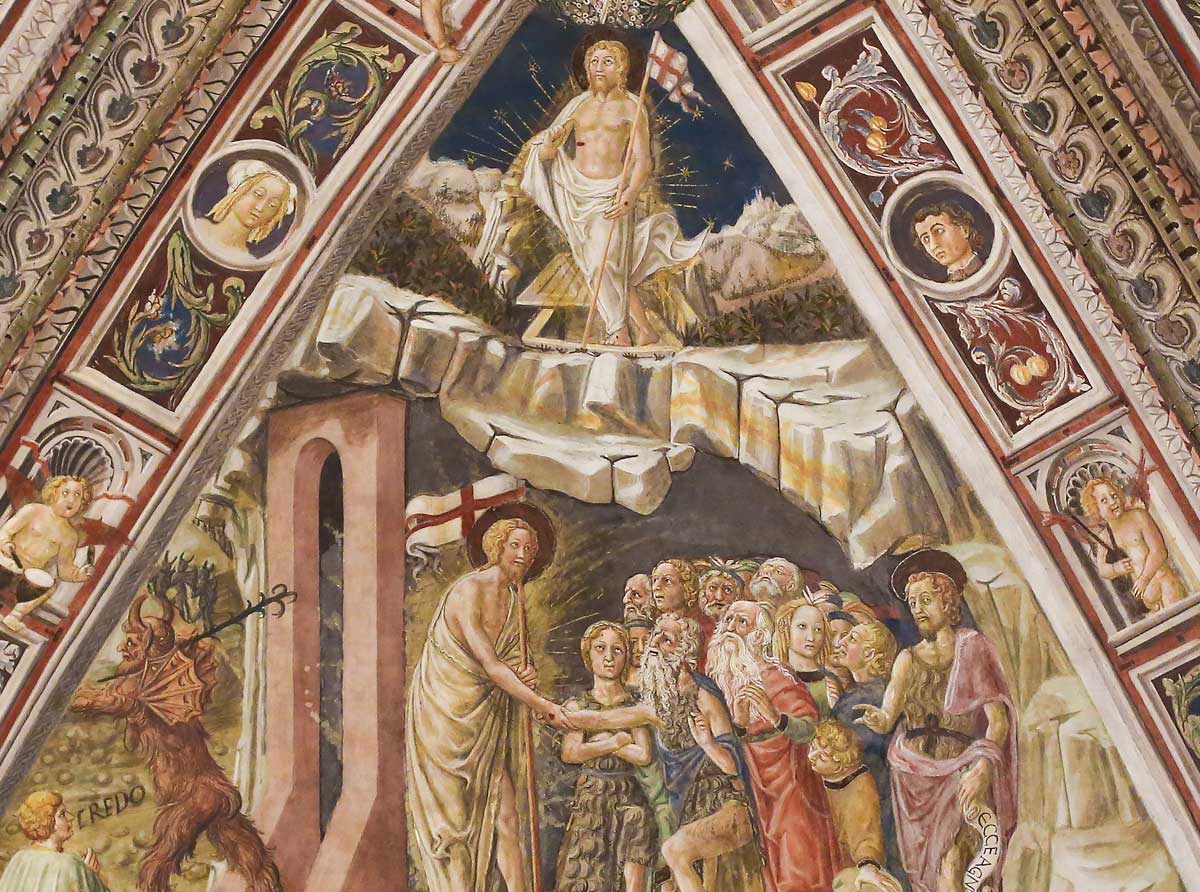
So why should we suppose that the angels are indistinguishable? Painters haven't helped us much here; they sometimes give us a blooming mass of cherubic baby faces and baby bodies, chubby and naked, like clumsy bumblebees. Yet if the rule I have suggested applies, then one angel is far more distinct from another angel than one saint is from another saint, and, moreover, this distinction implies all the more profound unity.


Anthony Esolen is Distinguished Professor of Humanities at Thales College and the author of over 30 books, including Real Music: A Guide to the Timeless Hymns of the Church (Tan, with a CD), Out of the Ashes: Rebuilding American Culture (Regnery), and The Hundredfold: Songs for the Lord (Ignatius). He has also translated Dante’s Divine Comedy (Random House) and, with his wife Debra, publishes the web magazine Word and Song (anthonyesolen.substack.com). He is a senior editor of Touchstone.

A Journal of Mere Christianity—Delivered to Your Door

  • Essays on theology, culture, and the Church
  • Contributors from across the Christian traditions

Subscribe (Print + Online)

Six print issues (one year) of Touchstone, plus full online access and PDF downloads for only $39.95.

Subscribe (Online Only)

Get a one-year full-access subscription to the Touchstone online archives for only $19.95.


bulk subscriptions

Order Touchstone subscriptions in bulk and save $10 per sub! Each subscription includes 6 issues of Touchstone plus full online access to touchstonemag.com—including archives, videos, and pdf downloads of recent issues for only $29.95 each! Great for churches or study groups.

Transactions will be processed on a secure server.


more from the online archives

25.3—May/Jun 2012

Just Sayin'

on What We Used to Know vs. What We Know Now by Thomas Howard

22.4—May 2009

Take & Give

on Two Words That Describe the Workings of Love by Bruce Brander

29.3—May/June 2016

Health of the Nation

A Deathbed Reflection on Catholic Social Teaching & Our Future Prospects by Karl D. Stephan

calling all readers

Please Donate

"There are magazines worth reading but few worth saving . . . Touchstone is just such a magazine."
—Alice von Hildebrand

"Here we do not concede one square millimeter of territory to falsehood, folly, contemporary sentimentality, or fashion. We speak the truth, and let God be our judge. . . . Touchstone is the one committedly Christian conservative journal."
—Anthony Esolen, Touchstone senior editor

Support Touchstone

00