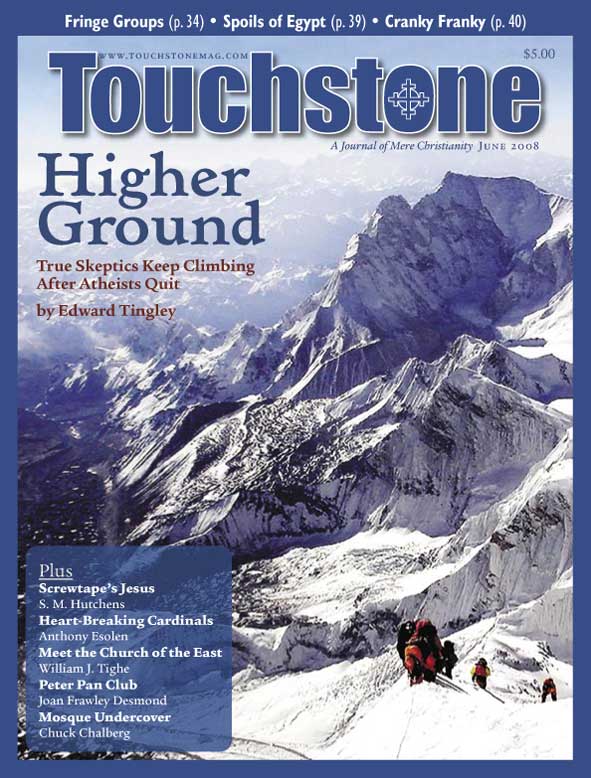
The Skeptical Inquirer by Edward Tingley
The Skeptical Inquirer
If Only Atheists Were the Skeptics They Think They Are
by Edward Tingley
Unbelievers think that skepticism is their special virtue, the key virtue
believers lack. Bolstered by bestselling authors, they see the skeptical and
scientific mind as muscular thinking, which the believer has failed to develop.
He could bulk up if he wished to, by thinking like a scientist, and wind up
at the “agnosticism” of a Dawkins or the atheism of a Dennett—but
that is just what he doesn’t want, so at every threat to his commitments
he shuns science.
That story is almost exactly the opposite of the truth.
Men of Truth
The story is right about virtue: The smoothly muscled skeptical-scientific
mind is a gorgeous thing—picture the Apollo of Olympia, a poised young
athlete in a throng of centaurs, passion-driven half-men. Science is a virtue:
a perfection of the human creature gifted with a mind, a use of the mind that,
says Aquinas, “perfects the speculative intellect for the consideration
of truth.” But to be “men of truth,” in the words of Exodus,
is to be vulnerable to truth.
Richard Dawkins speaks as a genuine scientist when he insists, “What
I care about is what’s true; I want to know, is there a God
in the universe or not?” Perfect. Truth is awaiting you, with its painful
grip.
But on the question around which Dennett, Dawkins, Hitchens, Harris, Grayling,
Onfray, and voices still to come are now springing up—the question of
God—the successor of Apollo is not the atheist or the agnostic. Both
lack the great virtue of the scientist, the skeptical virtue. Here they are
the hankerers after comfort, the scrawny ones who prefer their own commitments
over reason.
No matter how excellent these thinkers might be on other questions, on this
question they nimbly shift their allegiance: Between the life they like and
the demands of vocation (submission to the question), they choose their lives—ironically,
the very failing for which they ridicule believers. A seeker of truth has to
go where the truth can be found, and to go on until it is found, and both the
atheist and the agnostic are early quitters.
Dawkins is right that “the question of the existence of God or gods,
supernatural beings, is a scientific question,” straight from the mind
hungry for truth. On that question, the path of the scientist was shown to
us at the dawn of modernity by a consummate scientist: Blaise Pascal. Here
was a scientific mind that brushed aside the medieval proofs of God (which
did nothing for him) to attack the question anew.
People may think it just an odd coincidence that the author of the Pensées, a
work of apologetics, also came up with Pascal’s law, on the transmission
of pressure in confined liquids, but one mind seeking one thing generated both.
Pascal was a lifelong seeker of truth: “I should . . . like to arouse
in man the desire to find truth, to be ready, free from passion, to follow
it wherever he may find it,” he says in Pensée 119.
But the scientists who have asked Pascal’s question after him are rarely
scientist enough for that.
They do not follow truth wherever they may find it. On the topic they have
promised to illuminate, they are the defenders of Ptolemy in the age of Galileo:
resisters and avoiders of scientific thought inflexibly wedded to their own
commitments; and it is not hard to show this.
The Skeptical Theist
There are skeptical theists; Pascal was one. Skepticism and theism go well
together. By a “skeptic” I mean a person who believes that
in some particular arena of desired knowledge we just cannot have knowledge
of the foursquare variety that we get elsewhere, and who sees no reason to
bolster that lack with willful belief.
“Believing is not something you can decide to do as a matter of policy,” as
Dawkins says—though it is odd that he does so in a discussion of Pascal,
who, like him, is a skeptic. A complete misunderstanding of Pascal, however,
is crucial to the way that Dawkins and every one of his fellows (past and future)
always think.
Evidence is just not available to demonstrate the existence of
God, said Pascal, who called himself one of those creatures who lack the humility
that makes a natural believer. In that, he was of our time: We are pretty much
all like that now. Three hundred and fifty years ago he laid out our situation
for us: Modern man confronts the question of God from the starting point of skepticism, the
conviction that there is no conclusive physical or logical evidence that the
God of the Bible exists.
“I have wished a hundred times over that, if there is a God supporting
nature, [nature] should unequivocally proclaim him, and that, if the signs
in nature are deceptive, she should suppress them altogether”—but
nature prefers to tease, so she “presents to me nothing which is not
a matter of doubt” (429). “We desire truth and find in ourselves
nothing but uncertainty” (401). “We are . . . incapable of knowing
. . . whether he is” (418). This is where the modern person usually starts
in his assault on the question, Is God real or imaginary?
This is base camp, above the tree-line of convincing reasons and knock-down
arguments, at the far edge of things we can kick and see, and it is all uphill
from here. Thus, it is astounding how many Dawkinses and Dennetts, undecideds
and skeptical nay-sayers—that sea of “progressive” folk who
claim to “think critically” about religion and either “take
theism on” or claim they are “still looking”—who have
not reached the year 1660 in their thinking. They almost never pay attention
to what the skeptic Pascal said about this enquiry.
Instead, the dogmatic reflex, ever caring for human comfort, has flexed and
decided the question already, has told them what to believe in advance of investigation
and rushed them back to the safety of life as usual.
The modern thinking person who rightly touts the virtues of science—skepticism,
logic, commitment to evidence—must possess the lot. But agnostics are
not skeptical, half the atheists are not logical, and the rest refuse to go
where the evidence is. None measures up in these modern qualities to Pascal.
A Hidden God?
Pascal says that from base camp we must try to find a non-dogmatic route
of assault upon the question. Think about it logically, he says. If we do not
know that God even exists, we hardly know how he behaves. So we cannot begin
this ascent with any dogmatic presumption about his behavior.
Maybe, if he exists, God would show himself directly to our senses. But maybe
he wouldn’t. Maybe he would hide from us—maybe he is a Deus
absconditus, Pascal says, following Isaiah 45: “Truly, thou art
a God who hidest thyself.” What evidence do we have by which to rule
that out? We can’t be dogmatic, can’t say that God is this way
or that way: Everything possible is possible.
But we have, in fact, already tested one hypothesis about how God behaves:
that he shows himself directly to our senses. That is what got us up here past
the tree-line in the first place. We now have evidence for a conclusion that
all our fellow seekers of truth ought to draw: Either God does not exist or
he exists but does not show himself to our senses.
Our skepticism rejects the likelihood that things we can see will
resolve our doubts; that is progress already made. The Humean idea so nicely
put by Carl Sagan—that “extraordinary claims require extraordinary
evidence”—was hardly worth resurrecting, given that it was passé before
Hume was in diapers. “If this religion boasted that it had a clear sight
of God and plain and manifest evidence of his existence, it would be an effective
objection to say that there is nothing to be seen in the world which proves
him. . . . But . . . on the contrary it says that men are in darkness. . .” (427).
A hundred years earlier, Pascal had already ruled empirical theism a dead
end, a foolish hope for what we ought by now to know we were not going to get:
clear material evidence of clearly immaterial being. By 1660 there were only
two options left: Either God does not exist or he is not a gift to our senses.
Pascal the skeptic has ruled out a fruitless path, the path to God via logic
or concrete evidence: the easy route to the summit, sought for centuries but
never found. The only way forward is up from where we are, onto the
icy slopes out past the limit of concrete evidence. If that is possible.
At this point, of course, the venture is not looking especially promising.
The mind is made for hard evidence. It gets traction on rough ground,
but what stretches before us is sheer ice (minds are not issued with crampons). Is there
a way forward?
That is now the question. If we care about the truth more than we care about
some favored means of data-collection, we need to discover whether there is
any other way, up here where the air is thin and the ice treacherous, that
a rational person could settle the question of God.
A Question, Not an Answer
“Is there anything more?” is the scientific question, but as
Pascal asks it, the “scientists” vanish.
The agnostics ski down the mountain into the woods, searching for hard evidence
on the basis of which to decide whether God exists—which is very odd,
given that a moment ago they were standing here with us, ready to climb as
declared skeptics. Agnostics, plainly, are wafflers in their skepticism: As
the team gets going, they U-turn back to the foothills, where every true skeptic
says there is nothing to find. They do not care about the truth.
But even more astonishing than that, the atheists have just gone home. They
are not down in the valley looking for evidence; they are not looking at all.
They have packed in the science without lifting a boot, as if the summit were
already taken, the question answered.
The atheist is the team-member who was always talking up the loftiness of
the mission, but after all his fervid urgings to “search for what is
true, even if it makes you uncomfortable,” to go on no matter how hard
and painful the going gets, he is the chap who grandly announces, without bending
a knee, that victory is ours: “God should be readily detectable by scientific
means.” “Absence of evidence is evidence of absence.” We
now “rule out the God worshiped by most Jews, Christians, and Muslims.” The
climb is done, and the atheist scampers back to town to meet the press.
The great logician Bertrand Russell is a model of this illogic. The famous
quip he offered to explain his atheism—“Not enough evidence, God,
not enough evidence”—only snaps every person eager to quote him
(e.g., Dawkins) back to a day before buckled shoes, when material solutions
were still worth discussing.
To talk like Russell after Pascal only makes you quaint and silly, because
what the lack of evidence delivers is logically a question, not a conclusion.
Skepticism raises the question, Is there any way forward after we
have given up on material evidence? It certainly doesn’t answer it.
To clamber from skepticism to atheism without embarrassing yourself is only
possible with support from another premise— If we cannot know it
via the senses, then it cannot exist—and there is a lot to be embarrassed
about if you call yourself a skeptic and believe that. There is no sign in
Russell of the skeptic who will instinctively ask, What reason do I have to
subordinate the possibility of God’s existence to the powers of my senses?
Empty Demands
All of those people who insist that they would reasonably believe on the
basis of “a range of confirming evidence corroborated by a community
of inquirers,” or if there were no other way to explain the universe,
or if there were “evidence of miracles,” or if there were predictions
of “natural disasters . . . using non-ambiguous language,” or archeological
traces of biblical events, and all the rest of it, are truly not worth listening
to. Truly not.
Why? Because in all of this they are refusing to go where their own skeptical-scientific
questioning actually points: not back to concrete evidence but on to the question
of whether there is another way to answer the question, which they reject without
further thought. Rather than ask it, they balk, they flinch, they bluster—they
do everything that in their own eyes signals the dogmatic refuser of science.
Given the options that logic delivers, the one thing it is utterly ridiculous
to do is to keep going on about “strong, compelling evidence [for] the
existence of God.” Yet that is what both the agnostic and the atheist
never stop talking about: the agnostic, so that he can believe; the atheist,
as the crux of the belief he has already raced to. Pascal has left both behind
him: This is patent “folly,” he says.
All of the people who say that they are “atheists through skepticism, because
they see no evidence that God exists,” are patently unthinking people,
since by virtue of turning skeptic, no one has ever done anything—employed
any logic, gathered any evidence, found any way forward—to reach a conclusion
about whether God exists. So these atheists have not reached a conclusion;
they have made a commitment.
What the scientific skeptic ought to say is this: “Having examined
the hard evidence, we declare that route to be exhausted. The only kind of
evidence for God’s existence that counts will have to be of some
other kind—if there is any other kind.”
That would be reasonable. And it would be a fine thing for a skeptic to doubt
that there is any evidence besides the standard, demonstrable kind—and
there are skeptics who do so. But all those who, just because they doubt
it, run home with the question answered are frauds like their agnostic brethren
if they still call themselves scientists.
Hunches are starting points, not arguments. We need “to inquire, to
investigate, to think critically about any subject” before we settle
our minds, as they so love to tell us. But where are the skeptics who go up
the mountain with Pascal? Nowhere.
The Instrumental Heart
When the smart scientist of the seventeenth century was asked, “Is
clear water pure?” he did not go with his gut and answer “yes” or “no.” “The
naked eye says yes,” he answered, “but is there an instrument better
than the naked eye with which to see?” We need to listen to the scientist
who claims that there is, and that scientist is Pascal.
That instrument is the heart. “It is the heart which perceives God,
and not the reason” (424). “The heart has its reasons, which reason
does not know” (423). Pascal’s reasons of the heart are meant to
take over from an intellect that operates on hard evidence but has run out
of it. “The heart has its order, the mind has its own, which uses principles
and demonstrations. The heart has a different one” (298).
We are not talking here about feelings, which love to cheat us. Pascal says
that the heart convinces, makes us rightly sure. “Demonstration
is not the only instrument for convincing us” (821).
Many of his readers miss this, and so see him as preparing us to leap—but
conviction is not a leap. Dawkins takes him to say that when the evidence runs
out, you just throw in your lot with belief in God, because that is logically
prudent; he credits Pascal with “the ludicrous idea that believing is
something you can decide to do.” But the heart, Pascal is saying,
is not a springboard to choice; it charts a path to conviction about God. It
is not all done for us by logic and by sight. There is still the reasoning
of the heart.
The scientist Pascal claims to know a route that will take us over the ice
to convincing discovery. It is the refusal to test his thinking that betrays
the faith of atheists and agnostics.
No no, they will say, point to something material on which to base
belief and then I will look at it. “Give us solid evidence!” They insist that
every belief about reality must be accepted on the basis of evidence (“experience
or logic”). On what basis do they accept that? Evidence? But
there is none.
There is no evidence at all that everything reality might contain can be
apprehended by this faculty or that one, this instrument or that. There is
no reason at all to pick a horse, except as a matter of hope or “mood
and attitude” (the impulses, atheists explain, of religion, by contrast
with science).
But atheists and agnostics pick. They commit in the absence of evidence. They
never fail to stew at “the weary old canard that atheism is ‘a
faith proposition,’” but “commitment to a belief in the absence
of evidence supporting that belief” is their own definition of faith,
and that is what they do.
Signs to Be Seen
Ask any sensible person if it is possible that God exists, does not present
himself to us by way of material evidence, and yet seeks our acknowledgment
on some other basis, one in which we are more deeply invested. Could
there be a God who does not want to be known the way the facts of nature are
known or sums are known? The rational person will say, “Yes, it is possible.”
Isn’t it possible that God does not dance us into his presence by puppetry?
Clearly, he did not do that physically: He did not give us freedom to move
and then drop us onto an inclined plane that rolled us to his feet. It is possible
that God does not move us to him intellectually, either, by the locomotion
of evidence, so that merely by opening eyes and possessing minds we wind up
acknowledging him. Maybe he grants to our minds the freedom he gives our bodies.
That would explain why he “hides”—and also why “hiding” is
not the right word for this. In effect he hides, but “hiding” is
trying-not-to-be-found, whereas this is trying-to-be-found-only-by-the-free-man,
the man who has muscled up with virtues and risen to the point of readiness
for him, genuine readiness to know.
That was the idea in Arthur C. Clarke’s “The Sentinel,” the
basis of Stanley Kubrick’s film 2001, in which the superior
alien intelligence wishes to be discovered by the higher man, the man so ready
for discovery that he can make the voyage into deep space and so eager for
contact that he will risk it. (Interesting that during the filming of 2001 Clarke
went to see a movie about Michelangelo, after which he jotted in his diary, “One
line particularly struck me—the use of the phrase ‘God made Man
in His own image.’ This, after all, is the theme of our movie.”)
It is not so crazy after all, this Deus absconditus business. It
is not so hard to understand why, as Pascal notes, God might display “signs
which can be seen by those who seek him and not by those who do not” (149).
The signs can be seen, he is telling us. To the unbeliever requesting “verifiable
evidence”: So verify it.
Refusing the Facts
It logically follows that our most crucial decision might now have to rest
on something other than solid evidence. It is rational to wonder
about some other kind of evidence that it remains for us to find, whatever
confounded trouble that will put us to. In science, you may curse the direction
the investigation is taking you in, but you will follow it, if you want to
know. “I can only approve of those who seek with groans,” says
Pascal (405).
We are told we should face the facts. Well here they are: The only world
in which strictly empirical evidence is the road that we should take in our
views about God is a world in which God either shows himself by such evidence
or simply does not exist. Those are the options that the agnostic and the atheist like, and
it is because they like them that they never pay any attention to the further
fact that accompanies these: God might await us down another road. There are
three options, not two.
In a world in which God both exists and hides, relying upon conclusive evidence
is the way to be wrong about God. Reason delivers three options, but the agnostic
and the atheist are not listening to reason; they hear only the options they
like, and simply pick the one that suits them.
Settled or Seeking
We agree about the virtues of science. It is a virtue to be reasonable, but
the person who flees the above logic is plainly not reasonable. On the question
of the way in which the truth about God might be found he is openly illogical,
and Pascal is aghast at him.
There are only two kinds of people one can call reasonable: those who serve
God with all their heart because they know him and those who seek him with
all their heart because they do not know him. As for those who live without
either knowing or seeking him . . . It takes all the charity of that religion
they despise not to despise them to the point of abandoning them to their
folly. (427)
Those are better categories than the a-words I have employed because
it is never clear whether a self-confessed “atheist” or “agnostic” is
settled or seeking.
There is only one thing that is in any way real to the settled kind, and
it has nothing to do with evidence or reason or science or truth. He likes the
world that he has painted for himself, the world that demonstration alone reveals.
He likes a world in which he can stop thinking about something when the hard
evidence for it gives out: That is a beautifully simple world. “If I
had to sum up my own atheism, I would have to say that it amounts to this:
I have no interest in the supernatural.” Let’s “simply dismiss
the whole issue of whether ‘God’ exists as not worth any discussion.” “It
isn’t just that I don’t believe in God and naturally hope there
is no God! I don’t want there to be a God; I don’t want the universe
to be like that.”
He likes a world in which he can hold at bay the specter of religion (with
its insane demands), which he feels bearing down on his life ready to suck
out its vitality. Like Van Helsing, he can hold it at bay with ridiculous ease
just by crossing two random sticks: the two twigs of his skeptical gambit and
his credo about evidence, which he has cobbled into a principle for the purpose
of backing religion off. (As is here becoming apparent, it is no credo he lives
by.)
He likes a world in which he can feign disability—“I wish I could
believe in a god of some kind but I simply cannot”—and then be
left alone at every such sad-faced confession of impotence.
But it is not true that he cannot believe. What he cannot do is believe in
God in the posture that he has adopted, since he demands to believe on the
basis of the specific kind of evidence he is not getting. (Perfect!—the
one way never to believe.) He demands that God show himself to senses or logic,
and when God does not oblige, he considers the matter closed and ceases to
think.
The Dissenter’s Heart
If belief on the basis of senses or logic is the one rational option, why
does the dissenter not get all his beliefs that way? On other questions—in
fact, in his most fundamental commitments, in his credo—he does believe
without evidence, since there is no evidence to support the belief
that the divine must knock at the doors of eye and mind.
He ceases to care about what is logically possible because he has flatly
refused to accept that it is possible. And how has he done this? He has denied
it in his heart. He has answered the question of God first—not
by recourse to evidence but by consulting his heart, which has turned in on
itself, which seeks no God. “He hath said in his heart, I shall not be
moved” (Psalm 10). Because he simply “does not buy it,” he
will not engage the logic by which it can be bought, and in that disordered
posture he cannot unclench his heart and face the disturbing and painful logic
that leaves the possibility of God open.
He could do so, though. And looking then into his heart, he might
find that he wished to climb with Pascal, out onto the ice, making “every
effort to seek [the truth] everywhere” (427), trying everything that
all who have found the evidence advise.
He could, but he does not. Instead, he has not a moment to waste on what
it might mean to fail to discover a God who might exist, because he doesn’t
really care what it would mean, and he doesn’t care because all that
he can picture is a world without God. He wholly inhabits question-begging.
His logic is sketchy and his logos is lame: His rational power of
imagining has atrophied from selective use in the service of his pleasure.
The Mask of the Unbeliever
Who, then, is this person? He is not a skeptic at all (someone who,
for want of solid reasons, refuses to commit)—he commits. He is not a
lover of reason over passion—he chooses the possibilities he cares about
because those are the ones he likes. He is not a skeptic
who in the absence of evidence withholds belief—he is a believer.
You cannot even call him selectively non-committal, committing to some reasoning
of his own but refraining from ours—for the instrument he is using is
the very one he disparages. He denies Pascal’s reasons that do what hard
intellect cannot . . . on the strength of reasons of the heart that push religion
off his path, as reason fails to do.
The final self-description this character offers is this: That without evidence he cannot
believe, but now we must kick away this last support of his identity,
too. It is not true at all that he cannot believe without evidence; he has
already done so, having arrived at his commitment to evidence without evidence.
Evidence is not his only vehicle of locomotion, and he should admit
it. He should notice what his heart is already doing for him, when he lets
it.
But the chance is that he does not want to. He has accomplished by his heart
the thing he wants, which is to free himself from further thinking, and he
does not want to know how he got there. (The entire text of Pensée 886
is, “Skeptic for obstinate.”)
He could very well believe other things on the self-same basis, but he does
not want to. He likes the world that he has installed himself in, and that
is what tells us who he is: a lover—a lover of his own life, a believer
in the path that his heart has charted for him, a believer in the world under
the sun.
SOURCES: The numbers given for the Pensées refer
to A. J. Krailsheimer’s translation, published by Penguin. Unattributed
quotations throughout cite, verbatim, the words of atheists and agnostics:
In addition to Richard Dawkins and Daniel Dennett, quoted are Julian Baggini,
author of Oxford’s Atheism: A Short Introduction; R. T. Carroll,
philosophy professor and author of The Skeptic’s Dictionary; A.
C. Grayling, philosophy professor at the University of London and author
of Against All Gods; Paul Kurtz, founder and chairman of the Committee
for Skeptical Inquiry and Fellow of the American Association for the Advancement
of Science; John W. Loftus, proprietor of the Debunking Christianity blog,
labelled “one of the better anti-Christian sites on the net”;
Georges Rey, philosophy professor and author of Meta-Atheism: Religious
Avowal as Self-Deception; and Victor Stenger, author of God: The
Failed Hypothesis.
Obsolete Instruments
We need evidence that God exists. Agreed.
What kind? Is there only one kind? Scientific evidence. And
what is that: material evidence? Is that how science works? Didn’t
the nature of evidence expand as science went deeper into what
is? Aren’t there new and unexpected kinds of
evidence?
Even scientists don’t quit
when the old sort of evidence runs dry. Not quitting—going
beyond the established sort of evidence—is a virtue of
science.
What would we say to the pre-Darwinian
who did not believe that biodiversity could be explained? (“It
all had to be put here,” he insisted. “There
is no material evidence for a mechanism of biodiversity.”)
Was natural selection material evidence?
The researcher who quit that project,
enthralled by his “absence of evidence,” is what
we would call an uninspired, even a bad scientist. We would say
to him that scientists do not seek only data: Sometimes they
seek a way to get data, and when they find it, they may find
that it does not mimic the procedures they followed before.
It is a bad scientist who says that
nothing can possibly orbit Jupiter when the means of discovery
are absent—when there is simply no telescope by which to
check (the naked eye being deficient). It is a bad scientist
who says that metal is not crystalline when the fact is that
there is no microscope fit to show its structure (the light microscope
being deficient).
Maybe what the nay-sayers ought to
do is to stop pronouncing in the absence of evidence and start
looking for new instruments by which to get some. That is science. Modern science,
especially, advances by the discovery of new means by
which to acquire what is, to be sure, also concrete, measurable
evidence. But it is not always “material evidence,” “the
evidence of the eye.”
The lesson science teaches is the
pitfall of fetishizing past means of seeing, the kinds of things
that have convinced us thus far. It is a primitive thinker who
models the world on our present and standard abilities to perceive,
and who presumes to know the means of testing for x before
he has even considered what nature x might have.
— Edward Tingley
|
Edward Tingley teaches philosophy at Augustine College in
Ottawa and worships at the Cathedral of the Annunciation in the Anglican Catholic Church of Canada. |