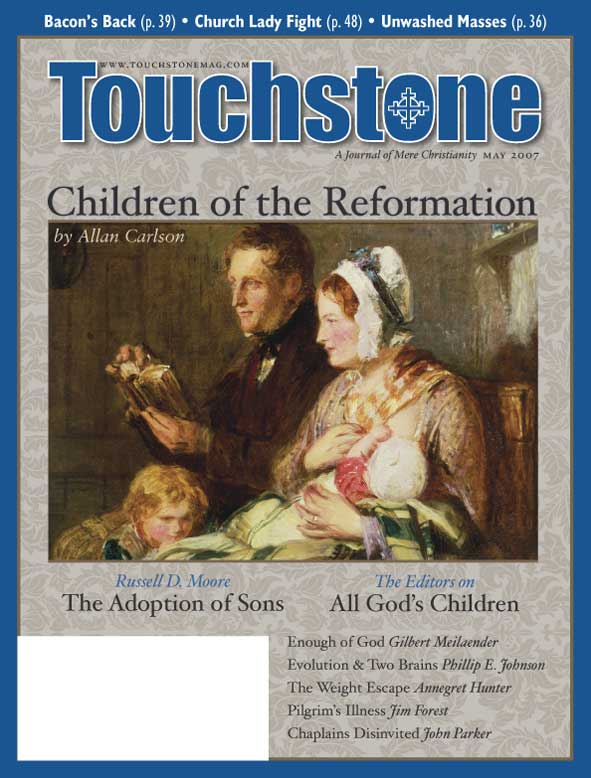
The Brotherhood of Sons by Russell D. Moore
The Brotherhood of Sons
What Some Rude Questions About Adoption Taught Me About the Gospel of
Christ
by Russell D. Moore
“So, are they brothers?” the woman asked. My wife Maria and I,
jet-lagged from just returning from Russia, looked at each other wearily. This
was the twelfth time since we returned that we’d been asked this question.
This lady was looking at the grainy pictures, printed off a computer from some
digital photographs, of two one-year-old boys in a Russian orphanage, boys
who had only days earlier been pronounced by a Russian court to be our children,
after the legally mandated waiting period had elapsed for the paperwork to
be filed.
Maria and I had returned to Kentucky to wait for the call to return to pick
up our children, and had only these pictures of young Maxim and Sergei, our
equivalent of a prenatal sonogram, to show to our friends and relatives back
home. But people kept asking: “Are they brothers?”
Now Brothers
“They are now,” I replied. “Yes,” the lady snapped, “I
know. But are they really brothers?” Clenching my jaw, I coolly
responded, “Yes, now they are both our children so they are now really brothers.” The
woman sighed, rolled her eyes, and said, “Well, you know what I mean.”
Of course, we did know what she meant. She meant did these two boys—born
three weeks apart—share a common biological ancestry, a common bloodline,
some common DNA. It struck me that this question betrayed what most of us tend
to view as really important when it comes to sonship: traceable genetic
material.
This is the reason people would also ask us, “So do you also have any
children of your own?” And it is the reason newspaper obituaries will
often refer to the deceased’s “adopted child,” as though
this were the equivalent of a stepchild or a protégé, rather
than a real offspring.
During the weeks that Maria and I waited anxiously for the call to return
to Russia to receive our children, I pondered this series of questions. As
I read through the Books of Ephesians and Galatians and Romans, it occurred
to me that this is precisely the question that was faced by the Apostle Paul
and the first-century Christian churches.
As pig-flesh-eating Gentile believers—formerly goddess-worshipers and
Caesar-magnifiers and all the rest—began confessing Jesus as Messiah,
some Jewish Christians demanded to know, “Are they circumcised?” The
Gentile believers would respond, “Yes, with the circumcision made without
hands, the circumcision of Christ.” From the heated letters of the New
Testament, it is evident that the response was along the lines of, “Yes,
but are you really circumcised, and you know what I mean.”
This was no peripheral issue. For the Apostle Paul, the unity of the Church
as a household had everything to do with the gospel itself. And where the tribal
fracturing of the Church was most threatening, Paul laid out a key insight
into the Church’s union with Christ, the spirit of adoption.
We went to Russia and back to accomplish a task, to complete a long paper
trail that would help bring us to the legal custody of our sons. Along with
that, however, it jolted us with the truth of an adoption more ancient, more
veiled, but just as real: our own.
It is one thing when the culture doesn’t “get” adoption,
and so speaks, for instance, of buying an animal as “adopting” a
pet. When Christians, however, think the same way, we betray that we miss something
crucial about our own salvation.
Perhaps if we understood the gospel more clearly, we would then see it more
clearly in the icon of adoption. And perhaps if we were more involved—as
families and churches—in adopting unwanted children, we would foster
a next generation better able to recognize the gospel message when they hear
it.
Adopted Identity
Before the apostle begins his discourse on adoption to the Roman church,
he addresses them as “brothers” (Rom. 8:12), a word that has lost
meaning in our churches because we tend to view it as a more spiritual metaphor
for “friend” or “neighbor.” In many Evangelical churches, “brother” is
a safe word one uses when one has forgotten someone’s name (“Hey,
brother, how are you?”) or when one wishes to soften spiritually a harsh
statement (“Johnny, I love you as a brother in Christ, but I just can’t
marry you”).
The churches emerging out of the Judaism of the Roman Empire, however, would
have understood precisely how radical such language is. The “sons of
Israel” started out, after all, not as a government entity, but as twelve
brothers. Moses speaks of the Israelite king obeying the Word of God “that
his heart may not be lifted up above his brothers” (Deut. 17:20). The
Mosaic Law speaks of Israelites as “brothers” as opposed to “strangers” and “sojourners” (Lev.
25:35–46).
To a Gentile church in Ephesus, Paul employs this precise language as he
tells them they are no longer to be considered “the uncircumcised.” Instead,
he tells them, “you are no longer strangers and aliens, but you are fellow
citizens with the saints and members of the household of God” (Eph. 2:11,
19).
Within this household—the tribal family of Abraham—all those
who are in Christ have found a home through the adopting power of God. It is
not simply that they have found a refuge, a safe place, or a foster home. All
those in Christ, Paul argues, have received sonship—they are now the “offspring
of Abraham” (Gal. 3:29).
Paul speaks of this new household in terms of a liberating rescue, for both
Jews and Gentiles. We have a unity in that we were liberated from the tutorship
of the Law in the old order (Gal. 4:1–5) and from the “spirit of
slavery to fall back into fear” (Rom. 8:15). Instead, as sons, we now
come before God as sons, bearing the very same Spirit as was poured out on
the Lord Jesus at the Jordan River, a Spirit through which we cry “Abba!”
There is a new identity found in this adoption, an identity forged in the
relationship of father and son. This filial identity was easily seen by the
first-century Christians. They were accustomed to seeing sons who followed
in the vocational patterns of their fathers, men who were called “son
of” all their lives (for instance, “Simon Bar Jonah”).
Of Israel, God once said, “Your origin and your birth are of the land
of the Canaanites; your father was an Amorite and your mother a Hittite” (Ezek.
16:3). But this was not Israel’s identity. Through God’s adoption,
they did not consider themselves sons of the pagan Terah or even sons of Abram.
They were sons of Abraham; the nation was the son of the living God (Ex. 4:22–23).
In Christ, this is now true of all of those who are grafted onto the vine
of the faithful Israel, Jesus of Nazareth.
All Moores Now
I suppose the root of my annoyance with the question “Are they brothers?” really
lay here. It seemed that the good-intentioned conversationalists saw these
children as somehow not quite part of our family, as though, if they were “really
brothers,” then “at least they’ll have each other.” The
same is true of other questions people asked us: “Have you ever seen
their mother?” (“Why, yes, and you’ve seen her too. Have
you met my wife Maria?”) or “Do you worry that their real parents
will ever show up?”
This wasn’t at all the way that we saw it. It didn’t matter to
us that the nurses in the orphanage across the seas still called these boys “Maxim” and “Sergei”;
we had on their walls nameplates reading “Benjamin” and “Timothy.” It
didn’t matter what their current birth certificates read; they would
soon be Moores.
This newness of identity also informed the way we responded to questions,
whether from social workers or friends, about whether we planned to “teach
the children about their cultural heritage.” We assured everyone we would,
and we have.
Now, what most people meant by this question is whether we would teach our
boys Russian folk-tales and Russian songs, observing Russian holidays, and
so forth. But as we see it, that’s not their heritage anymore, and we
hardly want to signal to them that they are strangers and aliens, even welcome
ones, in our home.
We teach them about their heritage, but their heritage as Mississippians.
They learn about their great-grandfather, the faithful Baptist pastor, about
their countrymen before them in the Confederate army and the civil rights movement.
They wouldn’t know “Peter and the Wolf” if they heard it,
but they do know Charley Pride and Hank Williams and “When the Roll Is
Called Up Yonder.” They are Moores now, with all that entails.
I suppose this is why the New Testament points all of us toward the Old Testament
narratives repeatedly, which are given, as Paul told the church at Corinth, “as
examples for us” (1 Cor. 10:6). It is not just that these accounts show
us something universal about human nature and God’s workings. It is that
they are our story, our heritage, our identity.
Those are our ancestors rescued from Egypt, wandering in the wilderness,
led back from exile. They are our forefathers and this is our family. Whether
our background is Norwegian or Haitian or Indonesian, if we are united to Christ,
our family genealogy is found not primarily in the front pages of our dusty
old family Bible but inside its pages, in the first chapter of the Gospel of
Matthew.
No Longer Orphans
When Maria and I first walked into the orphanage, where we were led to the
boys the Russian courts had picked out for us to adopt, we almost vomited,
in reaction to the stench and the squalor of the place. The boys were in cribs
in the dark, lying in their own waste.
Leaving them at the end of each day was painful, but leaving them the final
day, before going home to wait for the paperwork to go through, was the hardest
thing either of us had ever done. Walking out of the room to prepare for the
plane ride home, Maria and I could hear Maxim calling out for us, and falling
down in his crib, convulsing in tears. Maria shook with tears, and I turned
around to walk back into their room, just for a minute.
I placed my hand on both of their heads and said, knowing they couldn’t
understand a word of my English, “I will not leave you as orphans; I
will come to you.” I don’t think I consciously intended to cite
Jesus’ words to his disciples in John 14:18; it just seemed like the
only thing worth saying at the time.
When Maria and I at long last received the call that the legal process was
over, and we returned to Russia to pick up our new sons, we found that their
transition from orphanage to family was more difficult than we had supposed.
We dressed the boys in outfits our parents had bought for them. My mother-in-law
gathered some wildflowers growing between cracks in the pavement outside the
orphanage.
We nodded our thanks to the orphanage personnel and walked out into the sunlight,
to the terror of the two boys. They’d never seen the sun, and they’d
never felt the wind. They had never heard the sound of a car door slamming
or had the sensation of being carried along at 100 miles an hour down a Russian
road. I noticed that they were shaking, and reaching back to the orphanage
in the distance.
I whispered to Sergei, now Timothy, “That place is a pit! If only you
knew what’s waiting for you: a home with a Mommy and a Daddy who love
you, grandparents, and great-grandparents and cousins and playmates . . . and
McDonald’s Happy Meals!” But all they knew was the orphanage. It
was squalid, but they had no other reference point, and it was home.
We knew the boys had acclimated to our home, that they trusted us, when they
stopped hiding food in their high-chairs. They knew there would be another
meal coming, and they wouldn’t have to fight for the scraps. This was
the new normal.
They are now thoroughly Americanized, perhaps too much so, able to recognize
the sound of a microwave ding from forty yards away. I still remember,
though, those little hands reaching for the orphanage, and I see myself there.
The Sons’ Glory
The New Testament teaching on the adoption of believers in Christ isn’t
a reassuring metaphor for the Fatherhood of God and the brotherhood of man.
Adoption does not simply tell us we belong to God. It is a legal entitlement,
one we are prone to forget.
Paul warns the congregation at Rome that sharing the spirit of Christ means
that we will suffer with him (Rom. 8:17). It means that we will groan right
along with the rest of the creation for the “sons of God to be revealed,” for
our “adoption as sons, the redemption of our bodies” (Rom. 8:23).
But he fits this within the context of a legal inheritance. If we are adopted
by God, if we are his children, then we are “heirs of God and fellow
heirs with Christ” (Rom. 8:17). If we live through the “sufferings
of this present time,” it is only so that we can be conformed to the
image of our Christ, “in order that he might be the firstborn among many
brothers” (Rom. 8:29).
Paul identifies Jesus as the One who inherits the promises made to Abraham,
Isaac, and Israel. He is the One of whom it is said, “You are my Son” (Psalm
2:7), who is given “the nations as your heritage, and the ends of the
earth as your possession” (Psalm 2:8).
Thus, the Jewish believers in the early Church weren’t to look to their
biological ancestry for their inheritance. They were law-breakers (Rom. 2–3).
This is why the insistence on circumcision in the Galatian church was anathema
to the apostle. They were to look to the One in whom all the promises of God
find their Yes: the Lord Jesus (2 Cor. 1:20).
The Jewish and Gentile congregations were to find their identity in Christ,
not in the social and economic hierarchies of the Roman Empire. The churches
were to long for the inheritance to come, a cosmos flowing with milk and honey,
not, as their fathers before them, for the slavery from which they came (Deut.
8; Rom. 8:15).
My whispering to my boys, “You won’t miss that orphanage,” is
only a shadow of something I should have known. God pronounces Israel his “son,” brings
the Israelites through the baptismal waters of judgment, promises to give them
an inheritance, and they long for the fleshpots of Egypt (Ex. 16:1–3).
Jesus is pronounced the “beloved Son” of God, is likewise brought
through the waters of baptism, and is then tempted by the Evil One to believe
that a Father who promises him bread would give him only stones. Listening
to his Father’s voice, even to the point of crucifixion and apparent
abandonment by God, he “learned obedience through what he suffered,” and
he was heard (Heb. 5:7–8).
As he disciplines us—as sons, not as illegitimate children—our
Father warns us not to sell our inheritance for a mess of pottage, as our great-great-great-great-great-uncle
did a long time ago (Heb. 12:3–17). Why would we covet what seems important
to MTV or Wall Street, when we have waiting for us mountain ranges and waterfalls
and distant galaxies to rule with our Christ as the resurrected sons of the
new creation?
“I know you think this terrestrial orphanage is home,” our Father
whispers through prophets and apostles and our consciences and imaginations, “but
it’s a pit compared to home.” Or, as the Spirit says through the
Apostle Paul’s adoption teaching: “For I consider that the sufferings
of this present time are not worth comparing with the glory that is to be revealed
to us” (Rom. 8:18).
Not Ashamed
A few years after we adopted Benjamin and Timothy, the infertility that had
plagued Maria and me for years was suddenly lifted, and we gave birth to a
son, and then another, in the more typical way. And it was time for the “Are
they brothers” business again, this time from an elderly lady who approached
Maria and said, in the hearing of my sons, “I’ll bet Dr. Moore
is really proud of Samuel.”
Maria replied, “Yes, he is proud of all of his sons.” The lady
smiled and retorted, “Yes, but I’ll bet he’s especially proud
of Samuel, since he’s his.” In this woman’s mind, there was
something admirable but almost shameful about adoption; the adopted children
were just not quite as worthy of joy as the “real” son, the biological
one.
I was angered when I heard about this, angered because, while I love Samuel
and now Jonah, I don’t love them any more than Benjamin and Timothy.
As a matter of fact, I don’t think of them as “biological” children,
as though they are part of some different classification. Days go by when I
never think about the adoption, and when I do think of the boys as “adopted,” it
is always as a past-tense verb, not an adjective.
But this lady’s question—like the ones before it—reminds
me of our tendency to prize our carnality. We don’t think we were adopted.
In our persistent Pelagianism, we assume we’re natural-born children,
with a right to all of this grace, to all of this glory.
We think, Paul warns us right before he tells us of our adoption, that we
are debtors to the flesh, so we live according to the flesh (Rom. 8:12). We’re
ashamed to think of ourselves as adopted, because to do so would focus our
minds on the bloody truth that all of us in Christ, like my sons, once were
lost but now we’re found, once were strangers and now we’re children,
once were slaves and now we’re heirs.
And yet even the flesh and blood we share—not just with our children
but with all of humanity—have everything to do with our adoption. Jesus,
after all, shares in human “flesh and blood” so that he might deliver
those “who through fear of death were subject to lifelong slavery” (Heb.
2:15).
This is because he “had to be made like his brothers in every respect” (Heb.
2:17). And, speaking of us, our Lord Jesus—the only One with the natural-born
right to cry “Abba”—is “not ashamed to call them brothers” (Heb.
2:11).
According to the Apostle John, the religious leaders of Jesus’ day
were quite sure of their biological pedigree. They could trace it back to Abraham,
and had no shady parental background as they thought Jesus to have (John 8:39–41).
Jesus shockingly identified their birth father as Satan and their inheritance
as that of a slave (John 8:34–38).
But John ends his Gospel with a more hopeful sound. When Jesus is raised
from the dead, his message to Mary is to go “to my brothers” and
say to them, “I am ascending to my Father and your Father, to my God
and your God” (John 20:17). John isn’t “really” Jesus’ brother,
but he shares a mother with him, when Jesus “adopts” him into the
family at the Cross (John 19:26–27).
And these unfaithful and fearful disciples, quick to go back to the fisherman’s
nets they had when he found them, have no reason to approach a holy “God.” But
they—and we—are Jesus’ brothers, and so the Father is our
God. He is not ashamed.
One More Time
We fall for all our ideological idolatries—from white supremacy to
genocidal warfare and beyond—because we see our “brotherhood” only
in our DNA. We engineer radical reproductive technologies that sever procreation
from fatherhood and motherhood, precisely because we don’t want children
so much as we want ourselves, our own genetic material living on before us.
We identify more with our corporate brands and with our political parties than
with our churches because we don’t understand the household into which
we’ve come.
We dye our hair and Botox our wrinkles, fearing the Reaper, because we don’t
really believe that a Father waits for us with a feast on the other side of
the Jordan. And we live prayerless lives, paralyzed by our guilty consciences,
because someone says to us, as to our Brother before us, “ If you
are the son of God . . .” (Luke 4:3).
I don’t think about the adoption of my boys every day. But, when I
do, I try to remember the rude questions I once answered—and sometimes
still answer—about them. And I remind myself that I’ve been just
as far from “getting it” as the good-natured questioners I have
resented.
It is difficult to see before us the day when the graves of this planet are
emptied, when the great assembly of Christ’s Church is gathered before
the Judgment Seat. On that day, the accusing principalities and powers will
probably look once more at us—former murderers and fornicators and idolaters,
formerly uncircumcised in flesh or in heart—and they may ask one more
time, “So are they brothers?”
The hope of adopted children like my sons—and like me—is that
the voice that once thundered over the Jordan will respond: “They are
now.”
All His Sons
The aspect of adoption
in Christ as an inheritance is precisely why “gender-neutral” attempts
to translate Galatians 3:26 as, “For in Christ Jesus you are
all sons and daughters of God, through faith,” is so
wrongheaded. Yes, this sonship applies to both men and women, slaves
and free, Jew and Greek (Gal. 3:28), but why?
Because we have “put on Christ,” and thus share his identity
as Abraham’s offspring and his inheritance; we are “heirs
according to promise” (Gal. 3:29). The Galatians—and all
of us in Christ—have received adoption not as sons and daughters but
as sons. The inheritance, after all, in the ancient Near
East went not to the daughter of the patriarch, but to the firstborn
son. The daughter received her inheritance through her husband.
If Paul had told the Galatian congregation
that they were sons and daughters of God (which in one sense is
true), the Jews
could have
claimed the inheritance promises of the Old Testament covenants, even
as they conceded that the God-fearing Gentiles could have a “relationship” with
God through Jesus. Perhaps the men could have conceded that women could
pray and commune with God, but they were the sons, those
who inherit the promises.
— Russell D. Moore
|
Russell D. Moore is the author of Adopted for Life: The Priority of Adoption for Christian Families and Churches. He lives with his family in Louisville, Kentucky, where he serves as Dean of the School of Theology and Senior Vice-President for Academic Administration at The Southern Baptist Theological Seminary and as preaching pastor at Highview Baptist Church. He is a senior editor of Touchstone. |