




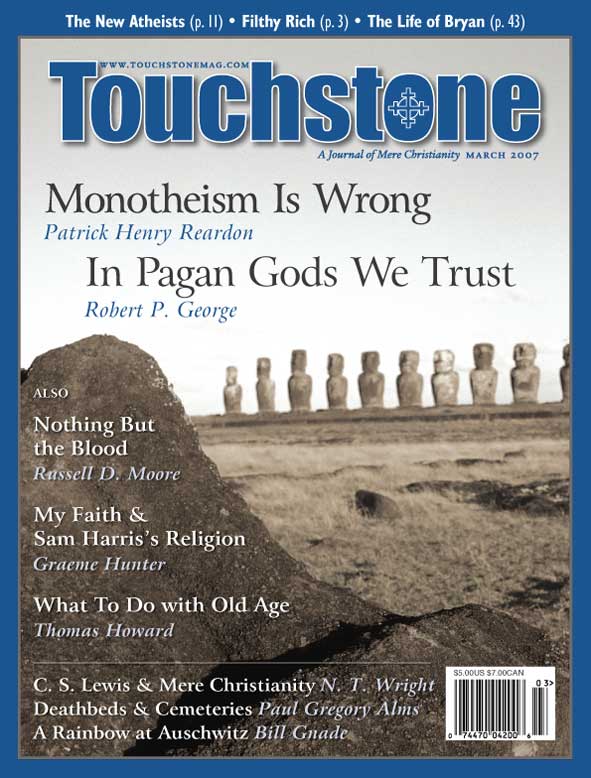
Home Bible School
Before he ever met the Apostle Paul, the life of young Timothy was already full of blessings. Indeed, Paul himself, among the last lines he wrote on this earth, reminded Timothy of those blessings: “But you must continue in the things which you have learned and been assured of, knowing from whom you have learned them, and that from childhood you have known the Holy Scriptures, which are able to make you wise for salvation through faith which is in Christ Jesus” (2 Tim. 3:14–15).
Both Paul and Timothy knew who were the latter’s first teachers of Holy Scripture. Paul wrote earlier in this same epistle, “I call to remembrance the genuine faith that is in you, which dwelt first in your grandmother Lois and your mother Eunice, and I am persuaded is in you also” (1:5).
These two women, Timothy’s mother and grandmother, had raised him, not only in the faith but also in the study of the Sacred Writings, ta hiera grammata—sacred grammar. It was this early study of Sacred Letters, carried on in the home, that grounded the soul of young Timothy and prepared him to become, in due course, an apostle of the Church and the bishop of Ephesus. The whole Church, for the past 2,000 years, owes to these two women an immense and unpayable debt of gratitude.
THIS ARTICLE ONLY AVAILABLE TO SUBSCRIBERS.
FOR QUICK ACCESS:
Patrick Henry Reardon is pastor emeritus of All Saints Antiochian Orthodox Church in Chicago, Illinois, and the author of numerous books, including, most recently, Out of Step with God: Orthodox Christian Reflections on the Book of Numbers (Ancient Faith Publishing, 2019).
subscription options
Order
Print/Online Subscription

Get six issues (one year) of Touchstone PLUS full online access including pdf downloads for only $39.95. That's only $3.34 per month!
Order
Online Only
Subscription

Get a one-year full-access subscription to the Touchstone online archives for only $19.95. That's only $1.66 per month!
bulk subscriptions
Order Touchstone subscriptions in bulk and save $10 per sub! Each subscription includes 6 issues of Touchstone plus full online access to touchstonemag.com—including archives, videos, and pdf downloads of recent issues for only $29.95 each! Great for churches or study groups.
Transactions will be processed on a secure server.
more from the online archives

31.1—January/February 2018
Getting Sex Wrong Is a Foundational Error by James M. Kushiner

32.6—November/December 2019
Historical Truth, Beguiling Stories & Three Kinds of Hearers by Anthony Esolen
calling all readers
Please Donate
"There are magazines worth reading but few worth saving . . . Touchstone is just such a magazine."
—Alice von Hildebrand
"Here we do not concede one square millimeter of territory to falsehood, folly, contemporary sentimentality, or fashion. We speak the truth, and let God be our judge. . . . Touchstone is the one committedly Christian conservative journal."
—Anthony Esolen, Touchstone senior editor
