





Feature
Faith of the Faithless
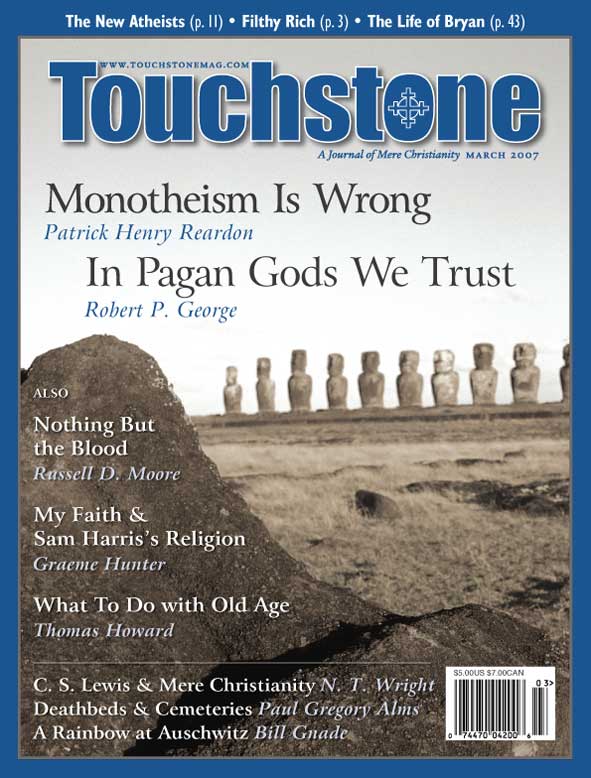
Why Sam Harris Can’t Stamp Out My Religion with His Own by Graeme Hunter
Many Christians will be aware of a stepped-up attack on the Christian faith in the recent secular press. As one observer says, “They estimate that the time is ripe and that professed believers have lost the will to resist.” One example is Sam Harris’s recent book The End of Faith. Having reached the New York Times bestseller list, won the PEN/Martha Albrand award for nonfiction, and sold upwards of 300,000 copies, it has made the author famous and a good deal richer as well.
Harris’s main contention is that our weapons of mass destruction have made tolerating intolerant faiths—Christianity as well as Islam—an unaffordable luxury. “Given the power of our technology, we can see at a glance that aspiring martyrs will not make good neighbors in the future. We have simply lost the right to our myths, and to our mythic identities.”
THIS ARTICLE ONLY AVAILABLE TO SUBSCRIBERS.
FOR QUICK ACCESS:
Graeme Hunter is a contributing editor to Touchstone and Research Professor of Philosophy at Dominican University College in Ottawa. He is the author of Radical Protestantism in Spinoza's Thought (Ashgate).
A Journal of Mere Christianity—Delivered to Your Door
- Essays on theology, culture, and the Church
- Contributors from across the Christian traditions

Six print issues (one year) of Touchstone, plus full online access and PDF downloads for only $39.95.

Get a one-year full-access subscription to the Touchstone online archives for only $19.95.
bulk subscriptions
Order Touchstone subscriptions in bulk and save $10 per sub! Each subscription includes 6 issues of Touchstone plus full online access to touchstonemag.com—including archives, videos, and pdf downloads of recent issues for only $29.95 each! Great for churches or study groups.
Transactions will be processed on a secure server.
more from the online archives


calling all readers
Please Donate
"There are magazines worth reading but few worth saving . . . Touchstone is just such a magazine."
—Alice von Hildebrand
"Here we do not concede one square millimeter of territory to falsehood, folly, contemporary sentimentality, or fashion. We speak the truth, and let God be our judge. . . . Touchstone is the one committedly Christian conservative journal."
—Anthony Esolen, Touchstone senior editor
