





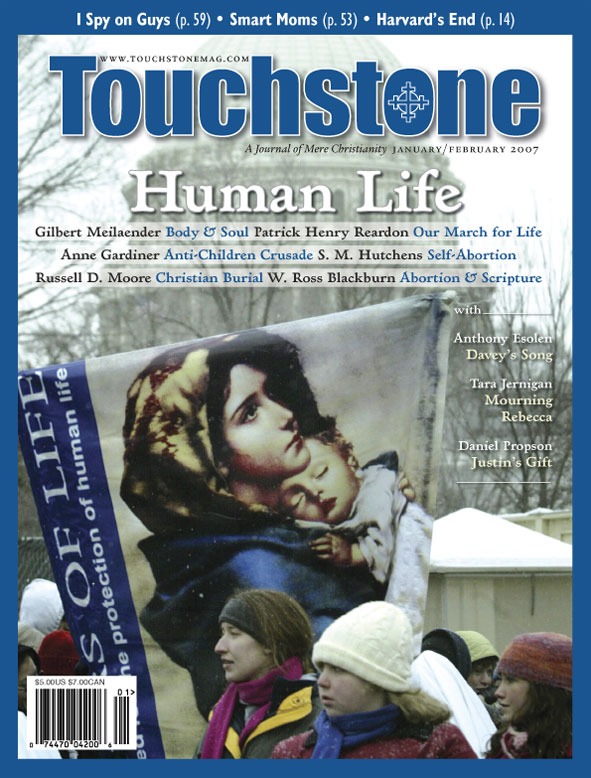
Smart Moms
The Mommy Brain
by Katherine Ellison
Perseus Books Group, 2005
(279 pages, $15.00, paperback)
reviewed by Jocelyn Mathewes
Everything changes,” muses a character in Nursery Crimes, written by retired public defender Ayelet Waldman, speaking of having children. “Your relationship is destroyed. Your looks are shot. Your productivity is devastated. And you get stupid.” Motherhood, many say, makes you dumb.
A “pessimistic chorus” of parents, non-parents, career women, stay-at-home moms, and others believe this to be a near “proven scientific fact,” notes Katherine Ellison in The Mommy Brain. She recounts a discouraging study in which “researchers showed audiences videotapes of a woman in various workplace situations—the same woman, the same work, but in some scenes wearing a prosthesis so that she’d appear pregnant—the ‘pregnant’ woman was rated less competent and less qualified for promotion.”
This debilitating perception—that “part of your brain exits with the placenta”—is a relatively recent lie, says Ellison, but a culturally dominant one nevertheless. Written in a personal and conversational tone, with an everyday-woman friendliness, The Mommy Brain shows that motherhood makes women anything but mentally incapacitated.
Ellison cites biological research to show how motherhood, “by means of a dynamic combination of love, genes, hormones, and practice” changes the human brain in positive, intelligence-enhancing ways, “baby-boosting” mothers’ brains in five areas: perception, efficiency, resiliency, emotional intelligence, and motivation.
Booster Babies
Plasticity—the ability of the brain to be altered with new, positive, emotionally charged, and challenging experiences—is the key. Motherhood is one of the ultimate learning experiences, especially since “human childhood lasts longer than any species on earth,” and for humans, motherhood is “fortified by powerful hormones and secured with rigid cultural conventions,” to ensure the survival and success of their offspring.
These “powerful hormones”—oxytocin (the “cuddle hormone”), estrogen, progesterone, and cortisol (the “stress hormone”)—combined with a little bit of old-fashioned parenting practice, may prove to be among the strongest brain-boosters. The “simmering” of female brains in these powerful, attention- and learning-enhancing hormones causes mothers’ sensory perceptions to increase in sensitivity. In one study, mother rats experienced “gains in learning and memory” as demonstrated by their performance in a maze.
But hormones are only half the story. When mothers and infants interact, they often imitate each other’s facial expressions, exercising areas of their cerebral cortexes involved in empathy. Self-restraint—a skill that especially comes in handy with unruly children—exercises areas of the frontal lobes. All the social practice that mothers get with children increases their overall emotional intelligence.
And during motherhood, “we [mothers] may be at our most efficient . . . for good reason.” Evolution may have given an advantage to women who managed their time well—a much-needed modern life skill.
Jocelyn Mathewes is a graphic designer for the National Fatherhood Initiative (www.fatherhood.org), and is working on her documentary photography series, Women with Icons, recently shown at the Amalie Rothschild Gallery in Baltimore. She is married and attends Holy Cross Orthodox Church in Linthicum, Maryland.
subscription options
Order
Print/Online Subscription

Get six issues (one year) of Touchstone PLUS full online access including pdf downloads for only $39.95. That's only $3.34 per month!
Order
Online Only
Subscription

Get a one-year full-access subscription to the Touchstone online archives for only $19.95. That's only $1.66 per month!
bulk subscriptions
Order Touchstone subscriptions in bulk and save $10 per sub! Each subscription includes 6 issues of Touchstone plus full online access to touchstonemag.com—including archives, videos, and pdf downloads of recent issues for only $29.95 each! Great for churches or study groups.
Transactions will be processed on a secure server.
more from the online archives
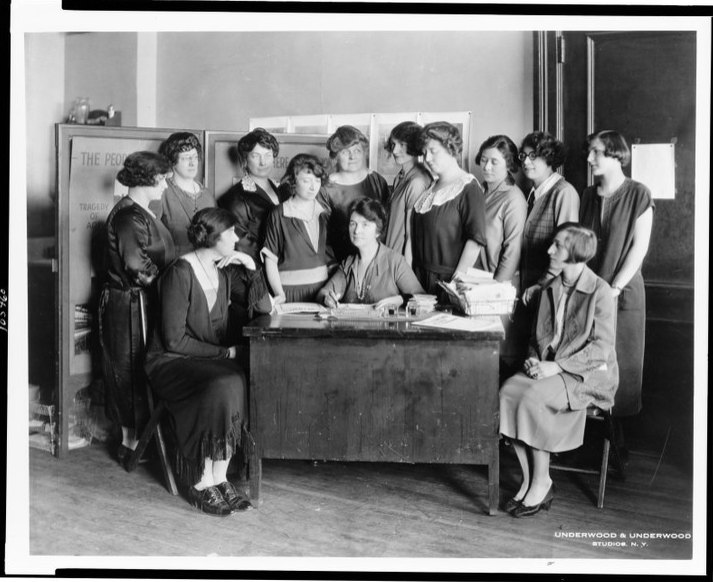
24.1—January/February 2011
How Planned Parenthood's Founder Played the Christians, and Won by Allan C. Carlson

32.2—March/April 2019
Finding Him Again Through the Patriarchal Group by Anthony Esolen
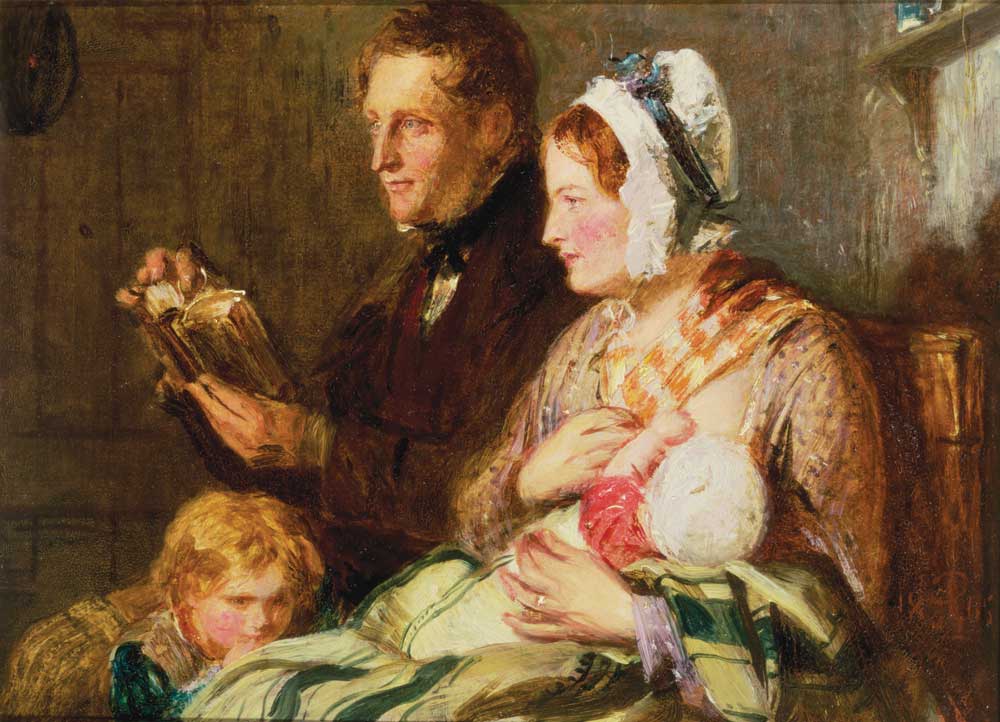
20.4—May 2007
A Short & Surprising History of Protestantism & Contraception by Allan C. Carlson
calling all readers
Please Donate
"There are magazines worth reading but few worth saving . . . Touchstone is just such a magazine."
—Alice von Hildebrand
"Here we do not concede one square millimeter of territory to falsehood, folly, contemporary sentimentality, or fashion. We speak the truth, and let God be our judge. . . . Touchstone is the one committedly Christian conservative journal."
—Anthony Esolen, Touchstone senior editor
