|
|
Subscribe to Touchstone today!
Exit WindowEveryman reviewed by Graeme Hunter Aging, growing ill, and dying are sure to be recurring themes in the years to come, as the noisy postwar generation awakens to the fact that sickness cannot always be cured, nor aging deferred, and that life’s confusing comedy has a final scene. But few will tell the story of everyman’s mortality with such cold, brief clarity as Philip Roth achieves in Everyman. Few will tell it so well. Religion, however, is written out of Everyman. Its protagonist (who is unnamed) is a militantly secular Jew.
This defiant absence of religion, however, has the paradoxical effect of making the story interesting and important for Christians, whether they know elderly people facing death without Christ, or merely want to understand what that would be like. Everyman is a window through which the challenges of such a death can be observed. An Average End The narrative begins at the protagonist’s funeral and tells in flashbacks the story of his life: how he worked in an advertising agency, had multiple -marriages, grew old. The breakdown of his body is told in clinical detail, including the planting in his flesh of alien gadgets with ugly names like “defibrillator” and “stent.” In the middle of one operation, his last, the story comes abruptly to an end. The subject has gone nowhere and become nothing, the narrator assures us. The steady focus is on one particular human body as part of the material world. Had the protagonist ever written an autobiography, the narrator reveals, he would have called it The Life and Death of a Male Body. But he never wrote such a work, having “never thought of himself as anything other than an average human being.” Mind you, the average has tilted considerably from what old-fashioned Christians sometimes think. This man has had three failed marriages, and has to deal with children from two of them. The two sons left behind from his first marriage have never forgiven him for walking out. He is amazed that they seem incapable of getting on with their lives, but is reconciled to their hatred. However, his only child from his second marriage, a daughter, sincerely loves him, and brings a note of grace into his life.
But Nancy is a single mother and has a different life to live. He sees no way to involve her in his own declining days. And in any case, what he longs for is not to be a father again, but a husband:
Everyman’s Knowledge In old age he finds himself alone with the bitter loneliness of a marital athlete who can no longer compete, “a one-time serial husband distinguished no less by his devotion than by his misdeeds and mistakes, and he would have to continue to manage alone. From here on out he would have to manage everything alone.” He has friends, but seldom sees them. He has a brother, but envy comes between them. His brother seems so much more successful, happier, healthier—fraternal affection cools. He had hoped that painting, for which he had a bit of talent, would see him through old age. And it does console him for a while. But then “the urgent demand to paint lifted; the enterprise designed to fill the rest of his life fizzled out.” Such disappointments and renunciations are signposts pointing to the end. They echo the plot of the medieval morality play, Everyman, after which Roth’s novella is named. There, too, a nameless protagonist learns that wealth, friends, kinsmen must all be left behind. Only his knowledge, at first, will accompany the medieval everyman as he creeps toward death. But knowledge leads him to confession and from there to the sacrament of penance, whereupon Everyman’s good deeds revive, enabling him to go to his death in their company. In the end we “hear angels sing,/ And make great joy and melody/ Where Everyman’s soul received shall be.” Roth’s protagonist is not received with angelic alleluias. He ends amid the whir of medical equipment and the ministrations of doctors who, ultimately, cannot heal. Letters Welcome: One of the reasons Touchstone exists is to encourage conversation among Christians, so we welcome letters responding to articles or raising matters of interest to our readers. However, because the space is limited, please keep your letters under 400 words. All letters may be edited for space and clarity when necessary. letters@touchstonemag.com Subscribe to Touchstone today!
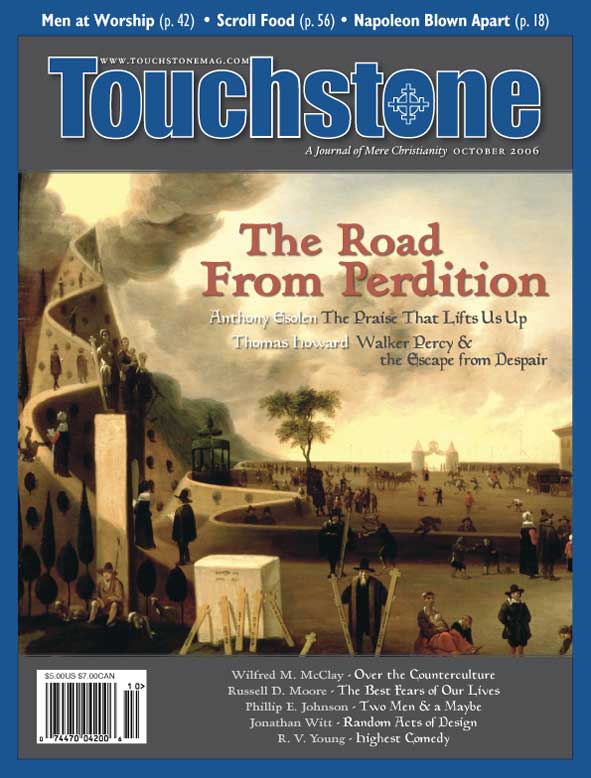
“Exit Window” first appeared in the October 2006 issue of Touchstone. If you enjoyed this article, you'll find more of the same in every issue. Click here for a printer-friendly version. An introductory subscription (six copies for one year) is only $29.95. |