




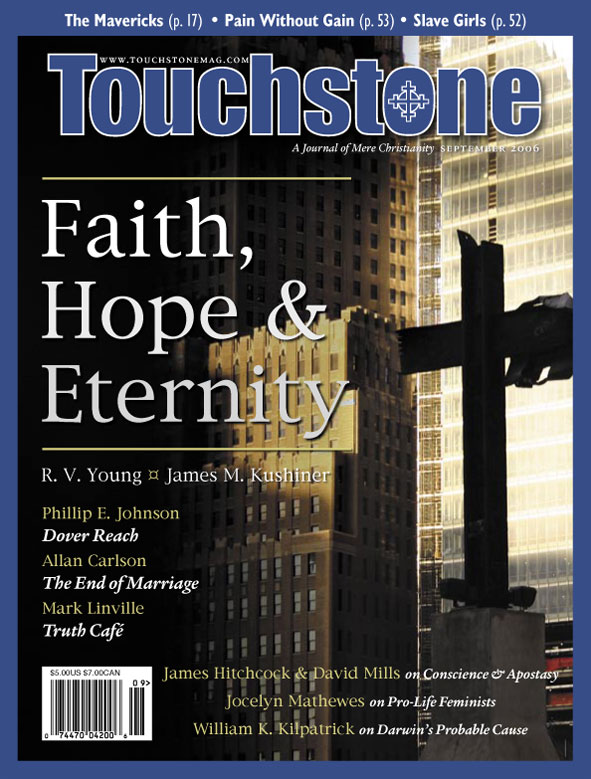
Editorial
Without Conscience
When Pluralism Means Disobedience & Rancor
The “Gospel of Judas” is rediscovered, which leads some people, and one famous magazine, to announce triumphantly that the entire New Testament story has been turned on its head. The Bible the Church has given us is fundamentally in error about Judas and the whole story of the Crucifixion, and this, along with the continually rediscovered Gnostic gospels, is taken as evidence that the original Christianity was a kinder, gentler, more informal, affirming, and egalitarian religion than the mainstream Christianity of tradition—a religion that just happens to be more congenial to modern tastes and desires.
This is an attack on the faith all Christians share, but each tradition suffers its own special trials from those of its own members who want to remake it. In some cases, these people have taken control of the church’s hierarchy. This past summer, the Episcopal Church entrenched teachings on ordination and sexual morality that would have left Thomas Cranmer in shock, while the Presbyterian Church was willing to receive and commend a report approving a variety of names for the Persons of the Trinity of a kind John Calvin would have thought self-evidently heretical.
Even those traditions thought (by outsiders) to be securely monolithic suffer similar trials. The Southern Baptist Convention has an active wing, exemplified (until he left the convention) by Jimmy Carter, that uses the ideas of “soul competency” and congregational independence to advocate doctrinal indifferentism and innovations like the ordination of women. The “Fundamentalists” are not so omnipotent as the media report.
The Catholic Church has its own dissenters, as earnest and energetic as any. When the Holy See notes that the idea of Limbo has never been official doctrine, newspapers declare that the Catholic Church has changed its teaching (with the implication that even more fundamental changes are coming) and a theologian exults that soon the doctrine of Original Sin will be abolished.
A newspaper reports that “an ordained Roman Catholic priest” has come to town, something that is noteworthy because the “priest” happens to be a woman. Several women who claim to be Catholic bishops ordain other women on a boat in Pittsburgh, and the local media play up the story as an important event in the life of the diocese, and a forceful challenge to Catholic teaching.
Theologians in Australia denounce their cardinal to the Vatican as a heretic, because he points out that “conscience” is not the ultimate criterion of truth. When the closure of a New Orleans parish is announced, parishioners complain that they are being denied the sacraments and manifest their love for those sacraments by repeatedly interrupting the celebration of Mass with jeers and threats.
The lay trustees of a Catholic parish appoint their own pastor, who serves entirely at their pleasure. The pastor in turn offers his support to a parish of the “American Catholic Church,” headed by a “bishop” who has never even been a Catholic priest, that has as one of its tenets the acceptance of homosexual activity.
Fundamental Denial
In each of these cases something fundamental to the tradition is being denied, sometimes, perhaps, without the people involved even realizing it.
To take only the Catholic examples: The church teaches that women cannot be ordained, so the woman who claims to be a priest is in fact not. The idea that “conscience” is not the ultimate criterion of truth for Catholics is not the invention of an Australian cardinal; any competent historian would consider it self-evident. If people value the sacraments, raucously interrupting the celebration of Mass as a means of protest indicates that they have little appreciation of what the sacraments even are. A congregation claims to be a Catholic church yet ignores church law in choosing their own pastor, who himself commends a church that denies important Catholic moral teaching.
James Hitchcock is Professor emeritus of History at St. Louis University in St. Louis. He and his late wife Helen have four daughters. His most recent book is the two-volume work, The Supreme Court and Religion in American Life (Princeton University Press, 2004). He is a senior editor of Touchstone.
David Mills has been editor of Touchstone and executive editor of First Things. He edits the opinion page of the Pittsburgh Post-Gazette.
A Journal of Mere Christianity—Delivered to Your Door
- Essays on theology, culture, and the Church
- Contributors from across the Christian traditions

Six print issues (one year) of Touchstone, plus full online access and PDF downloads for only $39.95.

Get a one-year full-access subscription to the Touchstone online archives for only $19.95.
bulk subscriptions
Order Touchstone subscriptions in bulk and save $10 per sub! Each subscription includes 6 issues of Touchstone plus full online access to touchstonemag.com—including archives, videos, and pdf downloads of recent issues for only $29.95 each! Great for churches or study groups.
Transactions will be processed on a secure server.
more from the online archives

23.6—November/December 2010
Darwin, Design & Thomas Aquinas
The Mythical Conflict Between Thomism & Intelligent Design by Logan Paul Gage
32.4—July/August 2019
Does Biblical Language for Man Matter? by Stephen F. Noll
calling all readers
Please Donate
"There are magazines worth reading but few worth saving . . . Touchstone is just such a magazine."
—Alice von Hildebrand
"Here we do not concede one square millimeter of territory to falsehood, folly, contemporary sentimentality, or fashion. We speak the truth, and let God be our judge. . . . Touchstone is the one committedly Christian conservative journal."
—Anthony Esolen, Touchstone senior editor
