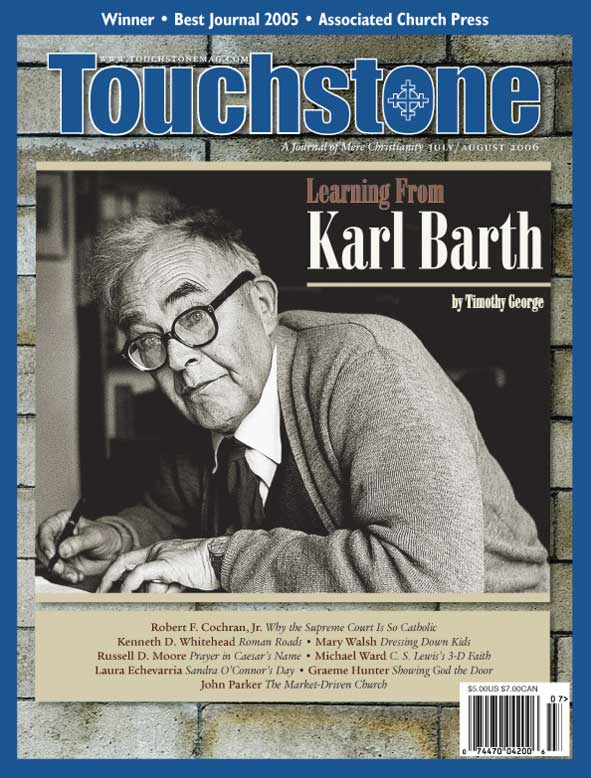
An Ecclesiastical Mind by Timothy George
An Ecclesiastical Mind
An Evangelical Appreciation of Karl Barth
by Timothy George
The Church runs like a herald to deliver the message. It is not a snail
that carries its little house on its back and is so well off in it, that
only now
and then it sticks out its feelers, and then thinks that the ‘claim of
publicity’ has been satisfied. No, the Church lives by its commission
as a herald; it is la compagnie de Dieu.
— Karl Barth, Dogmatics in Outline
I was first introduced to the thought of Karl Barth in an undergraduate course
on “contemporary” theology. We were asked to read The Word
of God and the Word of Man, a collection of Barth’s early sermons
and addresses, and though I was not then, and still am not now, a Barthian
with a capital “B,” Barth grabbed me right from the start.
Unlike Bultmann’s demythologizing and dismantling of the biblical worldview
and Tillich’s abstruse philosophy of religion—they, and a few others,
were the “canon” in those days (the sixties)—here was a theology
that spoke to the heart, that held high the revelation of God in Holy Scripture,
and that was also presented in such a provocative, passionate, and personal
way. Here was theology presented as though something eternally important was
at stake. Here was a theology that mattered.
Barth’s New World
When I began formal theological studies at Harvard Divinity School, Neo-Kantian
and liberationist paradigms prevailed there, and Barth, when mentioned at all,
was treated as only of antiquarian interest. But my doctoral studies propelled
me back to the Reformation, especially to the connection between the doctrine
of election and ecclesiology, and this in turn forced me back to Barth. I remember
plowing through Barth’s discussion of predestination in the second volume
of his Church Dogmatics and discovering there “a strange new
world” I had not encountered before.
True, I shared many of the standard Evangelical reservations about Barth,
such as his tilt toward universalism and his challenge to biblical inerrancy,
but I knew that I had something to learn from him, especially about the Church.
Even though I would not have called him “the great Church Father of Evangelical
Christendom, the one genuine Doctor of the universal Church the modern era
has known,” as the editors of the English edition of his Church
Dogmatics did shortly after his death in 1968, it was clear that I had
encountered a titanic figure whose work, I believed, Evangelicals could ill
afford to ignore.
From his early days as a young country pastor in Switzerland, Barth understood
theology as a spiritual discipline within the community of faith, “the
scientific self-examination of the Christian church with respect to its distinctive
God-talk,” as he put it at the very beginning of the first volume of Church
Dogmatics. But despite this commitment, he could be acutely critical and
negative in his statements about the Church. This was especially so in his
early writings, where the gospel is depicted in stark opposition to the Church.
The two realities cannot co-exist, for “the gospel dissolves the church
and the church dissolves the gospel,” he wrote in his Commentary
on Romans, published in 1922. “In the Church,” he declared,
the ‘Beyond’ is transfigured into a metaphysical ‘something’ which,
because it is contrasted with this world, is no more than an extension of
it. In the church, all manner of divine things are possessed and known, and
are
therefore not possessed and not known. . . . In the church, faith, hope,
and love are directly possessed, and the Kingdom of God directly awaited,
with
the result that men band themselves together to inaugurate it, as though
it were a thing which men could have and await and work for.
The Church, Barth seems to say, has become not a means to God but rather
a substitute for God, an idol. He put it like this: “Only when the end
of the blind alley of ecclesiastical humanity has been reached is it possible
to raise radically and seriously the problem of God.”
Blessed Terribleness
Failures and abuses, no matter how great, were mere trifles compared to what
in the commentary Barth calls “the blessed terribleness” of “the
Church which is the very Word of God—the Word of beginning and end, of
the creator and redeemer, of judgment and righteousness.”
In this dialectic the Church is divided into two parts: the Church of Esau
and the Church of Jacob. By this designation Barth does not refer to confessional
differences, say, between Roman Catholics and Protestants, nor to theological
camps such as conservatives and liberals. Drawing on Paul in Romans 9, he refers
instead to the distinction grounded in divine predestination.
The Church of Esau is “observable, knowable and possible,” whereas
the Church of Jacob, where the truth of the gospel triumphs over all human
deceit, is
unobservable, unknowable, and impossible . . . capable neither of expansion
nor of contraction; it has neither place nor name nor history; men neither
communicate with it nor are excommunicated from it. It is simply the free grace
of God, his calling and election; it is beginning and end.
Here we are at the headwaters of Barth’s dialectical ecclesiology.
It is not hard to see why those with a vested interest in the Church—any
church—would respond to Barth’s rhetoric with consternation and
reproach. If the Church is utterly unknowable, unobservable, so detached from
history that one cannot speak of it properly, then very practical questions
ensue: To whom do we pay our tithes (or church taxes in the state churches
of Europe)? Who shall train the church’s ministers, and how? Who shall
write the church’s liturgy, and lead its worship, and send out its missionaries,
and do its pastoral care? Such questions arise naturally for Protestants, Catholics,
Quakers, and Anabaptists alike.
It has always seemed to some of Barth’s critics that his “bifurcation” of
the Church would lead inevitably to ecclesial nihilism. But this is to miss
the deeper point Barth is making. It was necessary to be so decisively against the
Church, he believed, precisely in order to be so unreservedly for it.
Even in Romans, where the language of diastasis—positing a
Yes for every No, and vise versa—reaches fever pitch, Barth always remains
with both feet firmly planted within the physical, finite, fallen, Esau-like
church.
We must not, because we are fully aware of the eternal opposition between
the Gospel and the church, hold ourselves aloof from the church or break up
its solidarity; but rather, participating in its responsibility and sharing
the guilt of its inevitable failure, we should accept it and cling to it.
We must bear the tribulation of the Church as participant-observers. Only
through sharing its anguish are we able to pray for revival and work for reformation.
In Part Heretically
Interpreters of Barth do not agree themselves as to what extent his thought
is marked by steady development or by major breaks and new trajectories. Barth
himself pointed to some significant shifts in his thinking along the way, although
late in his life he could also claim continuity and once boasted that, unlike
Augustine, he had not found it necessary to publish a volume of retractations.
In any event, he later recognized that some of the language he had used in Romans was
a little over the top. He admitted in The Humanity of God, published
in 1960 (he died in 1968), that he had spoken “somewhat severely and
brutally, and moreover—at least according to the other side—in
part heretically.” What is clear is that he found a more constructive
way to describe the Church and its role in relation to the gospel and to the
revelation of God in Jesus Christ. “If I am a theologian,” he wrote
late in his life, “I must try to work out broadly what I think I have
perceived as God’s revelation. Yet not I as an individual but I as a
member of the Christian church. This is why I called my book Church Dogmatics.”
From the 1920s onward the image that came to dominate his ecclesiology was
that of herald or witness. To be sure, this image can be found in his earlier
writings as well. Already he had discovered Matthias Grünewald’s
famous depiction of the Crucifixion, originally painted for the chapel of a
hospice at Isenheim. Grünewald was an early sixteenth-century painter
from the Rhineland who may possibly have embraced the message of Luther near
the end of his life.
What drew Barth to this painting was Grünewald’s portrayal of
John the Baptist. John stands at the right of the cross with an open Bible
in one hand while he points with the other to the tortured figure of Christ
in the agony of death. In faded red letters behind John are the Latin words: Illum
oportet crescere, me autem minue, “He must increase, while I must
decrease” (John 3:30). In his famous typology of modern ecclesiologies, Models
of the Church, Avery Dulles has rightly characterized Barth’s approach
with the rubric, “The Church as Herald.” This image became even
more important in Barth’s opposition to the “anti-Christian counter-churches” of
Nazism.
Barth’s Real Church
After the war, in 1948, Barth addressed the first General Assembly of the
World Council of Churches, which met in Amsterdam. He spoke on the appointed
theme: “Man’s Disorder and God’s Design.” He criticized
the post-war optimism that prevailed in many ecumenical circles. “We
shall not be the ones who change this wicked world into a good one. God has
not abdicated his Lordship over us.”
One of those who listened to Barth’s remarks was a young 29-year-old
evangelist from America who had come to the assembly as a representative of
the Evangelical revival movement Youth for Christ. His name was Billy Graham.
Over the next fifty years, Graham rather than Barth would take the lead in
shaping the worldwide Evangelical movement. Barth heard Graham preach on one
occasion and referred to him as a “jolly good fellow,” but criticized
his Evangelical salesmanship. Barth appreciated the missionary zeal and vitality
of the Evangelicals, but he considered their lack of serious interest in the
Church and its theology a serious weakness.
In the same year Barth spoke in Amsterdam, he also traveled to Hungary to
deliver an important lecture on “The Real Church,” published
two years later in the Scottish Journal of Theology. It reflected
both his intense engagement with Roman Catholicism and his wider ecumenical
involvement at this time. His ecclesiology, set forth in this seminal essay,
would both compliment and challenge Evangelical understandings of the Church.
In this essay, we can identify five major themes that reflect Barth’s
thinking about the Church, themes he would continue to reflect on and develop
during the next two decades of his life.
First, the real Church becomes visible only through the power of the
Holy Spirit. Barth here sounds a note that recurs frequently in his
writings about the Church: The Church is an object of faith, as all Christians
affirm in the Apostles’ Creed, credo ecclesiam. Thus, the
Church is not like the state, the family, or the municipality in which we
live, all of which are human communities that can be defined empirically,
studied sociologically, and the like.
Although one can also study the Church as a religious community, that is,
apart from a commitment of faith, this is not the Church confessed by Christians
in the creed. That Church is an event, a happening, that can only be seen by
the eyes of faith when the Holy Spirit “enables her to step out of and
shine through her hiddenness in ecclesiastical establishment, tradition, and
custom.” Just as a neon sign remains dark and obscure until a current
of electricity floods it with color, light, and movement, so too the Church
is a lifeless form apart from the energy and vitality given to it by the Holy
Spirit.
Jesus the Head
Second, Jesus Christ is the Lord as well as the Head of the Church which
is his Body. The real Church is the congregation of lost sinners called
together by Christ and bound to him through the miracle of divine grace.
The connection between Jesus Christ and his Body on earth is genuine and
inviolable, so much so that Barth would later refer to the Church (in a very
Catholic-sounding phrase) as the “earthly-historical form of the existence
of Jesus Christ,” as he put it in
the fourth volume of his Church Dogmatics.
But the risen, ascended Christ does not surrender his lordship even to the
Body of which he is the Head. The Body is here on earth; the Head is in heaven.
The Body functions amidst the ambiguities and temptations of a world in which
the powers of darkness have not been finally vanquished; the Head abides in
the glory of the Father. What Barth is reacting against here is the temptation
to make the Church into an object of faith alongside Christ, a temptation that
needs to be resisted on both sides of the confessional divide.
In an earlier writing, an essay titled “Church and Theology,” Barth
refers to the fact that in some monastic communities the place of honor at
every mealtime in the refectory is properly furnished with tableware, linen,
and a chair which is always left unoccupied, just as at the Jewish Passover
a chair is reserved for the yet-to-come Elijah. He uses this example to underscore
the “not-yet” character of churchly existence in this present age. “God
has spoken in his Son, we are now God’s children; but ‘it
does not yet appear what we shall be’ (1 John 3:2).” The empty
chair at the table reminds the Church, the Bride of Christ, to await the return
of her Bridegroom and not to succumb to the heresy of an overly realized eschatology.
It has seemed to some Barth critics that his talk about a Christ who is in
some sense remote from the history of his community on earth—“separated
from it by an abyss which cannot be bridged”—leaves him vulnerable
to a semi-deist concept of Christ. But here, as elsewhere, Barth wants to say
both here and there.
In the fourth volume of Church Dogmatics (in the section “The
Growth of the Community”), he responds to such critics by emphasizing
the other side of this dialectic. What, he asks, “does it mean to speak
of there and here, height and depth, near and far, when we speak of the One
who is not only the true Son of Man but also the true Son of God, the man who,
exalted by the self-humiliation of the divine person to being as man, exists
in living fellowship with God?” It means, he continues,
that in the man Jesus who is also the true Son of God, these antitheses,
while they remain, are comprehended and controlled; that He has power over
them; that He can be here as well as there, in the depth as well as in the
height, near as well as remote, and therefore immanent in the communio
sanctorum on earth as well as transcendent to it.
The Word’s Creation
Third, the real Church is the creature of the Word and always stands
under the authority of Holy Scripture. As a Protestant theologian in
the Reformed tradition, Barth understands the Church to be creatura
verbi, a “creation of the Word.” He affirms the Reformation
principle of sola scriptura in the sense that the prophetic and
apostolic witness, which constitutes the content of the Bible, as inspired
and illuminated by the Holy Spirit, is the sole basis for the church’s
teaching and life.
Fourth, the real Church exists under the Cross and does not seek its
own glory. Barth’s writings about the Church can be understood
as a protest against every form of ecclesial triumphalism. The Church is
always ecclesia in via: the Church on the road, the Church under
the Cross. Thus, the real Church has no interest in vaunting itself or in
acquiring the accoutrements of worldly power, prestige, or wealth. The Church
is God’s shanty, not God’s palace. “The splendor of the
church can only consist in its hearing in poverty the Word of the eternally
rich God and making that Word heard by men.”
Such a church will be marked more by its fidelity to the gospel than its
numerical success or recognition by the media. Fresh from his appearance at
the first General Assembly of the World Council of Churches, Barth remarked
that “the smallest village church” would be more important than
the whole Amsterdam Assembly if its members acknowledge what is said about
the Church in question fifty-four of the Heidelberg Catechism:
I believe that, from the beginning to the end of the world, and from among
the whole human race, the Son of God, by his Spirit and his Word, gathers,
protects, and preserves for himself, in the unity of the true faith, a congregation
chosen for eternal life. Moreover, I believe that I am and forever will remain
a living member of it eternally.
Fifth, the real Church lives for the sake of the manifestation of God’s
grace and glory in its mission and witness to the world. The Church
of Jesus Christ was never intended to be a quarantined company detached from
the disparities and messiness of history. In a later section of the Church
Dogmatics, Barth devotes a lengthy section to “The People of God
in World-Occurrence.”
The Church that has been called out from the world, he argues, is the same
Church that is also sent back into it. In a sense, the Church might be thought
of as an advance party for the kingdom of God; in it, God’s purpose and
plan for all humanity is foreshadowed and realized in some measure. “The
community lives and grows within the world—an anticipation, a provisional
representation, of the sanctification of all men as it has taken place in Him,
of the new humanity reconciled with God,” he wrote in “Church and
Theology,” later published in Theology and Church.
As the divinely appointed herald of God’s good news to all persons
everywhere, the Church is charged with communicating God’s great “Yes” to
the world. The Church must not forget God’s “No” either,
but it must always lead out with the “Yes.” The “No” we
must speak, Barth says, will become audible enough if we occupy ourselves with
washing of feet, care for the poor, embrace of the homeless, and other acts
of service in Jesus’ name.
Eventful Witnesses
Something should also be said about Barth’s sacramental theology. He
never lived to complete his long-awaited study of the Lord’s Supper,
and there is very little about this important subject in the many pages of
the Church Dogmatics. Barth’s writings on baptism, however,
created quite a stir during his own lifetime and have continued to generate
further discussion and controversy.
In 1943 Barth published a short treatise, “The Teaching of the Church
Regarding Baptism,” in which he called into question the traditional
practice of infant baptism. In the final fragment of the Church Dogmatics, he
returned to this theme and went even further in rejecting not only infant baptism
but the last vestiges of a sacramental understanding of baptism.
Taken together, baptism and the Lord’s Supper are “eventful witnesses
to God’s righteous action in Jesus Christ,” as he wrote in Learning
Jesus Christ Through the Heidelberg Catechism, a late work. Through these
Jesus-appointed ordinances, believers receive the confirmation of their faith
and the community receives the confirmation of its origin in Jesus Christ and
its life through him.
Barth was fond of quoting a statement from the Augsburg Confession to the
effect that the sacraments of the Church are truly efficacious ubi et
quando visum est Deo, “where and when God so wills it.” In
all of his thinking about the sacraments, Barth wanted “to avoid any
suggestion that the action of the Church can be substituted for the action
of Christ through the Holy Spirit,” as the theologian John Yocum has
put it.
One further word may be said about Barth’s view of the Lord’s
Supper. In an interesting article on “Protestantism and Architecture,” Barth
suggested that at the center of an Evangelical church building there should
be a simple wooden table, slightly elevated, but distinctly different from
an altar. Attached to this table, or placed very near it, would be the pulpit
and baptismal font. This kind of arrangement, Barth thought, would demonstrate
to the congregation the coinherence of Word and sacrament.
In this sense, baptism and the Lord’s Supper are another form of proclamation.
No less than the preacher’s sermon, they, too, herald the Word of God;
indeed, sacraments are “the visible words of God.” Though he called
himself a neo-Zwinglian with reference to baptism and the Lord’s Supper,
Barth could nonetheless affirm that these two “eventful witnesses” are
not empty signs.
“On the contrary,” he writes in the fourth volume of the Church
Dogmatics, “they are full of meaning and power. They are thus
the simplest, and yet in their very simplicity the most eloquent, elements
in the witness which the community owes to the world, namely, the witness
of peace on earth among the men in whom God is well-pleased.”
Evangelical Lessons
What can Evangelicals learn from Karl Barth about the Church? Much, I think,
if we are willing to listen.
First, by grounding the Church so completely within the Trinitarian
and Christological framework of his theology, Barth presents a very high
ecclesiology, one that stands as a corrective to the rugged individualism
and “Jesus-in-my-heart-only” piety that marks too much of Evangelical
life today.
In the eternal election of Jesus Christ, God chose the Church, the community,
to be the Body and Bride of his Son. During his earthly ministry, Jesus summoned
individuals one by one to follow him and be his disciples, but he always intended
for them to follow him in the company of others. “From the very outset
Jesus Christ did not envisage individual followers, disciples and witnesses,
but a plurality of such united by him both with himself and with one another.”
Thus, Barth reminds Evangelicals of the corporate character of Christian
existence. He teaches us that the Church is not a mere option or add-on to
the Christian life, but that it is integral to the eternal purposes of God
and indispensable for faithful discipleship.
Second, Barth’s emphasis on the Church as herald or witness resonates
strongly with Evangelical perceptions. Historically, Evangelicals have
emphasized both the supreme authority of Scripture for the life of faith
and the centrality of preaching in the worship of the Church. But the Bible
is frequently praised more than used in evangelical worship and programs
of evangelism. He never forgot the connection between preaching and theology
he had learned as a young pastor in rural Switzerland, and his later sermons
to prisoners in the Basel jail show the importance of preaching not only
about the Bible, but from it.
Barth’s doctrine of Scripture has been strongly criticized by many
Evangelicals, for the disjunction he presents between revelation and the biblical
witness seems, despite his best intentions to the contrary, to open the door
to the kind of subjectivism and liberalism against which he himself reacted
so vigorously. His actual use of the Bible, on the other hand, is from an Evangelical
perspective not only extensive but exemplary.
Visible Witness
Third, Barth reminds Evangelicals that baptism and the Lord’s Supper
are powerful proclamation events, not mere rituals or optional add-ons to
the Christian life. Many Evangelicals will also appreciate what he called
his “cautious and respectful de-mythologizing” of sacramentalism,
and some, especially those with baptistic convictions, will applaud his disavowal
of infant baptism. On the Lord’s Supper, he would have done better
to follow Calvin rather than Zwingli, but even here his somewhat minimalist
theology can help Evangelicals, many of whom have an even lower view of the
Lord’s table than he did.
Barth did refer to the Lord’s Supper as the “common nourishment” of
the community of faith. He also, following Calvin, called for its weekly celebration
and once said, in Learning Jesus Christ through the Heidelberg Catechism: “Wherever
the Supper is celebrated, there Jesus Christ himself is present. And where
he is present, there the relation between God’s food and drink and the
earthly bread and wine is real.”
Fourth, Barth can help Evangelicals see that faithful witness is more
important than “visible results.” Evangelicals have sometimes
touted their commitments to mission and evangelism at the expense of a serious
interest in ecclesiology. It was Brunner, not Barth, who said that the Church
exists for mission just as a fire exists for burning, but this sentiment
matches Barth’s understanding as well. He would also remind Evangelicals
that the true missionary work of the Church is about more than “drawing
large crowds and enjoying success,” and he would surely chide the Evangelical
church for its penchant to produce “propaganda on behalf of its own
spatial expansion” rather than an unadulterated witness for the gospel.
It is hard to imagine his reaction to a few hours of American televangelism.
Finally, Barth can help Evangelicals appropriate the riches of the wider
Christian tradition without sacrificing their Reformation heritage. Barth
increasingly found genuine Christian fellowship and theological comradeship
more easily among his Catholic contemporaries than with his mainline Protestant
colleagues. While I would fully expect him to be critical of various joint
statements issued by Evangelicals and Catholics in recent years, I also believe
that he would rejoice that this conversation is taking place, and that he
would encourage its continuation. He would hope, I believe, that such an
engagement would—when and where God so wills it—transform both
communities in the interest of the one and only gospel of Jesus Christ and
for the glory of God alone.
In a short piece Barth wrote shortly before his death, “Starting Out,
Turning Around, Confessing,” published in Final Testimonies, he
wrote that “the distinctive mark of this one movement of the church” is
taking place or is visible today in the Roman church, or I would prefer
to say, the Petrine Catholic and the Evangelical Catholic confessions—for
we are Catholic too. For the moment it is surprisingly more visible and
even spectacular in the Petrine than in the Evangelical confession. But however
that may be, there is this one movement of the one church, in our case
of the
two confessions.
Uneasy Tension
Going to church with Karl Barth can be good for the Evangelical soul. His
ecclesial theology can help Evangelical believers in search of a sturdier doctrine
of the Church to move beyond the mere functionalism of “how to” Christianity
that American Evangelicals have mastered, and are in danger of being mastered
by.
Evangelicals may visit Basel on their way to Canterbury, Wittenberg, Rome,
and Constantinople, and perhaps even Schleitheim, knowing that the ultimate
goal of such a pilgrimage is none of these but rather that City that hath Foundations.
Such an Evangelical ecclesiology will be good not only for Evangelicalism’s
soul, but for that of Christianity itself.
Throughout history, the Church has always lived in uneasy tension between
the poles of identity and adaptability. The Church can, and often has, shipwrecked
on either side of this divide. By emphasizing identity so strongly, the Church
can become a holy huddle, cut off from its environing culture and bereft of
any sense of urgent mission to the world. Evangelicals have sometimes succumbed
to this temptation, resulting in separatism, fundamentalism, and isolation.
Today the greater danger is at the other extreme. In the valid concern for
reaching out with the good news of Christ, the Church has taken on board too
much of the world’s agenda. It has become too accommodated, even assimilated,
to the spirit of the age and in the process is in danger of losing its very
soul.
If he were here today, Karl Barth might refer the Evangelical church to these
words from his explosive commentary on Romans, originally addressed
to a situation perhaps not entirely different from our own:
He who hears the Gospel and proclaims it . . . knows that the church means
suffering and not triumph . . . He sees the inadequacy of the church growing
apace, not because of its weakness and lack of influence, not because it
is out of touch with the world; but, on the contrary, because of the pluck
and
force of its wholly utilitarian and hedonistic illusions, because of its
very great success, and because of the skill with which it trims its sails
to the
changing fashions of the world.
“The Real Church” was published in The Scottish Journal of Theology
in 1950 (pp. 337–353). “Protestantism and Architecture” can
be found in Theology Today, July 1962 (http://theologytoday.ptsem.edu/jul1962/v19-2-criticscorner2.htm).
Yocum’s comment can be found in his Ecclesial Mediation in Karl Barth.
Timothy George is dean of Beeson Divinity School of Samford University (www.samford.edu) and an executive editor of Christianity Today (www.christianitytoday.com). A different version of this essay is appearing in Karl Barth and Evangelical Theology, edited by Sung Wook Chung, forthcoming from Baker Academic. |