
Moderns Forever Be Holden by Douglas Jones
Moderns Forever Be Holden
J. D. Salinger's The Catcher in the Rye
by Douglas Jones
I’m the most terrific liar you ever saw in your life. It’s awful.
If I’m on my way to the store to buy a magazine, even, and somebody asks
me where I’m going, I’m liable to say I’m going to the opera.
It’s terrible.” That voice, that distinctive voice of sixteen-year-old
Holden Caulfield, confessing and sinning, tripping and announcing, produced
more fictional grandchildren in a short time than any bodily grandfather could.
Holden Everywhere
Holden is now everywhere. Short stories. Stage. Commercials. Novels. Big
screen. Home. Every contemporary writer can speak Holden Caulfield, even those
who have never read of him. Holden is a dialect. In 1951, the year J. D. Salinger’s The
Catcher in the Rye appeared, the literary critic T. M. Longstreth prophesied, “Fortunately,
there cannot be many of him yet. But one fears that a book like this given
wide circulation may multiply his kind.”
In some ways, that’s a compliment to Salinger: Something he created
became pervasive. In another way, it’s an insult: His art is easily imitated.
Hemingway and Joyce face the same problem; Shakespeare and Dostoevsky don’t.
So many social factors have to mesh at the right moment for an artwork to
dominate a culture like this, for even a brief moment of decades. Salinger’s
novel accomplished this by precisely expressing the secular theology of our
time, modern gnosticism.
On the surface, Salinger gave us the believable rebelwithoutaclue that
teens longed for. Critic Fred Batman said of his first reading at sixteen, “I
was simply dazzled. I thought the book had been written especially for me.
. . . Holden has also been a personal savior of sorts.” He speaks for
many.
Indeed, the novel is usually summarized as a characterization of how Holden
is torn between two worlds, the tense transition everyone faces between childhood
and adulthood. But in Holden, Salinger unwittingly captured the two paradoxical
dogmas of twentieth-century gnosticism: sentimentalism and cynicism, perfectionistic
idealism and hostility to common, material life.
For the gnostic, ancient or modern, spirit is the purity that produces a
faux childish, spiritual, unearthly innocence, and body is the evil that produces
the unspiritual, earthly, practical, civilized, and adult. The twentieth-century
gnostic regularly denounces evil and injustice in life because it doesn’t
fit his view of Edenic reality, all the while insisting that life is ugly and
not worth living. He associates spirit with innocent childhood, body with evil
adulthood. Thus, he simultaneously resents and embraces evil. Holden Caulfield
is modern gnosticism’s poster boy.
Kicked out of an expensive prep school yet again, and afraid to tell his
Manhattan parents, Holden delays his return home by trying to party around
town. His voice opens the novel in fine modern style, cutting himself off from
the past: “If you really want to hear about it, the first thing you’ll
probably want to know is where I was born, and what my lousy childhood was
like, and how my parents were occupied . . . but I don’t feel like going
into it. . . . In the first place, that stuff bores me.”
And in New York
Before leaving school for good, Holden visits an old instructor but soon
becomes annoyed with him. Back at his dorm, he struggles with acquaintances
and his roommate, with the latter finally bloodying his nose. He heads off
for New York and checks into a hotel.
In the city, he spends most of his time trying to connect with young women
by phone and dance and bar, but they all end up dropping him. He turns away
a prostitute he ordered and is forced to pay more. He runs into some nuns,
and they impress him, but the only person he can stand to be around is his
ten-year-old sister Phoebe.
He sneaks into his home and wakes Phoebe—a voice of adult wisdom. She
tells Holden, “You don’t like anything. . . . You don’t like
a million things. You don’t.” He likes Phoebe, he says, and he
really likes the picture expressed in an old song that speaks of thousands
of kids running about a rye field near a cliff, and how “I have to come
out from somewhere and catch them” to save them from falling, all day
long. Phoebe tells him he got the wording mixed up: It’s not “catcher
in the rye” at all, an irony that shows how shallow are his dogmatism
and dreams.
Holden visits his former English teacher, but interprets his teacher as making
homosexual advances. He sends a note to Phoebe announcing that he’s running
away and asks to meet her. She insists on joining him, but he refuses. He gets
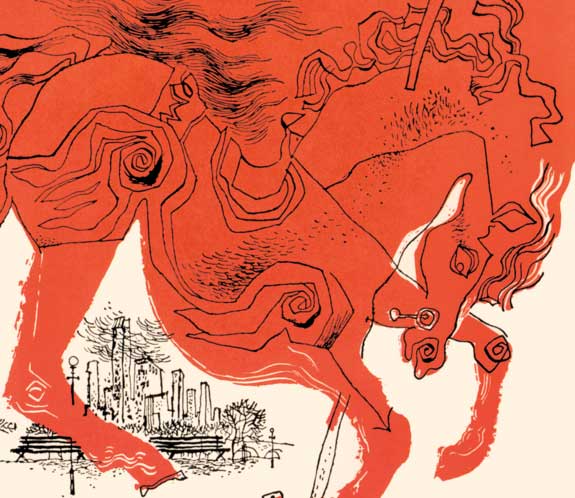
her interested in a carousel and delights in watching her ride: “I felt
so damn happy all of a sudden, the way old Phoebe kept going around and around.”
The novel closes with Holden refusing to give us all the details of how he
became “sick” after that, but he says the psychoanalyst at the
institution keeps asking annoying questions.
The Phony War
Throughout the novel, Holden famously declares himself at war with phoniness,
a war against life’s common compromises and messy interactions. His idealism
lifts him above actual life to a seat of pristine judgment. “It was one
of the worst schools I ever went to. It was full of phonies. . . . Even the
couple of nice teachers on the faculty, they were phonies, too.”
But the people he criticizes aren’t villains, just regular people trying
to persevere through confusions. Holden resents anything that doesn’t
match his naïve and perfectionistic demands. As literary critic Sanford
Pinsker surmised, “Holden is too moral for the world.”
Not exactly. Holden’s war against phoniness reveals his assumption
that his life and life in general is wholly innocent, that he still dwells
in some unfallen moral state, Edenic, childlike, and happy. Hence, any evil
or imperfection he sees is unjust, an intrusion into Eden. Evil has no rightful
place in Holden’s life, and so he has no category for sanctification
or chastisement, or maturity.
So Holden and millions of other moderns learn at a very early age to simply
resent evil, to despise all ugliness, but not to face evil, including the evil
in themselves. For Holden, evil can never be an obstacle, because he is innocent.
Holden, like other moderns, portrays this resentment of evil as a sensitivity
to all suffering, but it is a sensitivity, a deadly tenderness, that kills
maturity. Flannery O’Connor wrote at the same time as Salinger, and
she often complained about the sentimentalism of the times, noting that “sentimentality
is a skipping of this process [Christ’s cross] in its concrete reality
and an early arrival at a mock state of innocence.” Holden expresses
this gnostic, “mock innocence” precisely.
The Catcher in the Rye, then, works wells as a catechism for moderns.
This story and Holden’s famous voice stick in the memory. The story moves.
It creates personalities. It teaches its disciples how to live in the gnostic
paradox of sentimentalism and cynicism, childish idealism and hatred of life.
Deadly Tenderness
In contrast to Holden’s sentimentalism stands his cynicism. Where sentimentalism
sees reality as fundamentally innocent and clean, a pastel nursery, cynicism
sees evil and ugliness in everything. It is the conspiracy buff’s chosen
vision. Everything is so depraved that no good can overcome evil. Whereas sentimentalism
is optimistic about the future, cynicism sees it all decaying.
We find Holden’s sentimentalism and cynicism nicely intertwined in
the passage that describes his first night at the Edmont Hotel. He looks out
his window dualistically, selfrighteously denouncing the people he sees, all
the while drawn by the dirtiness of the body. The body is simultaneously inferior
and enticing. Looking into another room he sees
a man and a woman squirting water out of their mouths at each other. It
probably was highballs, not water, but I couldn’t see what they had in their glasses.
. . . You should’ve seen them. They were in hysterics the whole time,
like it was the funniest thing that ever happened. I’m not kidding,
the hotel was lousy with perverts. I was probably the only normal bastard
in the
whole place. . . .
“The trouble was, that kind of junk is sort of fascinating to watch,
even if you don’t want it to be,” he continues.
In my mind, I’m probably the biggest sex maniac you ever saw. Sometimes
I can think of crumby stuff I wouldn’t mind doing if the opportunity
came up. . . . The thing is, though, I don’t like the idea. It stinks,
if you analyze it. . . . It’s really too bad that so much crumby stuff
is a lot of fun sometimes.
Holden has no categories for holy sexuality. He can identify perverts, and
he’s enticed by “crumby” sexuality, and yet it all “stinks.” He’s
innocent and yet tainted by body.
This clash of sentimentalism and cynicism doesn’t arise naturally in
every life. And it certainly ought not be a perennial part of everyone’s
growing up. It nicely captures a recent dilemma, but it’s a huge stretch
to claim, as does Pinsker, that Holden “is perhaps the most rounded,
most affecting portrait of a sixteen-year-old American boy we shall ever have.” Much
too much. It’s that claim of eternity that sticks in the throat; the
book captures the mind and ideals of a few decades, and that’s it.
Quaint Holden
Though for many readers like Pinsker, Holden is a universal man, a man in
whom we can recognize ourselves, he is a very parochial, not universal, figure.
Salinger doesn’t really give us the “perennial confusions of adolescence.”
A thousand years from now, the modernity he expresses will merely be a several-century
fad. Holden will be to readers then as trivial as an early Gnostic prophet
is to us, a quaint archetype of a short era. Alyosha and Dmitri and Frodo will
still stand, but our descendents will have a hard time remembering the characters
who represented modernity’s ideal.
The Catcher in the Rye is a powerful morality tale for a certain
fading mythology, and as such, it provides a convenient model for moderns raising
themselves, which explains why Holden is now everywhere. They can absorb him
and get direction on how to feign profundity, honesty, and angst, and conveniently
both resent and embrace evil. Colleges are still full of them marching in lockstep
individuality.
Douglas Jones is senior editor of Credenda/Agenda magazine (www.credenda.org)
and a fellow of philosophy at New St. Andrews College in Moscow, Idaho.
|