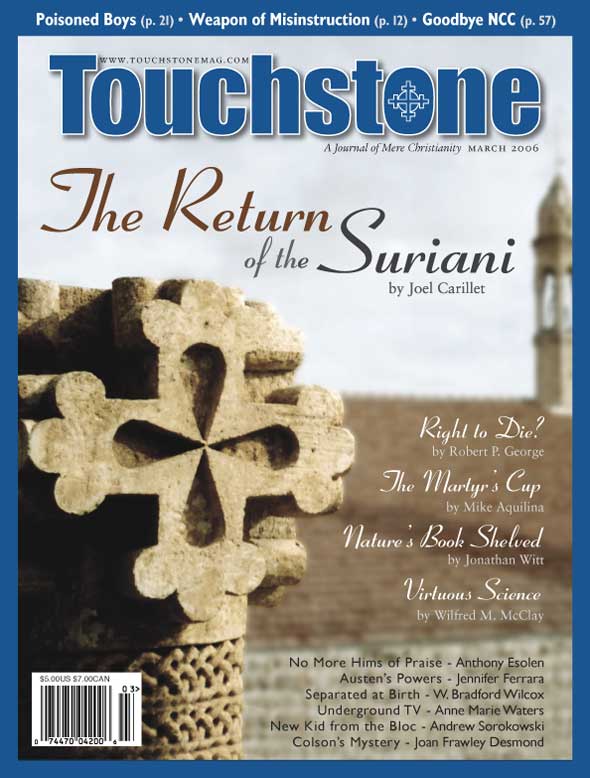
The Return of the Suriani by Joel Carrilet
The Return of the Suriani
A Visit to a Christian Minority in Turkey That Refuses to Die
by Joel Carillet
On a plateau of barren hills in southeastern Turkey, bordering the Tigris River
and Syria, sits the historic heartland of the Syrian Orthodox Church, Tur Abdin.
In his 1994 book From the Holy Mountain: A Journey Among the Christians of
the Middle East, the English writer William Dalrymple predicted that Tur
Abdin’s Christian community, known as the Suriani, would vanish within a generation.
At the time, his prediction made sense.
Breaking Community
Dalrymple was writing at the end of a century in which the Suriani had suffered
staggering losses. During the Armenian genocide around the time of the First
World War, their numbers shriveled as they faced deportation, starvation, and
massacre. According to Dalrymple, the Suriani population had been 200,000 in
the nineteenth century, but fell to 70,000 by 1920. A few years later the Syriac
patriarch himself, whose seat had been in Tur Abdin for more than 600 years,
was forced to relocate to Damascus.
During the 1980s and 1990s, the brutal conflict between the Turkish government
and the PKK, a Kurdish separatist movement, raged throughout southeastern Turkey,
claiming an estimated 30,000 lives. Another group, the Kurdish Hezbollah (not
to be confused with the Lebanese party of the same name), actively harassed Christians;
there were reports of girls being kidnapped to marry Muslims and of a monk being
kidnapped for ransom.
In the three years following Dalrymple’s visit, 65 Suriani were killed,
mainly by the PKK and Kurdish Hezbollah. The violence, military curfews, and
a dismal economy squeezed the Christian community to the breaking point. By 1990
the population had shrunk to 4,000, by 1994 to 900. Most monasteries were abandoned;
the few that remained were barely staffed. Villages were given up as entire communities
moved to countries such as Germany and Sweden.
In December 2004 I went to Tur Abdin to see this dying church before it was too
late. I needn’t have rushed.
Darkness Broken
It was bitterly cold as the minibus ascended onto the Tur Abdin plateau, leaving
behind the early morning fog that lifted off the Tigris. Snow lay on the roofs
of Kurdish villages and in the fields, but precipitation wasn’t the only
thing on the ground. Soldiers on foot patrol, one group backed by an armored
personnel carrier, trudged along the highway. I had read that a few weeks earlier,
thousands of police, backed by tanks and helicopter gunships, carried out a weeklong
siege of Kurdish rebels hiding in cotton fields outside the city of Diyarbakir.
In the afternoon I reached Mar Gabriel, a monastery founded in A.D. 397 and the
first of three that I would visit. I entered the compound’s fortress-like
walls and asked permission to spend the night. Referring to my backpack, a layman
employed at the monastery said, “We can’t turn you away with such
a heavy burden.”
Evening vespers were held in a room built in A.D. 512, making it one of world’s
oldest functioning churches. Inside the stone walls darkness was broken, just
barely, by two candles. The congregation of monks, nuns, and students—about
25 people—chanted together in Aramaic, the language of Jesus. The archbishop
stood before the congregation wearing a robe that has changed little in over
a thousand years. The entire setting was like having stepped out of a time machine,
a lesson in the history of the Church well before Christians ever made it to
America and thought up things like seeker-friendly services.
But what struck me most was how they prayed: on their knees, faces to the floor.
It was a form of prayer that demanded something of the body and not just the
mind. And it was also a reminder that when Islam was starting out, it borrowed
much from Christianity. Except for the sign of the cross, which the congregants
made between prostrations, and the presence of women in the same rows as men,
this prayer could have been in a mosque.
Uncounted Suriani
Boiled chicken, rice, bread, salad, and a bowl of beans were served for dinner.
Eleven of us sat at the table, including the archbishop of Tur Abdin, who resides
in the monastery, and the Syriac bishop of Mosul, who had made the drive from
Iraq that afternoon and was en route to Damascus, stopping here to spend the
night. The two bishops spoke like old friends. The border between Iraq and Turkey,
a twentieth-century creation, suddenly seemed like the young thing that it was,
cutting through a much older Christian community that for most of its history
knew no such boundary.
Adjourning to the parlor, where a wood stove graciously broke the winter chill
that clung to all the other stone rooms, everyone drank tea and dipped into a
plate of assorted nuts picked from the monastery’s fields. The men spoke
Turoyo, a modern dialect of Aramaic that is still the first language of the Suriani
(the bishop from Mosul spoke a different dialect of Aramaic and occasionally
required a translator). The only other sounds in the room were the crackling
of fire and the clicking of prayer beads, which many of the men thumbed through
their hands.
I asked the archbishop how many Suriani remain in Tur Abdin. “We don’t
know, we don’t count them,” he said bluntly. Others, however, later
offered me numbers ranging from 2,000 to 5,000. Consistent figures would prove
elusive, but one thing was clear: The numbers in Tur Abdin were increasing; the
disappearance Dalrymple predicted no longer looked inevitable.
The next morning I toured the monastery. There was so much history, but what
struck me was the renovation in progress. Muslims from nearby villages, paid
by the monastery, were chipping away old mortar from between the stones and filling
the gaps with new mortar. Other renovations had already been completed, and Mar
Gabriel did not feel like a dying outpost. Things that die can still leave nice
buildings behind, I knew, but the construction here was a testament to hope.
A Remote Warmth
Suriani children attend Turkish public schools, but each day after classes end
many reconvene at a monastery or church to study their history and language.
It was to a church in Midyat, a town 15 minutes away from Mar Gabriel, that
I went late in the afternoon and sat in a room where students were completing
their Aramaic assignments. Outside on the streets snow stood in dirty piles,
unable to melt in the freezing temperatures.
Class was over at 5:00 P.M., after dark, and I piled into a van with six students
who live in the monastery of Mar Yacub, where I had been invited to spend the
night. We shared the van with several Kurdish families who live in the village
beside the monastery. It was a crowded affair, with much laughter and warmth.
Mar Yacub, founded in A.D. 419, was in the midst of a blackout when the children
and I were dropped off outside its imposing gates. There were stars above, and
for a moment I thought this could be the year A.D. 700: a Kurdish village, an
old monastery, kids discussing in Aramaic how to get beyond the locked gate.
Based on the remoteness, I had expected a dilapidated, frigid stone cellar of
a place, but I was instead led to a beautiful living room where Father Daniel,
one of three monks in residence, and three children, all around 12 years old,
sat on comfortable sofas near a wood stove watching a Turkish sitcom on a Sony
television. Exhausted, I sank into the coziness of the room.
When the nuns called us to dinner, the sitcom had the children’s interest
piqued, sparking a moan when Father Daniel cut the television. But it was the
sound of disappointment rather than complaint. For dinner, after everyone prayed
together in Aramaic, we dipped pancakes into a syrup and oil mixture, and the
nine children who live in the monastery spoke to each other with muffled voices.
Back in the living room after dinner the students were allowed to watch one more
show and then, without prodding, filed out to do their homework. Rarely had I
seen children who seemed both so happy and obedient.
A Monk’s Home
Father Daniel had a lay assistant, Sefir, a gentle 29-year-old Suriani who grew
up in Istanbul. His parents were originally from Tur Abdin, and for two and a
half years he has been back, learning to read and write Aramaic as well as work
with the children, who are all either Suriani from outlying villages or, in some
cases, sent here from Europe by their parents in order to learn their history
and language. Sefir told me that Salah, the village we were now in, had 30 Christian
families in 1965, but now only one remains. Almost all the others went to Germany.
Father Daniel, now in his mid-30s, was 15 or so when his family—both parents,
two sisters, and three brothers—moved to Germany. He, however, chose to
stay behind. When I asked why he replied simply, “This is my home.” When
he was 23 he decided to become a monk.
I asked how Kurdish-Christian relations are today. “Now is better than
15 or 20 years ago, but tomorrow we can’t say.” His was a perspective
informed by history, by a one-day-at-a-time philosophy.
Father Daniel had the remote and flipped through several channels before settling
on Suroyo TV—two hours of Syriac programming beamed each evening from Sweden.
With this we finished the evening.
Early the next morning I rode with the students back to Midyat. The high-school
students were dropped off first. Next we should have gone to the middle school,
but the students urged our driver to go first to the bus stand so they could
personally escort me to the vehicle that would take me on to my final destination.
I had arrived at Mar Yacub feeling depressed that just a handful of boys and
three monks lived there. But they themselves were not depressed, and I left with
much hope. The youth, boys of solid character, witnessed to the community’s
determination to maintain a presence in the land.
Unimaginable Worship
Through a frosty window, in a van with well-bundled Kurds and Arabs, I looked
out at the countryside as we approached Mardin. The city had been without a bishop
since 1969, but much to the joy of Mardin’s 75 to 80 Suriani families,
an Oxford-educated Suriani had recently been appointed to the post.
While the Suriani are the bulk of Mardin’s Christian population, there
are also several Armenian and Chaldean families. Since they have no priest, they
worship with the Suriani, something that would have been unimaginable in centuries
past. As one monk told me, the theological differences that once divided these
churches are no longer an issue.
Kurdish farmers gave me a lift on their tractor to Deir Zafaran, which lay a
few kilometers to the east of Mardin. Father Stefanos, a 25-year-old monk born
in Sweden, received me warmly. Dedicated to his tradition—he moved to
Syria when he was 13 to study Syriac and theology, became a monk at 19, taught
Syriac at a Syriac monastery in Germany, and now teaches Syriac to students at
Deir Zafaran—he also warmly affirmed my Christian faith as a Protestant.
Knowing that many ancient churches are unhappy with Protestant churches in their
historic domain, I asked what he thought of the Protestant church in Diyarbakir,
which is not far from Tur Abdin. “We are all Christians,” he said. “I’m
happy they are there.” Then he grew excited: “Their missionaries
are effective in Turkey—there are converts among the Muslims.” He
was also glad to hear that thousands of Kurds have asked the Protestant church
in Diyarbakir for Bibles. “Even if Kurds don’t become Christians,
it is good they are learning about our faith. I am now reading the Koran for
this same reason.”
Father Stefanos was a hopeful personality. Perhaps this was because he was younger
than most other Suriani I spoke with, or because hopefulness is in the nature
of an immigrant, especially one who has left the West to return to the East.
From the roof of the monastery, he looked glowingly over the landscape. “Before,
things were very bad. Now the government provides us free water, it has paved
the road to the monastery, it asks us what we need.”
In the last several years the government had also abolished the law prohibiting
the teaching of minority languages, thus enabling the monasteries to teach Syriac
without fear of retribution. And in the summer, hundreds of tourists, sometimes
thousands, visit the monastery in a single day. Most of these are Turks, and
Father Stefanos was keen to point out the value of having Turkish Muslims exposed,
in a positive way, to the Syriac community.
The greatest sign of hope—and this is perhaps the key development that
has undermined Dalrymple’s prediction—is that Syriac communities
in Europe are sending people back to Tur Abdin. Over the decades, as villages
in Tur Abdin emptied and people found new homes in Europe, especially in Sweden
and Germany, the village communities kept in contact through regular reunions.
Today, these reunions are often venues for the Suriani to discuss ways to support
the return of some families and to collect money to rebuild churches and houses
in their former village.
And the Turkish government is helping. In many abandoned villages, Kurds have
moved in and are not always receptive to the return of Suriani. Stefanos shared
an example from one village in which several Kurdish families were hostile to
a returning Christian family. The Turkish government warned them to stop their
harassment. When they refused, the government relocated the Kurds.
“Twenty to twenty-five families have returned in the last several years,” Father
Stefanos said with a focused gaze as I snapped a picture of newly renovated guest
quarters, beyond which stretched the vast plain of Mesopotamia. “More are
coming.”
New Freedoms
History evolves. I thought this in front of the Digiturk satellite dish built
into the wall of Mar Gabriel.
I thought it, too, when I stood outside an old chapel at Deir Zafaran and watched
Father Stefanos awkwardly explain that more than a thousand years ago “this
chapel was for the slaves because the monks worshipped separately, but this is
an old tradition and we would not do this anymore.” And I thought it inside
Deir Zafaran’s monastic cells, which were under renovation: The showers
being installed were equipped with built-in radios that picked up Turkish pop
songs—something the seventh-century founders would never have envisioned.
In its quest for membership in the European Union, Turkey has loosened restrictions
on its minorities, and the Suriani are enjoying their new freedoms. The Suriani
have also received the increased attention of Western politicians. The month
before my visit, Prince Charles had visited Deir Zafaran, and the US ambassador
to Turkey, European parliamentarians, and others have stopped in as well.
Father Stefanos offered me a cup of tea before escorting me to the road. He was
upset that there was no one to give me a ride back to Mardin, but I assured him
it was a good day for a walk. And indeed it was—a newly laid road with
a bright white stripe down the middle; a sunny, blue sky with a smattering of
clouds; a cup of tea and fellowship still fresh in my mind. Just before we said
goodbye, Father Stefanos said one last thing, “When you get to Mardin you
should visit the churches.”
Two hours later, in the courtyard of Mardin’s Church of the Forty Martyrs,
four young girls giggled at my approach and then yelled, “Marhaba!” I
asked their names. One was Jennifer, a nine-year-old Suriani, and the other three
were her Muslim friends. Around the church was last week’s snow, shoveled
into massive piles that looked as if they would last forever.
But at the base of each, water trickled in tiny rivulets down the stone alleyways.
In more ways than one, a thaw was in the air here in the old heartland of the
Syriac Orthodox Church. Tur Abdin, it seemed, was the one place in the greater
Middle East where the ancient Church, rather than shrinking, is expanding.
Tur Abdin is part of the least-developed region of Turkey, and Christians here
will continue to face tremendous economic challenges. Also, the violence between
Kurds and government forces, which declined significantly in recent years, has
flared up again, and, to paraphrase Father Daniel, no one knows what tomorrow
will bring.
But for the first time in their history, the Suriani are feeling valued rather
than grudgingly tolerated by the Turkish government. And unlike a visitor a decade
ago, who would have found a vanishing church, today’s guest will witness
a tenacious church, one that is scarred and facing daunting challenges, yes,
but one that is facing them with new hope.
Joel Carillet has worked in Egypt and Israel/Palestine, including six months with the World Council of Church?s Ecumenical Accompaniment Programme in Palestine and Israel. At the end of 2004 he completed a fourteen-month backpacking journey across Asia and is now writing a book about the trip. He is a member of the Christian Churches/Churches of Christ. |