The Well-Connected Mother by Juli Loesch Wiley
The Well-Connected Mother
The Centrality of Motherhood Is Not Just an Idea
by Juli Loesch Wiley
We get mothering wrong sometimes. We get it wrong with sexism and with feminism.
We get it wrong with sentimentality and utopianism and cruelty. And when we
get it wrong, a conversation about one good mother can help us get it right
again: a conversation about the Mother of God—she who is more honorable
than the Cherubim and more glorious than the Seraphim, as the ancient hymn
put it—as a pattern and prescription for all human motherhood.
Bodily Connectors
Motherhood starts with conception. Pope John Paul II said that the
Annunciation, the conception of Jesus in the womb of Mary, is a high point
not only of the history of the human race but of the universe. At the Annunciation,
the Word became flesh, became flesh in the body of a woman. This reminds me
of how women’s bodies are different from men’s, and what this meant
for Mary and what it means for us.
Men are often tempted to think that their bodies were made for their own
use. To a great extent this is true for everyone: Your hands, sir, are yours,
they are for your use, and mine are for my use. A man can indulge this illusion
of autonomy even further by supposing that even his genitals are there for himself. They’re
a source of at times almost compelling drives and intriguing sensations. Even
his testes are useful for him, in that the hormones they produce
provide certain secondary sexual characteristics he has an interest in maintaining.
But a woman’s body has all these nooks and crannies which are no use
to us but evidently were put there for someone else. Don’t
get me wrong: We women have our pleasure doodads and our own hormonal self-interest
as well. But then, well, there’s the womb. That’s not there for
me. I can do without it. It was obviously put there for someone else. The same
is true of mature mammary glands, rich with branching ducts and reservoirs,
as they are found in nursing mothers and as they are not found in
childless females, however nubile and Partonesque they may be.
Our female bodies are connectors: Inter-connectedness is not just a concept,
it’s built into us. This gives us the sense that we find in Mary’s Magnificat, of
being, within our own bodies, the living link between past and future: “Behold,
all generations will call me Blessed. . . . His mercy is on those who fear
him, from generation to generation. . . . As he spoke to our ancestors, to
Abraham and to his posterity forever.”
Mary sees ancestors past, and posterity future, linked in the center of her
being. Her person—her body, her soul, her faithful heart—is the
connector. She who is more spacious than the heavens. This makes autonomy,
as an ideal, a poor fit for women. Women have a special gift, even a genius,
for bondedness.
In conception and pregnancy, the mother and the child form a kind of multi-personed
continuity. They are kaleidoscopically interdependent. To me, it is somewhat
perverse even to imagine a pregnant woman and her unborn child separately.
I saw an ad in a Christian magazine for a book called The Wondrous Story
of Where Babies Come From. The cover shows the bold and Crayola-colored
image of a human embryo projected, as it were, on a huge movie screen, while
a stereotypical Mom, Dad, and Two Kids gawk and point. All I could think
of was some low-concept science fiction movie (“K-K-Kevin, Look! The
Killer Embryo From Mars!”)
It had none of the heart-catchingly fragile and translucent beauty of a real
embryonic child, and worst of all, there was no sense that it was inside of
a woman. The woman had disappeared. It was not wondrous. It was monstrous.
Sexual Injustice
In any case, if Light-Saber Bulgy-Muscle Action Figures express some aspect
of the masculine—and they do, at least, for my half-grown sons—the
corresponding image for the feminine would be the Matreshka doll: babies inside
of women, people inside of people, generation nestled in generation. Autonomy?
I don’t see it in me. But I do see another paradigm: “Trinity.” A
multi-personed continuity. The Supreme Being who is always giving, and always
receiving, the Love which is himself. For love is the only power that can unite
persons without destroying them.
It seems to me that when a woman marries a man, she has a right to expect
children—or at least an honest go at it. I had a friend, Callie, with
two children, Mark and Sophie, 5 and 2. Callie was a fine homemaker, the picture
of happiness nursing her strong and vigorous little daughter, and obviously
good at mothering. One day she told me she felt blue, because she knew Sophie
was her last. After her, there would be no more babies.
“Callie, that’s so sad. What’s the problem?” I asked. “I
always wanted four kids or so,” she told me, “but Burt (that’s
her husband) only wanted one. I kinda sneaked past him with Sophie. But when
she was born, he insisted that I should have my tubes tied.”
Tubes tied at 28. Her eyes brimmed up, and I could feel the tears start in
my own eyes too, tears of sympathy, but also tears of anger. It’s as
if her husband, instead of saying to her, “Callie, I dearly cherish what
you are as a woman, a wife, and a mother,” had said, “Honey, I’d
like you a lot better if I could get you surgically disabled. Motherhood? Let’s
cut that out right here. Let’s cut you down to size.”
I know two dedicated activists in the pro-life movement whose private grief
was that their husbands refused to let them have children. These women—I’ll
call them Susan and Rose—were attractive, warm women who would not submit
to sterilization or to contracepted sex, so their husbands refused to have
sexual relations with them at all. I was deeply saddened to learn that it was
possible for things to be that way between husband and wife. I wonder how widespread
this could be?
For any married person, husband or wife, to refuse his spouse children is
a shocking injustice. For a husband to tell his wife, “I hereby condemn
you to have no more babies for the rest of your natural life,” is to
strike a humiliating blow to her sexual identity. If the child-rejecting spouse
intended from the beginning to deny his partner’s reasonable right to
children, surely this would be grounds for annulment!
Stunning Fertility
I have a lot of stories. I used to do a lot of traveling and speaking on
a very low budget, which means that I slept on a lot of people’s couches
and mooched a lot of car trips from city to city. It’s simply astounding
what people will tell a virtual stranger who’s strapped into the car
next to them for a couple of hours. So, on the subject of conception, one last
story.
A horse-trainer and acoustic guitarist was giving me a ride from one end
of North Dakota to the other. He related that he and his wife had had two children
early in their marriage, and then practiced various forms of contraception
for ten years. Then they experienced a crisis that threatened their marriage,
followed by a mid-life religious conversion and reconciliation. They decided
to put their lives in the hands of God. Specifically, they decided to throw
away their jellies and jams and diaphragms, and rely on Natural Family Planning.
This man told me it was stunning how much difference it made to them to be
aware of their fertile times. Before, time was flat: One day was like another.
Now time had texture, topography. You’re approaching fertility. You’re
fertile. Hold your breath. Now you’re past the peak. Now you’re
not fertile anymore.
He admitted that before, when they had disabled their fertility, he had been
getting bored with sex. It was always the same. It seemed inane. Now, looks
and gestures had drama. Touches, advances, could turn out either way. Sex and
longing loomed bigger, took up a more significant chunk of emotional energy.
He wasn’t sure he wanted sex to take up that much space. But
he realized that his wife was taking up that much space. His wife.
His wife. He found himself thinking about her as he had never thought about
her since—well, since they were courting.
And one night, knowing they were fertile, with great awe and trembling, they
decided to make love anyway, come what may. “You know,” he said,
staring straight ahead at the North Dakota Interstate, “after 15 years
of marriage, you don’t expect it to involve trembling anymore.”
“So? What happened?”
“So, we got pregnant. (Laughs.) Of course! (Laughs more.)”
“And?”
“And it’s unquestionably—unquestionably—the best
thing we’ve ever done. Our hearts just opened and melted. We had a wonderful—wonderful—here,
let me show you a picture.” So he pulls off the road and shows me pictures
of his wife and baby. Laughs again.
This is truly a joyful mystery. Right and just, proper and helpful, the Yes to
motherhood.
Pregnancy’s Paradise
Conception, of course, begins pregnancy. Pregnancy is depicted in Psalm 139
as a season of divine activity, as the Creator knits a child in his mother’s
womb. What does a child need at this point? Only his mother, his Paradise.
Mary is often called the New Eve, but she is also the New Eden. Her body is
her child’s garden of delights, and her love radiates to her little one
every time she sings, or prays, or breathes his name.
A child needs to love and to be loved, even before he or she is born; and
meeting this need is both the simplest and most satisfying thing in the world.
But the mother’s needs may be complex. Every mother in the world needs
good food and pure water. She needs reassurance and cherishing love from those
around her. She needs to be protected from anxieties and stresses so that she
can experience pregnancy with calmness and confidence.
Unfortunately, much of our society seems to conspire against pregnancy as
a season of divine and womanly creativity. One out of three children in this
country is conceived in a way that marginalizes them even before they are born.
I’m not speaking here of our culture’s ugly custom of abortion.
I’m speaking of children being conceived outside of the sacred covenant
of holy matrimony. This means that the parents did not even care enough about
each other, much less their child, to commit themselves to a durable attachment
of love.
Every child is precious, even if the circumstances of his or her conception
were fornication or adultery, prostitution or rape. But to beget a child in
such a way is to demean him even as he is brought into existence. To have sexual
intercourse outside of marriage is, in itself, an injustice: because the child
who might come needs a covenant, deserves a covenant, has a right to
a covenant. Every child has a right to married parents.
A woman with child who does not have the man who begot the child by her side
is poor, no matter how much money she has. She is poor because she and the
baby need him. “It takes a village,” some say, and pregnancy support
services can do a lot, village-wise, to generate friendship and assistance
for pregnant women. But when the door is closed and the lights are out, and
the pregnant girl wakes up in the middle of the night in a panic, she doesn’t
need a village, a helping-hands ministry, or a hotline: She needs a husband.
Birthing Combat
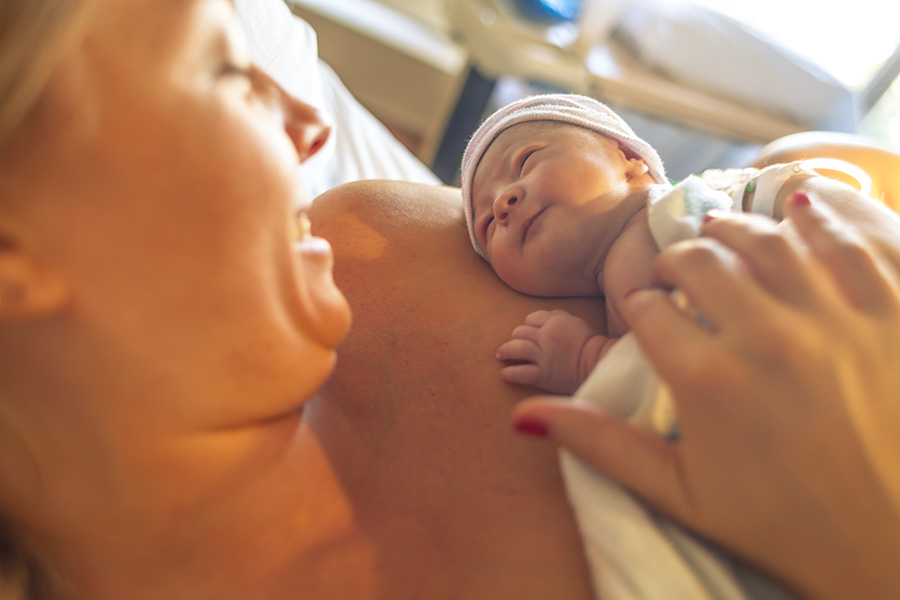
Pregnancy ends in childbirth. Childbirth, as it’s supposed to be, is
an intense bodily experience shared by the mother and the infant. An awake,
alert mother, even amidst waves of contractions, is aware that her child is
being thrust downward, squeezed, massaged, turned, molded, shaped, stimulated,
and pushed toward the light by the hard, hard labor of her body. The child
is like the soul in this dark valley of existence, moving or being moved we
know not how, straining toward the Light.
My own birth story isn’t that hey-golly inspirational (emergency cesarean.)
Still, all’s well that ends well: Ben and I did fine. But I can’t
deny that I was disappointed that my son was denied his proper rite-of-passage:
the thrust, the stress, the success of real birth; and that I was only an observer,
not a participant, in the arrival of my only child.
Mothers who have had both cesareans and normal childbirths say that there
is a real spiritual difference. When a mother gives birth in a conscious, undrugged
state, the child is not “taken from” her, but rather she gives;
and if she is a believer, she gives, mindfully, in the presence of God. It
is not unusual for a Christian woman experiencing waves of pain to unite her
suffering to that of Christ on the Cross: the blood, the profound exhaustion,
and even the fear: “How much more can I take? How long can this possibly
go on?”
Each is different: Childbirth can be quick and slippery, or harrowingly prolonged;
it can be hysterical, orgasmic, or serene. But however it comes upon a woman,
it comes upon her as an episode of blood and valor, a kind of single combat
or monomachy, life and death locked in battle. A birthing mother will remember
this for the rest of her life: the panting struggle, the ecstasy.
What’s in it for the woman if she can be “there,” undrugged
and alert, for childbirth? For one thing, she has a far greater chance of delivering
a baby who is also undrugged and alert. This can make the initial bonding a
far more fierce and tender and hotly forged experience. And she has a new view
of herself, of what she can do and endure.
Midwives tell me that whoops and howls of victory at parturition are not
uncommon, even for a woman quiet, small, and meek: She went into it a scared
girl and she came out of it a conqueror.
Be aware, though, that the dignity of the birth-giving woman is certainly
undermined by anything that treats her as if she were an impersonal incubator
or a passive invalid, anything that robs her of her “ownership” of
the process. I am not arguing here for a complete rejection of modern obstetrics
(since my own life was probably saved by it), but for the recognition that
birth is a woman’s work.
If this work is taken away from her without a compelling medical necessity,
she and her child lose a primal experience of struggle and bonding that is
ordained by the Creator and is the birthright of the race.
The Subject Lord
Childbirth begins a new way of being a mother, which in Mary’s life
we see is one of joy commingling with sorrow. Think of the love-in-tears when
Mary and Joseph left Jerusalem without Jesus, and then found him again teaching
the teachers: Jesus was lost, or so they thought, but now he’s found.
Truly the Temple of the Lord is Jesus’ own home—it is “his
Father’s House”—and yet he went down with Mary and Joseph, “came
to Nazareth and was obedient [subject] to them.” The narrative goes on, “And
Jesus increased in wisdom and in stature, and in favor with God and man.”
Now, why would the King of the Universe, who had a rather pressing job to
do, saving the world and all, want to be obedient to two of his lowly creatures
and be “subject” to them in their home, for, as far as we know,
the first thirty years of his mission on this problematic planet?
There can be no irrelevance here, since every event in Jesus’ life
is given to us as a sign and a teaching for our salvation. Jesus went back
to the Nazareth household, we can rightly suppose, because he highly valued
living with his family. This is how Wisdom increased in wisdom. This is how
God found favor with God.
How is it going with family living these days? Do American children increase
in wisdom in the place, with the people, that Jesus did? In the United States,
55 percent of infants and children under the age of five are not at home during
the day with their mothers, fathers, or even grandparents, but are being raised
in a non-family, substitute-care arrangement.
The much-idealized middle-class Victorian house-hold of just one hundred
years ago had a staff of servants—nannies, cooks, governesses—to
undertake the nurturing, caring, and teaching of the family’s children—followed
by boarding school. What is different now is that some of the most depersonalizing
features of the elite lifestyle have now been “democratically” extended
to all the classes of society.
Motherhood is, after all, not a “job” or a loosely associated
set of “roles,” but an intimate embodied relationship and the foundation
of every other relationship, human and—inasmuch as it touches us—divine.
And the alienation from the spiritual, personal, body-presence of mothering
is almost total in some sectors of American society today. From routine cesareans,
hospital nurseries, and bottle-feeding, to sitters, TV, and daycare, mothers
have marginalized their own little children, and have themselves been marginalized
as the living centers of their own families.
Centrifugal Families
I have seen the sociologists’ claim that, in many households, the mother
spends less than eleven minutes a day talking to her children, with most of
the “conversation” consisting of corrections, commands, one-word
and one-sentence interchanges. You’ve got speeded-up, stressed-out working
mothers trying—really trying—to relate to their speeded-up, stressed-out
school-age children, mothers serving in the main as appointment secretaries
and chauffeurs, shuttling their kids to supervised after-school activities,
mothers whose role mainly consists of interfacing between their kids and other
adults.
And fathers! Even fathers who care to be fathers find themselves merely brushing
past their children en passant during the week, and then abjectly
courting them—if they can wrest their attention away from the mall or
the computer screen—on the weekends.
Such is life in an advanced industrialized society. Most of the world—or
so they tell us—would like to live this way. But the centrifugal family,
while giving its members unparalleled levels of individual mobility and material
choice, does not in the end satisfy our deepest natural hungers for attachment,
for belonging, for sharing intimately with other persons. And little or none
of this actually advances us toward the ultimate purpose of human life, which
is an intimate union of love with God forever.
Are such children advancing in wisdom and favor with God? Or are they gaining
the whole world and losing their souls?
Many a mother says she would like to be more centered, more in touch with
her children, more the Mater et Magistra within her own home, but
cannot see the way clear because of the need to bring home a paycheck. I’m
generally inclined to think these mothers are telling it like it is. Yet the
Bureau of Labor Statistics reports (perhaps surprisingly) that families with
full-time mothers are found within every income-level of society.
Think of what that means. It means that there are women devoted to full-time
mothering whose husbands are underemployed or who make $15,000 or $20,000 a
year, all the way up to—well, kaboodles of money.
How is it that some women with a family income of $20,000 can afford to stay
at home with their babies, and some whose husbands make four times as much
say they can’t afford it? How is it that some husbands can support a
wife and four homeschooled children on a $30,000 salary, and others at twice
that salary say they can’t survive without their wives going out and
joining the ranks of the wage-earners and bringing home a paycheck?
Satisfying Children
I realize I am treading on dangerous ground here. The rest of this essay
was merely about religion and sex, but now I am dealing with something people
get really touchy about: money. Yet I cannot escape the conclusion
that the difference between families with absentee mothers and families with
at-home mothers has less to do with what they earn than with what they value.
Families with on-site mothers will often have much more modest material expectations
than those with mothers in the full-time labor force. At-home mothers (and
their husbands) expect to live frugally. They expect to have old clothes and
old furniture. They expect to get their main satisfaction in life from their
children—and not from their possessions.
This is not to say that women with children can’t—or shouldn’t—earn
money, or that they can’t or shouldn’t employ any of the talents
that God gave them, other than their mothering talents. Far from it. The “Perfect
Wife”—valiant woman—of Proverbs works for money, buys land,
plants a vineyard, manages a large and productive household, and earns praise
(and income) for her skilled work with the loom, the distaff,
and the spindle.
Think of St. Elizabeth Seton, mother and teacher; the biblical Deborah, mother
and judge; Zelie Martin (St. Therese of Lisieux’s mom), mother and lacemaker;
Elizabeth Anscombe, mother and Cambridge University professor; Maisie Ward,
mother and publisher/writer/lecturer; Dorothy Day, mother and journalist and
servant of the poor; Gianna Beretta Molla, mother, physician, and martyr. This
list could extend from here to heaven—and does.
As always, it is a question of priorities. That the child of three or four
needs his own mother in his own home I am convinced. If
his mother can also do graphic design or editing or real estate sales or architectural
design on the home computer, so much the better.
My mother’s mother ran a tavern and lived above it. She was with her
family, and her family was with her: The kids—this was in the old days—swept
the floors and served customers and made sandwiches to go. Grandmother Loesch
took in laundry; she did it at home, and the kids took baskets of laundry back
and forth in a little wooden wagon. My husband’s female ancestors were
mostly farming women, and a harder-working lot you’ll never see; of course,
the kids worked with them, side by side.
(There’s something to be said for bringing back wisely managed, moderate,
and productive child labor, too; but that’s another article.)
The question is, where is your treasure? And this question is for fathers
as well as for mothers. Is your treasure your job, your career, your earning
power, your advancement, your house, your car, your vacation, your computer,
your money, and the things that money can buy? Or is your treasure your children?
For where your treasure is, there also your heart will be.
Mother’s Grace
Grace builds on nature. And young human beings grow the natural foundation
for loving—literally, the brain pathways and neural synapses, the habits,
appetites, and aptitudes of love—through the embodied, physically engaged
self-giving of those who mother them.
Mothering provides the natural foundation for love, which God’s grace
makes supernatural and eternal. Thus, splendid, dedicated mothering is, naturally
speaking, the central activity of human history. Everything is supposed to
serve this. Everything. Husbanding and fathering. Church and state.
Tax law. Zoning. Corporate culture. The broadcast media. Market mechanisms.
Cybertechnology. Foreign and military policy.
Nothing can replace mothering and the family life it makes possible. Nobody
has a right to break it up and distribute its functions hither and thither.
Nobody—not the state, or the culture, or business, or schools, or husbands
(remember Callie), no, not even mothers themselves.
Every culture must uphold the personal bonds that unite the mother and her
child, the bond God hallowed by making a young Jewish woman the Mother of God.
Any so-called civilization can be judged in terms of whether it does, or does
not, do justice to that relation by which our Savior came to us.
An earlier version of “The Well-Connected Mother” appeared in
Caelum et Terra (www.caelumetterra.com).
Milk of Kindness
If God Almighty came to you and
said, “I myself have designed
a special food that will strengthen your baby’s body and
develop his brain, which will comfort him and cheer his heart,
and lay the foundation for his lifetime health and well-being.
I have given this food into your keeping; I have placed it in your
body; it is my loving provision for your child”—who
would reply, “No thanks, no divine gifts, I’d rather
give him a can of Similac”?
Personally embodied nourishment
is not only good for the body, it is good for the soul. It
is (as some Christians would put it) proto-sacramental.
Mother’s milk promotes sanctity?
From the infant’s point of view, yes. Look at it this
way. What are we here for? What is the purpose of human life?
It is “to know, love, and serve God in this world, and
to be happy with him in the next.” It is to love and
to be loved.
And how do young humans learn to
love? One would think this would be one of the core concerns
of theology: studying, with sustained attention, on our knees,
the process by which a child learns to give and receive love.
How does the child learn love? Where
are the foundations laid? At his mother’s breast. According
to the research brought together in Fr. William Virtue’s
philosophically rich and cheering book, Mother and Infant, breastfeeding
teaches the tiniest infant some immensely important lessons:
(1) that the universe is good; (2) that he has personal power:
the power to elicit a response; and (3) that his deepest needs
and appetites can be satisfied in a committed relationship
with one loving person.
Did I say “the universe”?
From the infant’s point of view, yes. The newborn’s
sight, generally hazy and undefined, is designed to come to
a focus at one
specific distance: 8 to 12 inches, not much more and not less.
Why 8 to 12 inches? Because that’s the distance from a nursling’s
eyes to his mother’s face while he is being cradled at her
breast. Increasingly, within weeks of birth, he’s not looking
at her breast. He’s looking at her eyes.
She fills his whole range of vision;
she satisfies his hunger and thirst, succors him with warmth
and comfort; the timbre of her voice (the higher female tone)
is precisely the range of frequencies his ears are fine-tuned
to hear. She is his universe: To the nursling, she is the Immensity.
Breastfeeding is not just a connection
between a mammary gland and an alimentary canal. It is a relationship
of a person to a person. It is not just nutritive. It is unitive.
If it is wrong deliberately to sunder the unitive and procreative
powers via contraception—and I am convinced it is—then
I would also argue that there is something wrong about separating
the unitive and the nutritive powers via the artificial bottle-feeding
of the young infant.
I don’t say that every use
of a baby bottle is intrinsically immoral, as a contraceptive
is. What I do say is that if a mother knows the physical
and spiritual benefit of nourishing her baby at the breast, knows that
her child has a right to her milk as a proto-sacramental gift
of embodied love, and is able to nurse (even at a
considerable personal sacrifice)—but chooses not
to—she has greatly wronged her child.
And if a woman does not know about
breastfeeding, or is made incapable of doing so by grave familial
or social or economic pressure, then, in her education or in
her circumstances, she has been greatly wronged.
“It is thou, God, who took
me from the womb, And kept me safe upon my mother’s breasts” So
says the Psalmist (22:9), speaking prophetically of the divine
care and protection to be enjoyed by the Messiah. And what
mother, loving her own baby, would want it any other way?
— Juli Loesch
Wiley
|
Juli Loesch Wiley is a freelance writer and long-time pro-life activist. She lives with her husband and two sons in Johnson City, Tennessee. She can be reached at jlw509@earthlink.net. |