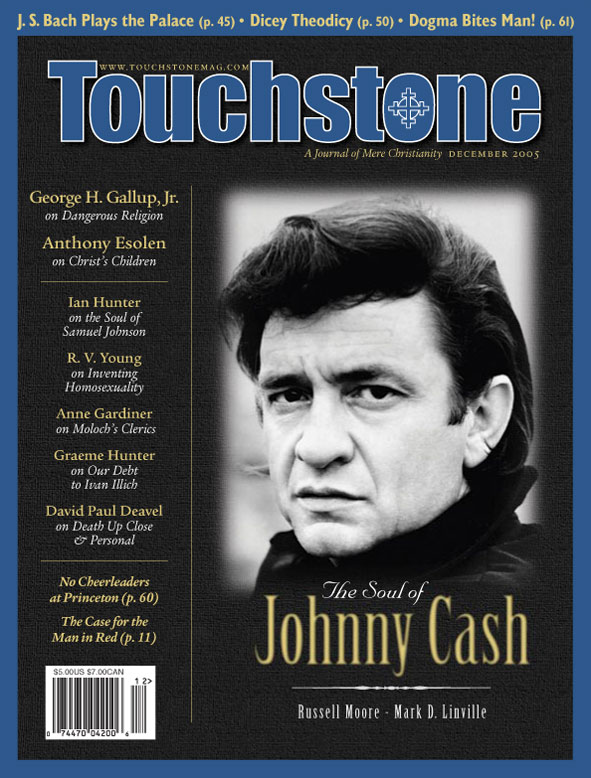
Just As He Was by Mark D. Linville

Just As He Was

Mark D. Linville on Why Johnny Cash Sang from His Mother’s Hymn Book

The satirical newspaper The Onion once featured the headline: “Affluent White Man Enjoys, Causes the Blues.” The article reports on a self-described “blues nut” who is a senior vice-president of a Chicago-area industry that employs—and grossly underpays—African Americans. At least a part of the humor here pokes fun at the Caucasian blues aficionado who “loves the music” but, of course, has never really participated in the culture from which it emerged.

Your typical Taj Mahal concert these days will be attended by throngs of adoring, Abercrombie & Fitch-wearing yuppies. Then there is the Wall Street trader who is devoted to the music of, say, Doc Watson or Flatt and Scruggs. Though he would hardly wish to spend time in that flyover territory between New York and L.A. and rub elbows with the unwashed for whom such music is a way of life, he enjoys a good PBS bluegrass special featuring Alison Krauss.

There is, of course, nothing particularly wrong with this. Great music tends to transcend the culture that spawned it and command a wider audience. It is possible to enjoy folk music without being one of the folk.

There is a similar way of appreciating Johnny Cash’s My Mother’s Hymn Book. One Sunday a few years ago in a small cabin on his property, Cash sat down alone with his guitar, literally thumbed through his mother’s dog-eared old hymnbook, and recorded the old country gospel songs that his mother once sang to him—songs that he knew by heart.

It would be hard to imagine a simpler production. There is Cash’s familiar but lived-in voice accompanied by his signature alternating bass line guitar picking. Though several of the songs were “arranged by John R. Cash,” they are pure and unadorned, like the faith they express. There is appeal here for people who have never darkened the door of a church—much less a little clapboard-sided church in rural Arkansas. After all, this is Cash and, as they say, if you don’t dig Cash you’ve got no soul.

That Was Cash

And then, too, there is the cultural appeal of an endangered bit of Americana. Daniel Dennett, “dangerous Darwinian” that he is, once suggested that fundamentalist culture is worthy of preservation as a kind of museum piece and that perhaps it would be a good thing to keep a few Baptists around in “cultural zoos” of sorts. If this music is appropriately bracketed, and thus demythologized, it may well be circulated even among the unbelieving hip. Were he still with us, it would not be difficult to imagine Cash performing some of this music before an appreciative crowd at this year’s Bonnaroo.

But listening to the recording and reading the accompanying byline, it is obvious that Cash himself is not keeping the music at arm’s length. This is an intensely personal creation: a work of love. This was his “favorite album,” the one of which he was the most proud. “That was me,” he says. Cash is “singing and playing this music back to his mother,” recalling a childhood that, though unhappy in many ways, was steeped in the message and music of the gospel.

Some of the hymns have acquired an additional significance for him, too. “When the Roll Is Called Up Yonder” and “In the Sweet By and By” were sung at the funeral of his brother Jack (“my best friend”), who was killed in a horrible sawmill accident when Cash was 12. The family sang, “Let the Lower Lights Be Burning” as they gathered around Cash’s coma-stricken father on his deathbed. As Cash describes the scene, “though he had been sound asleep in a coma for days, his lips started moving and he started singing that song along with us.”

But I suspect that Cash himself would tell you that the deepest significance of this music is its message, a message that sustained him in troubled times. He speaks of his “wilderness years” when “the demons crawled up my back.”


Mark D. Linville is Professor of Philosophy at Atlanta Christian College and author of Is Everything Permitted? Moral Values in a World Without God (RZIM Critical Questions Series). He and his wife Lynn have four grown children and four grandchildren, and live in Fayetteville, Georgia, where they attend the Christian Church.

A Journal of Mere Christianity—Delivered to Your Door

  • Essays on theology, culture, and the Church
  • Contributors from across the Christian traditions

Subscribe (Print + Online)

Six print issues (one year) of Touchstone, plus full online access and PDF downloads for only $39.95.

Subscribe (Online Only)

Get a one-year full-access subscription to the Touchstone online archives for only $19.95.


bulk subscriptions

Order Touchstone subscriptions in bulk and save $10 per sub! Each subscription includes 6 issues of Touchstone plus full online access to touchstonemag.com—including archives, videos, and pdf downloads of recent issues for only $29.95 each! Great for churches or study groups.

Transactions will be processed on a secure server.


more from the online archives
31.6—November/December 2018

Virtue Gone Mad

Victimhood Culture Scapegoats Its Very Source by Michael P. Foley

32.3—May/June 2019

Editing Jesus

on the Implications of Changing the Pater Noster by John M. McCarthy

23.6—November/December 2010

Darwin, Design & Thomas Aquinas

The Mythical Conflict Between Thomism & Intelligent Design by Logan Paul Gage

calling all readers

Please Donate

"There are magazines worth reading but few worth saving . . . Touchstone is just such a magazine."
—Alice von Hildebrand

"Here we do not concede one square millimeter of territory to falsehood, folly, contemporary sentimentality, or fashion. We speak the truth, and let God be our judge. . . . Touchstone is the one committedly Christian conservative journal."
—Anthony Esolen, Touchstone senior editor

Support Touchstone

00