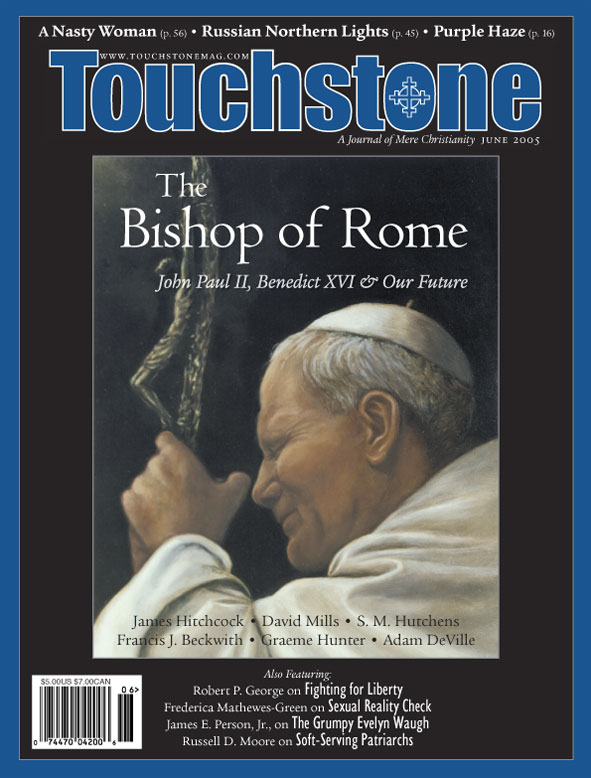
Vatican Bible School by Francis J. Beckwith
Vatican Bible School
Francis J. Beckwith on What John Paul II Can Teach Evangelicals
When my father attended St. John’s University in the late 1950s, his
apologetics professor (a Catholic priest) told his class that the two greatest
evils of the age were Communism and Protestantism. In the early days of Fuller
Theological Seminary, Professor Harold Lindsell (later the editor of Christianity
Today) offered a course on cults that included a section on Roman Catholicism.
Today, although not agreeing on every policy or program, Evangelicals have
become close cultural and political allies to theologically and morally conservative
Catholics. Both sides embrace a common philosophy that informs our understanding
of the good, the true, and the beautiful. (I write as an Evangelical.)
For this reason, as we both celebrate the life and mourn the death of Pope
John Paul II, Evangelicals should explore those writings of his that offer
great insight and wisdom in the two areas in which many have found common interest
with Catholics: understanding the relationship between faith and reason, and
nurturing a culture of life, represented respectively in the two encyclicals Fides
et Ratio and Evangelium Vitae.
Faith & Reason
In 1998 John Paul II issued an encyclical, Fides et Ratio: On the Relationship
Between Faith and Reason. The most important lesson that Evangelicals
can learn from this document is the pope’s insights on how certain
philosophies will, because of their own internal logic, undermine confidence
in the truth of the gospel message.
The pope is interested in saving souls, and he understands that bad philosophy,
if not challenged by good philosophy, will make the church’s mission
of soul-saving more difficult. Although he notes that there is no one correct
Christian philosophy, there are limits to the extent to which a philosophy
can be employed to illuminate Christian truth. For example, a Christian scholar
cannot incorporate scientific materialism, deconstructionism, or moral relativism
into Christian theology without distorting fundamental truths about the order
and nature of things taught in Scripture and church history.
Evangelicals schooled in the sort of worldview analysis of thinkers such
as Francis A. Schaeffer and James Sire will say in response to this, “Of
course, that’s obvious.” But I think that they miss John Paul’s
point. He is not saying that proponents of the Christian worldview must
be aware of philosophy. That goes without saying. He is saying that biblical
scholars and systematic theologians who think they can extract doctrine from
Scripture unaided by the resources of philosophical analysis are kidding themselves,
and are not doing a service to the Church.
There are two reasons for this. First, such a scholar, whether he knows it
or not, approaches the biblical text with a cluster of assumptions—a
philosophy—about the accessibility of theological truth as well as about
texts and their meaning not derived from the biblical text itself. Second,
when reading the Bible, he is confronted with scriptural truths that call for
a philosophically informed and coherent theology by which to understand and
make sense of them.
Consider, for example, the recent challenges on the classical attributes
of God: that he is omnipotent, omniscient, omnipresent, immutable, incorporeal,
and personal. Over the past several decades proponents of Open Theism (who
deny that God knows the future and is immutable) and Mormonism (who deny all
the classical attributes except “personal”) have challenged some
of them.
Their reasoning is, not surprisingly, “biblical.” They read the
text and they see, for instance, that God has regrets (Genesis 6:6), is corporeal
(Deuteronomy 34:10), and is sometimes surprised (Jeremiah 32:35). So they conclude
that classical theism (or some variation of it) is wrong about God because
it is the result of reading the Bible encumbered by “pagan” philosophy.
Many of the Evangelicals who rightly oppose Open Theism and Mormonism respond
in kind. They too cite Scripture, also claiming to do so untouched by philosophical
analysis. They offer their own collection of proof-texts that they are convinced
clearly show that God does know the future, is unchanging, does not have a
body, and so forth.
The Same Bible
Each side presents to the other its own collection of biblical passages,
both claiming to do so by purely reading the text.
Although these traditionalists see themselves as upholding the creeds of
Christendom (and that is, of course, a good thing), they rarely consult the
Fathers or the Great Doctors of the Church and avail themselves of the reasoning
that gave rise to the creeds they seek to protect. Their opponents do investigate
their ecclesiastical patrimony, but not as teachable students willing to grant
a strong presumption to the wisdom of this tradition and its formation. Their
approach is like that of a criminal prosecutor seeking to find Mafia corruption
in the business dealings of a corporation.
It seems odd to say this, but we must remember that our predecessors read
the same Bible that we read, and they confronted the same apparently disparate
accounts of God’s actions and nature that we find in Scripture. Why,
then, did they develop the view of God that they did? They employed the resources
of philosophy and did so in order to provide to the Church a coherent doctrine
of God consistent with Scripture as well as reason.
The classical view of God was developed not merely because its defenders
thought it the most accurate picture of the biblical God. It was developed
because they thought it consistent with an understanding of the sort of Being
deserving of the name “God” who at the same time is able to perform
the actions ascribed to him in Scripture. In terms of biblical interpretation,
this means that the favorite passages of Open Theists and Mormons cannot be
read in isolation from either the favorite passages of the classical theists
or, just as importantly, from what it means philosophically to say that a being
is God.
This is why, for John Paul, an interpreter of Scripture must be conscientious
in ensuring that he is approaching the text with sound philosophical principles.
As he notes: “Those who devote themselves to the study of Sacred Scripture
should always remember that the various hermeneutical approaches have their
own philosophical underpinnings, which need to be carefully evaluated before
they are applied to the sacred texts.”
Many Evangelicals may find themselves in disagreement with the pope’s
critique of “biblicism,” which he defines as a perspective “which
tends to make the reading and exegesis of Sacred Scripture the sole criterion
of truth.” However, he is not merely talking about the necessity of the
church’s Magisterium in interpreting Scripture (where all Evangelicals
will part ways with him), but he is also talking about the mistake of thinking
that one can do theology without any reference to, or understanding of, philosophy.
On this point, John Paul is absolutely correct.
The Gospel of Life
John Paul constantly reminded us “of our obligation to build a culture
of life, in which the strong protect the weak,” as President George W.
Bush said soon after John Paul’s passing. Unfortunately, few Evangelicals
have read the papal encyclical Evangelium Vitae ( The Gospel
of Life), in which the “culture of life” is fully explained
and defended. It is a remarkable document, in which John Paul carefully offers
a case for the sanctity of human life; the wrongness of certain practices,
including abortion and euthanasia; and the obligation of Christian citizens
and public officials to advance a culture of life.
What will surprise many Evangelicals is John Paul’s impressive grasp
and use of Scripture and how he weaves together an extended argument whose
premises include passages and principles from the Word of God. But what John
Paul will teach Evangelicals, and what will appear novel to some of us, is
the careful manner in which he shows that the moral principles found in Scripture
are consistent with a reflective understanding of the order and nature of things
that one can know apart from the biblical text.
For example, John Paul teaches that the Bible and Christian tradition affirm
that human beings have intrinsic dignity because they are made in the image
of God and that we ought to treat each other justly, and that this affirmation
and obligation, grounded in the nature that God gave us, ought to be reflected
in our laws so that the state may advance the public good. Although he believes
we can find these truths in Scripture, he also believes that these truths may
be found in natural moral law, accessible to—and therefore binding upon—all
human beings, even those unacquainted with the Christian Bible or its teachings.
One way by which John Paul seeks to show that we have an intuitive awareness
of this natural moral law is in his critique of the self-defeating argument
for liberal democracy that embraces moral relativism, as is often done in the
name of pluralism or tolerance. He shows that this argument is philosophically
incapable of sustaining liberal democracy, a political regime that claims that
the purpose of its laws is to protect human equality and dignity. Writes John
Paul:
It is true that history has known cases where crimes have been committed
in the name of “truth.” But equally grave crimes and radical
denials of freedom have also been committed and are still being committed
in the name of “ethical relativism.” When a parliamentary or
social majority decrees that it is legal, at least under certain conditions,
to kill unborn human life, is it not really making a “tyrannical” decision
with regard to the weakest and most defenceless of human beings? Everyone’s
conscience rightly rejects those crimes against humanity of which our century
has had such sad experience. But would these crimes cease to be crimes if,
instead of being committed by unscrupulous tyrants, they were legitimated
by popular consensus?
According to John Paul, a democratic regime, whose purpose is to do justice
by treating all human beings under its authority with equal regard, cannot
do so without embracing certain fundamental moral truths as foundational to
its institutions and laws: “the dignity of every human person, respect
for inviolable and inalienable human rights, and the adoption of the ‘common
good’ as the end and criterion regulating political life.”
This means that governments that permit (much less encourage) abortion-on-demand
and suicide, and do not protect (much less undermine) the institutions of marriage
and the family, do not advance the cause of liberal democracy, because they
are in fact violating its essential principles. For abortion-on-demand and
suicide are inconsistent with the dignity of the person, and marriage and the
family are necessary for the common good.
No Better Place
Over the past few decades, Catholics and Evangelicals have forged cultural
and political alliances and, as a result, have begun to learn from one another,
oftentimes discovering that some of our beliefs about the other did not correspond
to reality. This is not to say that there are not real theological differences.
There are. But we have so much more in common than we realized before.
For this reason, we should enthusiastically plumb the many resources in the
other’s tradition with which we can nurture our souls and sharpen our
minds. There is no better place for Evangelicals to start than in the works
of John Paul II, a good and faithful servant who did well.
Francis J. Beckwith is Professor of Philosophy and Church-State Studies at Baylor University. His most recent book is Politics for Christians: Statecraft as Soulcraft (InterVarsity Press, 2010). His writing can be found at www.francisbeckwith.com. |