A Geography of Kind by Anthony Esolen
A Geography of Kind
The Preservation of Landscapes & the Beauty of the Sexes
by Anthony Esolen
When I was a boy we lived at the back end of a glacier. True, it was a glacier
in retreat, and had disappeared a few thousand years before I was born, but
it had done its work well, and for that I was grateful. It had backhoed up long
corrugations in the land—we called them “mountains”—like
furrows in a rug. Between these furrows snaked the drain-water, a “river”
as it came to be called, gouging out a long narrow valley where Irishmen would
come looking for farmland and would find instead a soil shiny black and gritty:
a sign of coal.
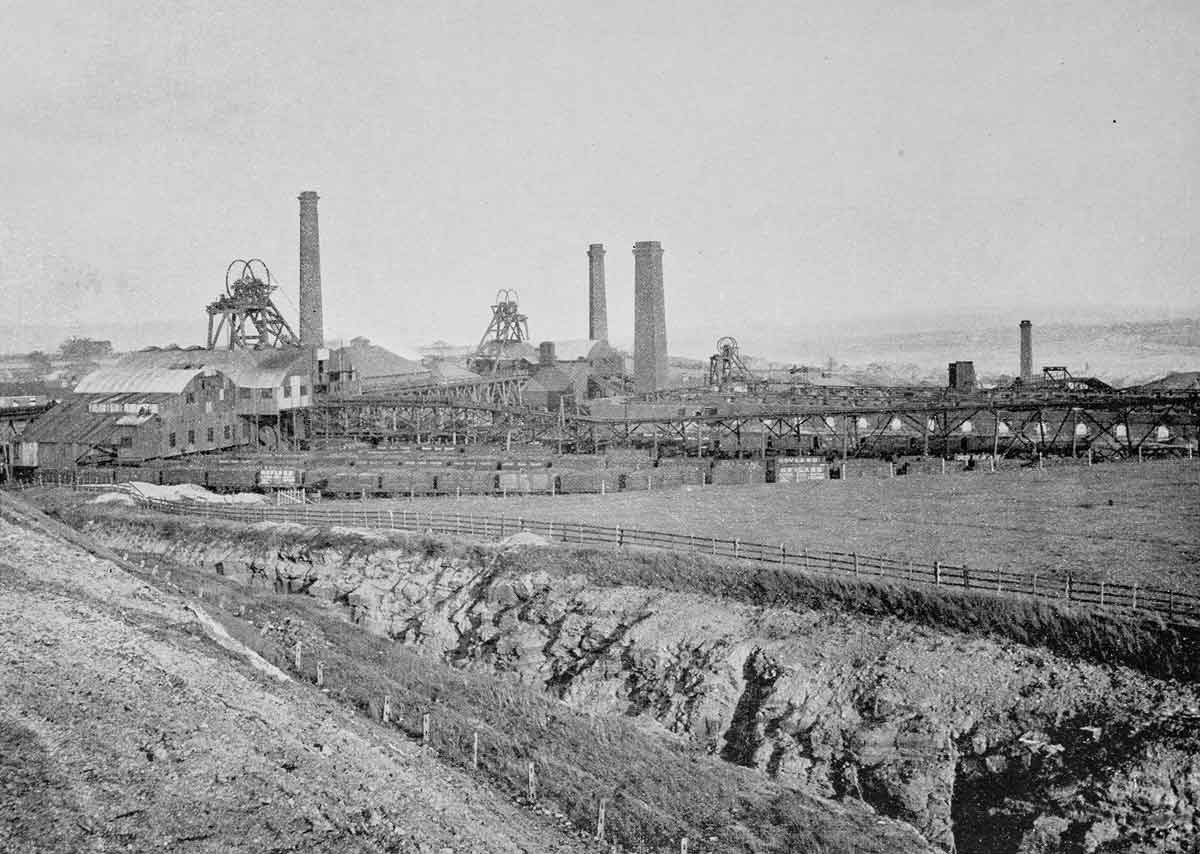
Miners, first the Irish and Welsh and then the Italian, laced the rocky knobs
overlooking the valley with cartroads and train beds, digging great and small
stripping holes from which they took the “black diamonds,” the hard
anthracite coal. Those diamonds laid out the crazy streets and built the schools
and curtained the lone hotel of my town; they erected the rounded spire of my
church, St. Thomas Aquinas; they paid for Italianate frescos of the apostles
and the prophets therein, and of the Immaculate Conception, with the Dominican
Aquinas looking on in adoration.
A Place to Love
Then the coal petered out, or better coal was found elsewhere, and the railroad
ties were torn up and the cartroads were grown over with weeds. The stripping
holes were left to lie. Some filled up with greenish water; some were used as
dumping grounds for various oddments: a refrigerator, a bowling ball, the rusted
chassis of a bus. The hotel closed; the bars stayed open.
That was the woods of my boyhood. It was marred by man’s hand, no doubt,
but it was still a woods, thick with white birch and sumac, and the occasional
sugar maple or hemlock. In the summer you could see blackberry brambles everywhere;
in winter, the evergreen laurel, scrappy and dark against the snow. It was not
a place to go for a planned, secure, scenic walk. Bike paths had not yet been
invented to lull people into the illusion of seeing the woods.
If you went up there—only boys went very far—you’d walk
along the rutty cartroads, maybe run into a drunk, maybe see a hawk yawing over
one particularly dismal swamp (the glacier had arranged it so that we had swamps
on the tops of high hills—go figure), or find a brand new old wheelless
car on the edge of a stripping hole.
I loved it. One place especially: the glacier had dropped granite rocks as
it trundled back to its polar home, and some of these were dumped on a broken
knuckle of a hill overlooking my town several hundred feet below. Over the years
windblown dust had covered most of the boulders with a thin and paltry topsoil.
Some had not been covered, but just stuck out at strange angles, and sometimes
the wispy filling between two rocks would subside, leaving crevices underfoot,
five or six feet deep and not more than an inch or two wide. You had to watch
your step. Nothing can grow in soil so stingy; nothing but moss, some short
white birches, and blueberries.
And blueberries did grow there, where so little else would; the place was
carpeted with them. In the summer my brother and I (and the dog, to scare off
snakes) would pick for hours. Pickings always improved the year after the town’s
fire chief set fire to the woods; everyone knew he did it, but no one minded,
and now I think he did it because he loved the blueberries. In winter I would
hike to the top of that pile of glacial debris, alone, looking fifteen miles
east and west, but no more than a mile south, as the great fold of the land
loomed up against my line of sight like a brown and violet wall, the town and
its little gray roads far below.
I loved that place as I have loved no other. It was not pretty. It was a stone
to reject. But there I would go, in those long winters of my youth, bearing
my questions and fears and loneliness. Because I loved it, I found its beauty.
It had beauty; but it was shy about it. I did not love it because I thought
it was beautiful. I knew it wasn’t. I learned to find the beauty it possessed
only because I loved it. I even made maps of it, as a lover might draw the portrait
of his beloved, and lent names to rocks and holes and ways, like an Adam among
some of the odder fossils of Paradise.
Endless Pavement
That place still exists, barely. The hills leading up to it have been leveled
out, the swamp drained, the paths widened and straightened and paved. Individually
handsome but absurdly out-of-place houses have been built nearby, for people
too rich to afford a home in an ordinary quilt of a neighborhood with children.
Sic transit penuria mundi. I have said my goodbye to the place; nor
am I writing to protest the loss.
Or perhaps I am protesting the loss, not of that place in particular, as much
as I loved it, but of the very idea of a place; of the very idea of the singular,
the fleshly, the odd, “all things counter, original, spare, strange,”
in Gerard Manley Hopkins’s words. Ours is a dreary parking lot of a world.
We will not slaughter animals, we; no, machines will do the task very nicely
for us. We are too finicky to hunt, even had we the opportunity to cherish the
ways of the animals we must use.
Millions will watch football on television nowadays, football played under
cozy domes; no frost forms on the helmets of sweaty Vikings, and of course our
own fields lie idle. We live among creeks whose names have fallen into oblivion.
We eat drab food in garish non-places whose appeal consists in their being the
same same same everywhere. Music has collapsed into the wailing of narcissistic
melismas, if you are a girl, or the grunting of obscene quarter-rhymes, if you
are a boy, and it too is the same everywhere. Newspapers, once the gadflies
of the local barnyard, are but more pavement for the mind, and a stretch of
pavement in New York looks as arid as a stretch of pavement in Nevada. We are
nomads without herds, barbarians without clans.
There is one last thing this will-to-weakness might not pave over, might not
reduce to dreary sameness: our own bodies. If any sense remains in us of place,
of unique flesh, surely it must remain there. But it does not; our bodies have
been paved. Male and female in all their complexity and beauty have been reduced
to the same same same.
It occurs to me that if you don’t want people to drain swamps, level
hills chock with coal and fossils, and cover glacial ploughage with Zoysia-brand
sod, same here as everywhere, indeed put out by the same firm, you need a weapon
more powerful than rational discourse or appeals to authority. You must prevail
upon people to notice the swamps, the hills, and the mad escarpments. A science
lesson won’t do for that: No one comes to love a swamp by reading a text
in swampology. Nor does a man come to love a heap of granite by being told,
on divine authority, that it would be a good thing for him to love it, or even
that he had been commanded to love it.
He will, rather, love it if he is patient with it, if he allows it to enter
his moods, if he pauses to see its angles and speckles, without immediately
bulldozing it in his mind, erasing it under the category of “general terrain.”
Only by loving it will he come to know it. Love and only love will allow him
to see the beauty of the weird white birches, their bright and frail bark so
oddly resistant to the ice. He may then see, at the edge of the swamp, a strange
ring of hummocks, where the water table does not usually rise to the surface,
but where it is high enough for the ground to be squelching thick with red moss.
The Weapon of Beauty
We have tried, in fighting the macadamizers of the human body, to appeal to
reason. But reason has long been flattened into ratiocination, and that machine
is as predictable as a roller. Yet we have a more powerful weapon we have left
unused. Beauty is that pikestaff still in the rack: the beauty of the small,
the local, the “unconsidered trifle,” that odd stone in the corner
of the quarry, the stone none of the builders had the imagination to see. As
I miss the lost sense of the beauty of swamps and coal and blueberries, I miss,
achingly, the lost sense of the beauty of mankind, of man and woman.
We would not put up brick asylums for the warehousing of thousands of children
if we saw, and felt poignantly, the beauty of children. So too with the blaringly
drab garages and converted machine shops that are now called, with telling dreariness,
“Early Learning Centers.” I was once a child, and never do I recall
longing to go to a “center,” or to an “academy,” or
to some ugly “Rainbow Connection,” or any such other lie.
Muddy ditches I did like—there are a thousand interesting things you
can do in one of those, especially in March after the snows have left a crust
of frozen dirt like a roof over the flowing water underneath. You’ll never
learn about frozen dirt in a “center.” If we loved children, and
we do not, we would be kinder to them, in the old sense of that word: We would
treat them according to their kind, their nature, and according to our own.
We would respect the contour map of childhood. We would follow a Geography of
Kind.
If we saw and felt the beauty of animals, even of the stolid and shambling
cow, we would not turn them into carnifaction machines, same here and everywhere,
now and evermore, world without end. We would like them too much as animals,
even when we were slaughtering them for food or clothing.
If this is true of animals, how can it not be true of the sexes? If you really
love men and women, if you have troubled to grow accustomed to the landscapes
of their beings, the couple-colors, the rose-moles, the stipplings, their strange
rocks and sudden springs, their wild laurel green in the heart of winter, sweetness
and tenacity thriving in the most unlikely places—why on earth would you
want to dress them in khakis, crop their hair, lop off the honorific titles
that used to present them as fully human (that is to say, sexed) beings, and
place them indiscriminately in this or that pulley-rig or conveyor belt of the
great economic machine? What would be the beauty of that? What would be the
fun of that?
We who notice no place do not even notice ourselves, and thus it does not
occur to us to ask of the sexual bulldozer what we might still occasionally
remember to ask of the suburban planner: “What is it about flatness and
sameness that you find so appealing?”
The sexes are as rich and strange as flowers. Notice them. Notice an odd thing
about boys and men: They whistle. Why? Girls are not shy of singing in public,
and singing is riskier and more conspicuous than whistling. The old finger-wagging
against girls who whistle forces the question, “Well, why isn’t
it considered ladylike?”, and in any case I haven’t heard anyone
worry about that in years. Girls sing; boys, many of whom would prefer to have
a tooth broken than to be caught singing, whistle. Why is that? Why is it that,
if you hear somebody whistling around the corner, it is almost certainly going
to be a man or a boy? Even the jaunty old Christmas carol, “I Saw Three
Ships,” has Mary singing but Joseph whistling.
Whistling is about the most abstract form of music that the average person
can readily indulge in—so why is it boys who do so? I know a few men my
age who will whistle an air from Puccini so as to fill a courtyard with melody.
And I know women who will cheerfully and without embarrassment lead groups of
children in song, a cappella. Some cultures are more open to singing than are
others; but can we even imagine a place where women will whistle Mio babbino
caro but not be caught singing it, while men lead children in song but
never whistle? I can’t imagine it. These would be males and females of
a species different from mine.
Wondrous Harmony
What beauty lies in the lilts of the human voice! It annoys us when, on the
telephone, we cannot tell whether we are speaking to a man or a woman; we instinctively
prefer soprano to contralto and baritone to countertenor. My daughter sings
in a Swedish women’s choir, itself the partner of a Swedish men’s
choir. As are the voices, so are the beings—and if you listen and watch,
you discover wonder. The women sing well, as do the men, but there is a certain
thinness and shrillness that always besets the women, as there is a gruffness
and hoarseness that besets the men.
When they sing together, though—now there you have human harmony. Imagine
a Swede well over six feet tall, the leader of the men’s choir, singing
tenor next to a thin, kindly old lady who does not come up to his lapels. Imagine
a smallish bearded man singing two octaves below middle C, holding the low note
so loud and long the walls tremble with it, and standing in front of him the
women’s lead soprano, a thick-set lady who was certainly once a tomboy,
belting out notes higher than anyone and singing them with gleeful abandon.
These are men, these are women. As I sit at a table during their rehearsals,
reading a book, one of the men—never one of the women—will clap
me on the shoulder and ask me what I’m reading. Another will engage me
in conversation about the nescience of schoolteachers these days, or whether
the pope did too little to help the Jews. The music director and pianist will
discuss with me (and notably not with the women in his choir, women of whom
he is quite fond) beautiful or dreadful liturgical music, “On Turkey’s
Wings” being our favorite laughingstock. None of the men has ever asked
me whether I was comfortable or whether I had had enough to eat, but the tiny
old lady does so all the time, somewhere in her heart really worrying about
me.
At Christmastime the choirs join and make the rounds of the Scandinavian nursing
home where they practice, and then you see the lead soprano do what astonishes
me, as a man: Without hesitation, with a perfect delicacy of cheerfulness and
generosity and love for weak and needy creatures, she goes into the rooms of
strangers, greets them, sings for them, and wishes them a Merry Christmas. How
astonishing is the simple generosity of a good woman!
And when they all go downstairs for cookies, pickled herring, Swedish crackers,
and glögg (made by one of the men, the same who leads the party in a chorus
of “Yingle Bells” as they troop down the halls), an older man who
has never had a single lesson in music and who cannot read a note dons an elf’s
cap and sits at the piano and plays songs for an hour, plays brilliantly, using
all eighty-eight keys, all imaginable chords and combinations and rhythms, in
a complex and sprightly style all his own. He will play Santa Lucia
or Annie Laurie or I’ll Take Manhattan or any number
of songs in five or six languages, peppering the lyrics with bawdy variants
here and there, while a couple of the men, feeling the pleasant effects of the
glögg, gather around, and the women laugh at the foolery and maybe join
in. How fine it is to have not males and females but men and women!
A child in the yard runs along a fence, rattling a stick against the pickets.
Need I mention that it is a boy? Not the most reality-denying feminist would
imagine otherwise. And why should it be otherwise? A child is sitting in the
living room, decorating party invitations by hand. Need I add that it is a girl?
Should it be otherwise? At the party one of the guests is performing, to some
merry laughter, an impersonation of one of the other guests. Men, of course,
both impersonator and impersonated. A child leads yet another guest by the hand,
to show off a new toy or a picture. Whom but a woman would a child so thoughtlessly
take by the hand?
Delight’s Shadow
Scripture knows of this beauty. The Lord God likes beauty: “And God
saw the light, that it was good.” Note that God does not arbitrarily consider
the light to be good; he does not define “good” so as to include
light. If I may be allowed a simile, God is like an artist standing back from
his creation and sizing it up. He likes the light, he finds it beautiful. I
am not suggesting the existence of any standard of beauty outside of the most
beautiful, the God who is the source of beauty; but I do suggest that human
delight in beauty can be but a shadow of God’s delight in it, and that
if we do not cherish that love for beauty, we will find ourselves ill-attired
for Paradise.
Another thing we learn from Scripture is that God’s delight is like
God’s ways and thoughts generally: It does not follow the caprices of
man’s choice. God does not usually reveal himself as the Creator of thunderbolts
(those cheap tricks fit for Jove), or of tourist attractions like canyons and
waterfalls. Rather he reveals himself in the first instance as the maker of
ordinary things, kinds of things great and small: even the creeping things that
creep upon the earth.
He is the Father who tends to the ostrich of the desert (a thing Jove would
not condescend to do), that swift-footed creature too birdbrained to care for
her own young; but with what powerful legs can she outrun the warhorse! God
has appointed, with special care, that the humble rooster should have foreknowledge
of the dawn. The dog wags his tail as the boy Tobias returns home. A still small
voice speaks to Elijah. The kingdom of God is like a mustard seed.
Consider too the parables of our Lord. Note the fineness of description, as
if he were what indeed he was and is, the Creator of all things, who knows them
and loves them to the marrow of their bones. With an exact knowledge of women
he gives us the parable of the woman who has lost her coin—a single coin,
her whole treasure, no doubt kept in a safe place, as it is probably a treasure
more of the heart than of the purse. She sweeps the house and moves everything
in sight, looking for that coin, and when she finds it, with innocent generosity
(she is not one to claw her way to the boardroom) she invites her neighbors
to come over and celebrate. We have met that woman many times before, as we
have met the adoring Mary of Bethany and her busying sister Martha.
We have met, or have been, the younger son (not daughter; the parable cannot
work that way) whose decision to return to his father’s house (not mother’s;
it cannot work that way either) is first of all motivated by a desire to fill
his belly. Yet when he sees his father he falls to his knees, asking neither
for pity nor for food, but confessing his sin like a man, simply and frankly,
with decorous summation: “I have sinned before heaven and before thee;
now I am no longer worthy to be called thy son.” It is his first deed
as a man. By contrast, the elder brother (whom we have seen, whom we have known
and been), so manly in his duty, or perhaps so secretly envious of the younger
son’s looseness and license, seems puerile by comparison.
When Jesus asked his disciples to behold the lilies of the field, it was because
he himself had beheld the lilies of the field and, we may suppose, had been
cheered to do so. Nor had he any eugenic desire to turn lilies into figs, or
figs into chickens, for whatever imputed benefit to mankind.
The Kindness of Sexes
How shall we then raise handsome men and women? We should love the geography:
we should be kind. My grandfather built terraces into the hill behind his house,
using what the land gave him, so that the winding path up that slope became
an entry into a fine and fit world of tomatoes, grapes, corn, beans, and peas,
with fruit trees overhanging and a chicken coop perched at the top. It was more
of a hill when he finished with it than when he had begun. So, I think, we should
raise men and women.
In boys we encourage but also train and discipline their nervous energy and
aggression. It is good, that is to say it is fitting, it is decorous, to see
a team of boys play hockey, learning how to strive without anger, how to lose
without sullenness, how to win without vanity. Their bodies are sturdy and their
blood runs high; it is in order. In girls we encourage but also train and discipline
their quiet love for the small and the helpless. Perhaps there are now pinch-souled
turkey-necked women who sniff at the idea of making cookies; but when my daughter
does the baking with my wife, I am stunned into gratitude. How like a mill would
our daily lives be without that womanly generosity!
But we know these things, we know them all. We know that it is ugly and stupid
to make little boys vain about their hair color, and we know that it is ugly
and stupid to dress up Jennifer in a hockey outfit and sit her in front of a
goal. I don’t mean to offend here; but our desire to feminize boys and
masculinize girls springs from a proud desire to correct the Creator.
We do not see the beauty of the sexes in its fullness; we are bored or impatient
with the sexes; or we would prefer to have some other thing reputedly good,
typically something in dollars, and if the sexes get in the way of that, then
for us it is exactly as if a marsh were in the way of a new golf course. The
proponents of the ugly—especially when, as is often the case, the ugly
brings in money—will always seem to have the better of the argument. “The
tax revenues will be so helpful to the community!”
Ignore the old and familiar, ignore the proprieties, smooth over the grooves
and corrugations, straighten the crooks and fill the crevices, and you do not
have a community; you have Levittown. But alas, the love of such things as marshes
cannot be so easily or glibly expressed. “We must move with the times!”
That is, we must surrender our humanity and consider ourselves no other than
bolts and nuts in a great monstrous machine, producing “culture”
on a conveyor belt stretching into the unseen but oh so superior future. Let
the times instead move with us, or let the times go hang! But it is hard to
argue against a wisdom that presents itself as inexorable.
“Boys must learn to be sensitive! Girls must learn to compete!”
Why? Boys have always been sensitive, in points of honor too sensitive; girls
have always been competitive, for social prestige too competitive. Boys rather
need to learn to do their duty in spite of their feelings, and girls need to
learn to give up their competition, that they may be gracious to one another.
Why such wisdom should make Christians uneasy is hard for me to understand.
Perhaps we are supposed to think that God wants us to be gods over ourselves,
molding ourselves according to our vain imaginations, rather than experiencing
ourselves as gifts from him? No one wants to live in Levittown. Who then would
want a spouse from there?
A Wild Heaven
There is no Levittown in Scripture, unless its name be Laodicea. In Hell I
imagine there are vast stretches of Levittown transplanted, replete with Bauhaus
architecture and lots of macadam; indeed, certain cities of the old Soviet Union
are said to have been swallowed whole ad inferos, without the citizens
noticing any change beyond a small drop in temperature.
Heaven, I am sure, is as wild and as complicated, as of its self-kind, as
the most living of living creatures. No male, no female there? Or only for ornament?
A wedding feast then, but only in the abstract, with all memory of the sexes
spayed? A sexual parking lot, for Paradise? Not so, my soul, not so. For it
will be a Man seated on the throne, and all the geography of kind will be raised
into glory:
The voice of my beloved! Behold, he comes,
leaping upon the mountains, bounding over the hills.
My beloved is like a gazelle, or a young stag.
Behold, there he stands behind our wall,
gazing in at the windows, looking through the lattice.
My beloved speaks and says to me:
“Arise, my love, my fair one, and come away;
for lo, the winter is past, the rain is over and gone.
The flowers appear on the earth,
the time of singing has come,
and the voice of the turtledove is heard in our land.
The fig tree puts forth its figs, and the vines are in blossom;
they give forth fragrance.
Arise, my love, my fair one, and come away.
O my dove, in the clefts of the rock, in the covert of the cliff,
let me see your face, let me hear your voice,
for your voice is sweet, and your face is comely.”
(Song of Solomon 2:8–14)
Anthony Esolen is Professor of English at Providence College in Providence, Rhode Island. He has translated Tasso's Gerusalemme liberata (Johns Hopkins Press) and Dante's Divine Comedy (Random House). He is a senior editor of Touchstone. |