
Vanity Fair’s Thanatos Syndrome by Adam Schwartz
Vanity Fair’s Thanatos Syndrome
Malcolm Muggeridge, Modern Capitalism & the Culture of Death
by Adam Schwartz
Like many of his forerunners among the famous converts of the last century,
Malcolm Muggeridge was an acute social critic whose spiritual pilgrimage was
spurred on in crucial ways by his qualms about twentieth-century culture’s
direction. Among his principal anxieties was the materialistic ethic he associated
with modern capitalism, one he judged corrosive of the core social institution,
the family, and one especially manifested in the eugenic impulse. He therefore
reproved Western consumerism consistently, and eventually decided that orthodox
Christianity was the best—perhaps the only—basis for resistance.1
He sensed early in his life (he was born in 1903) a need to choose to pursue
either the quality of life or the sanctity of life, and he chose the latter.
He found it to be part of the way of love and the imagination, whereas the former
belonged to an ethic animated by power and the will. He increasingly felt that
modern Western society privileged the quality of life over its sanctity, and
he condemned the culture of consumerist concupiscence that arose from this choice.2
Greed the Mainspring
Muggeridge argued consistently that greed is the mainspring of Western capitalist
society and “about the most contemptible of all” such bases, generating
an economically lucrative but ethically hollow culture in which the pursuit
of happiness was merely the pursuit of pleasure.3 Such a hedonistic
civilization was “the most horrible and degraded that ever existed on
the earth” and should not be considered civilized.4 He often
dubbed the affluent West a gilded “pigsty” and a “zoo.”5
Initially, Muggeridge found consumerist capitalism destructive of individual
freedom and integrity. At times he invoked Hilaire Belloc’s idea of “the
servile state,” arguing that twentieth-century Western man’s pursuit
of pleasure in security would lead him to forsake his freedom voluntarily, creating
a “freely constructed concentration camp.”6 Echoing C. S.
Lewis and George Orwell, he feared in 1954 that so surrendering personal liberty
would entail the “final obliteration of the individual as we know him
today” and the advent of a race of mass-minded slaves in thrall to sensuality
and the passions: “Leviathan’s belly [is] warm and secure, but dark
and confined.”7
Muggeridge regarded the British welfare state as a manifestation, rather than
a mitigation, of capitalist materialism’s deadly cultural effects. He
contended that the welfare state embodied consumerism’s “shallow
and fatuous” ethos, and he thought that concentrating state power to facilitate
social security would exacerbate the self-enslavement already fostered by dependence
on oligopolies for an everlasting stream of consumer goods and the financial
wherewithal to purchase them, leaving Westerners “sleepwalking into our
own Gulag, incarcerating ourselves in our own high-rise prisons.”8
Besides threatening man’s liberty and identity, Muggeridge averred,
capitalism also spawned an inhuman homogenization and humorlessness, a utilitarian
aesthetic inimical to genuine imaginative art, and an unjust distribution of
wealth. The latter grew, in part, from the misapplication of Darwin’s
model of animal biological development (the “survival of the fittest”)
to human society. He concluded that when future eras surveyed the twentieth-century
West, they would see a society ruled not by men like gods, but “men like
apes . . . and even that will seem rather hard on the apes.”9
Muggeridge was convinced that a culture so seemingly at odds with human nature
was unsustainable. Modern Western society was a “nightmare,” one
afflicted with a neurosis or madness arising from its consecration of the pleasure
principle and its consequent denial of life’s essentially tragic nature.10
He thus felt that wealth was bringing widespread individual and collective despair,
especially in places of exemplary affluence like Scandinavia and America, concluding
in 1983 that “to believe in man’s capacity to create his own circumstances
is a doctrine of despair.”11
Unsurprisingly, then, he considered consumerist capitalism an incarnation
of, and contributor to, the “death wish” of the modern West, which
was seeking to commit civilizational suicide. As early as 1940, he detected
a Western craving for “violence and bloodshed” in entertainment
to relieve the “boredom and desolation of mechanized life,” making
carnage the “poetry of mass production.”12 By 1958, he
was asserting that “the trouble with capitalism is . . .
that for the sake of a shilling today it will advance causes which will destroy
it tomorrow,” such as trading with Communist states.13
Four years later he speculated that “perhaps the pursuit of happiness
will end in extinction,” and by 1970 he was certain that “a neurotic
passion to increase consumption” could only precipitate such a culturally
self-destructive climax: “We press on through the valley of abundance
that leads to the wasteland of satiety, passing through gardens of fantasy;
seeking happiness ever more ardently, and finding despair ever more surely.”14
Consumer Idolatry
Muggeridge linked much of this cultural malady to secularization. “Faith
and its sacred texts are of the desert, not of affluence; on sandy wastes and
rocky mountain tops men think of God; in the lush, sheltered plains forget Him.”15
By 1981 he identified consumerism as ego-cenctric idolatry: “In the twentieth
century, man’s created the most disastrous of all images which is himself
and he falls down and worships him. . . . Never in human history
have the unworthwhile things of life been presented so alluringly, through advertising. . . .
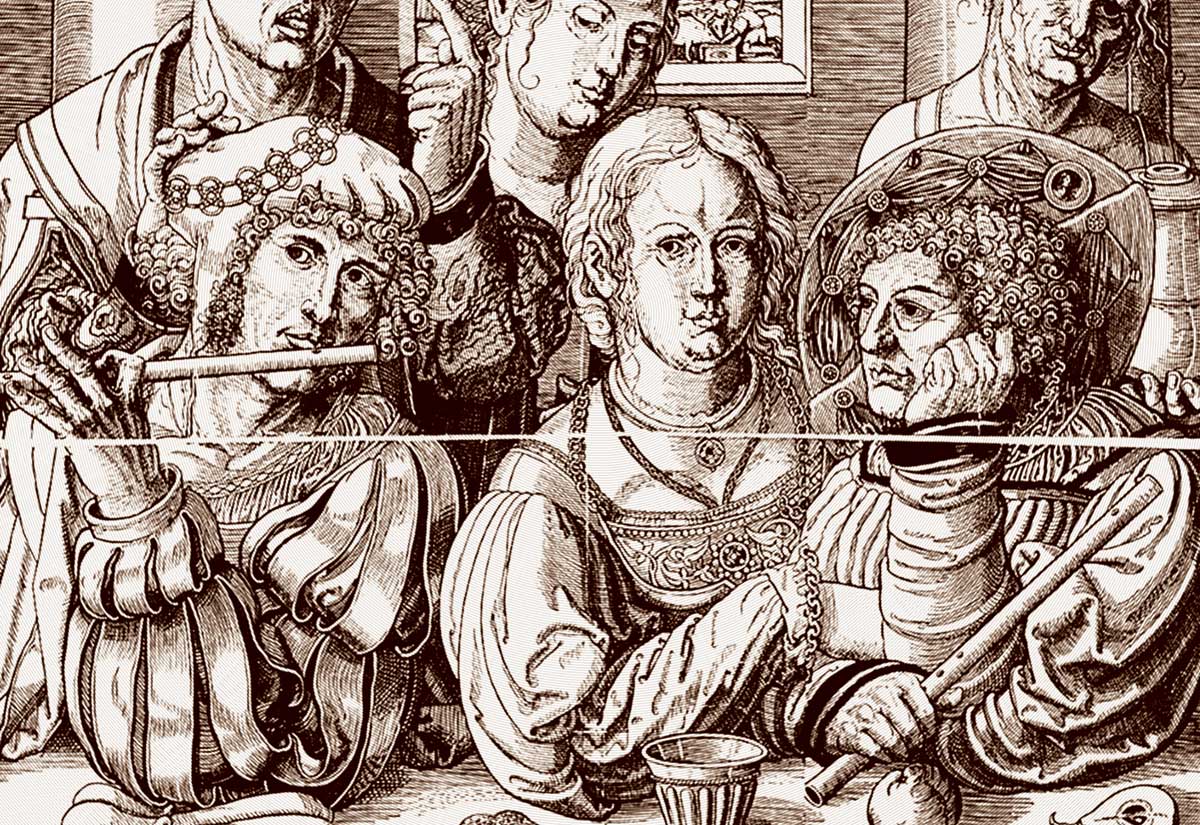
[T]his is Vanity Fair into every single person’s sitting room, hours and
hours of it, day after day.”16
More specifically, Muggeridge regarded this self-worship as sex-worship. Sex,
he said, “is the mysticism of materialism.” A consumerist culture
enshrines sex as one of its “tribal gods” and then exploits it in
advertisements to nurture the system of chronic getting and spending: “In
a society whose most pressing need is to create wants and desires, sexual appetite
is obviously a valuable adjunct to salesmanship.” Besides making sex a
stimulant to consumption, a consumerist culture also uses it as a narcotic:
“Nothing is more calculated to induce acceptance of the social and economic
status quo than erotic obsessions. . . . Unfolding the month’s
playmate in Playboy magazine, any tendency to think and question things
is automatically extinguished.”17
Muggeridge thought a culture founded on such fantasies was part of the illusory
“Legend” rather than substantial “Life,” and was hence
inherently friable.18 But he also saw that in the mid-twentieth century
such a culture seemed to conquer all others. He wrote in the late 1950s that
“for the first time in the history of the world 99.99 percent of mankind
want the same things—viz.: American way of life.” He thought this
civilization was symbolized by “the logos of our time,”
ubiquitous neon signs advertising Food, Beauty, Drugs, and Gas: “the means
to sustain life, to reproduce it, to protract it, and to achieve mobility. These
are our Four Pillars.”19
Muggeridge held that orthodox Christianity offered the lone satisfactory alternative
to this ethic. “If only the people had been up to supporting their Catholic
Church, there would have been no capitalist system, because you couldn’t
have had a capitalist system without usury.”20 He thought orthodox
Christianity contravened what Max Weber called modern capitalism’s hallmark,
its stress on constantly increasing production: “It is difficult to see
how [this] concept of a continuously expanding economy can be fitted into the
Christian canon. . . . The basic difficulty remains that Christian
doctrine calls for abstinence whereas our way of life requires indulgence. . . .
Between Madison Avenue and Gethsemane there would seem to be a wide and impassable
gulf.”21
Specifically, Muggeridge felt that orthodox Christian rebellion against the
worship of the Gross National Product on behalf of the gospel would supply remedies
to many of materialism’s malignancies. To him, Christianity valued the
sanctity of life more than its quality, because it taught that “in all
creation the hand of God is seen . . . in the first stirrings
of life in a fetus and in the last musings and mutterings of a tired mind.”22
Hence “happiness—which usually means pleasure—as an end or
pursuit runs directly contrary to the Christian way of life,” for Christianity
is “the dispensing rather than the consuming society.”23
He consequently judged Christian charity a more radical and more humanistic
(and thus more salutary) balm for social injustice than the welfare state, because
it is inspired by belief in man’s eternal destiny, and his ensuing unique
individual dignity, instead of concern merely for his material well-being. “Welfare
is for a purpose . . . whereas Christian love is for a person.
The one is about numbers, the other about a man who was also God.” He
argued that those who prioritize the soul treat bodily needs more tenderly than
do materialists.24
He affirmed that transcendent relationship is more crucial to human flourishing
than ameliorating temporal poverty: To say “‘Dadda’ to God
is what people need even more than [the] minimum wage.”25 Muggeridge
therefore located authentic freedom not in the fulfillment of material desires,
but in humble obedience to and service of this Father, “when you can kneel
down and say ‘Thy will be done’ and really mean it in the fullest
and most absolute sense, that whatever God wills is the best thing . . .
‘whose service is perfect freedom.’”26
Christianity’s Cure
Muggeridge also argued that orthodox Christianity could ease modernity’s
psychic ills. He thought its affirmations of Original Sin and asceticism could
help restore sanity by revealing consumerism’s inability to quench human
desires and thereby could quiet restlessly concupiscent minds and hearts: “It
is the children of affluence, not deprived monks, who howl and fret in psychiatric
wards.”27 He similarly saw in the Christian idea of sex as a
“sacrament of love” a compelling counterweight to the treatment
of sex as a commodity used to serve (and acquire) wealth and power.28
The Cross is the antidote to narcissism: When “contemplating God in
the likeness of man” upon it, “with all our earthly defenses down
and our earthly pretensions relinquished . . . we may understand
how foolish and inept is man when he sees himself in the likeness of God.”29
Worldly despair can only be cured by otherworldly hope:
I only began to hope when I ceased to be a materialist. . . .
Material hopes cannot survive because they are material—that is, subject
to corruption . . . [but] men [are] not made happy or unhappy,
serene or unsettled by their circumstances whether physical or social or economic,
but according to their sense of sharing a destiny which transcends their earthly
circumstances, and consequent brotherliness between one another.30
As Muggeridge regarded Christianity as his age’s last, best hope of
cultural renewal, he cautioned the contemporary churches against their growing
willingness to accommodate modern mores. From the 1930s, he noticed a tendency
among twentieth-century Protestants to baptize “romantic materialism”
by transforming “creeds into political programs, and transcendentalism
into utopianism,”31 and he was alarmed when he saw the Catholic
Church also adopting “a kind of consumer religion” in the aftermath
of the Second Vatican Council.32 As he put it in the late 1960s,
The Christian Church is inevitably involved in this death of our civilization. . . .
If you consider the death symptoms, the foremost is an increasing preoccupation
with the material things of life. Here the Churches go with the popular trend,
and endorse, and even enhance, our affluent society’s materialist standards . . .
[and they therefore] will expire with our expiring civilization.33
This suicidal disavowal of traditional Christianity’s distaste for materialism
became a central stumbling block in Muggeridge’s own spiritual journey,
as he complained for years that “an aspiring Christian today is left in
a kind of catacomb of his own making,” being unable to find any corporate
citadel of unalloyed orthodoxy.34 In such circumstances, he felt, it
was better to sing a solo version of “Backward Christian Soldiers”
(the title of one of his most famous essays) than to join the chorus of any
church and its bare ruined choirs.35
Muggeridge localized this sensed conflict between consumerism and Christianity
in the fate of the traditional family and sexual morality. He deemed family
life “the most agreeable form of happiness . . . available
to us here on earth,” and by the 1950s he upheld the orthodox Christian
position that “the family is, and ever must be, the basic and true unit
of society.”36 Indeed, his disaffection with Communism stemmed
partly from the early Soviet attempt to abolish the traditional family, which
Muggeridge felt had left only “teeming misery” as its legacy.37
The Unfolding of the Death Wish
Yet he became increasingly anxious that the West was engaged in a similar
assault. He argued that its favoring of the quality over the sanctity of life
engendered sensualist attitudes inimical to the family: “The quality of
life means simply gorging, fornicating, and never having children and so on.”38
Moreover, because the affluent “have no material obstacles to shedding
relationships,” an acquisitive society erodes and degrades ties between
spouses and between parents and children.39
He found it unsurprising that a culture that made sex a commodity considered
the marriage bond a contract rather than a covenant, and regarded the family
as “a factory farm whose only concern is the well-being of the livestock
and the profitability of the enterprise.”40 Such sub-human conceptions
of the core human institution were a further indication of the modern West’s
death wish.41
In fact, Muggeridge anticipated John Paul II’s idea of “the culture
of death.” His belief that the sanctity of life mattered more than its
quality led him to posit that either “no lives are worth living or that
all lives are worth living, but not that some lives are worth living and others
not.”42 By contrast, modern Western society subscribed to the
eugenic principle that only lives that are economically efficient and materially
productive are worth sustaining, and he was not surprised to see it condoning
abortion and euthanasia—what he (injudiciously) called the “humane
holocaust”—in the name of the quality of life. “The logical
sequel to the destruction of what are called ‘unwanted children’
will be the elimination of what will be called ‘unwanted lives.’”43
Similarly, he foresaw the possibility of the terminally ill and the mentally
ill and retarded having their organs harvested to be transplanted into more
industrious citizens, and feared that a hedonistic polity would use genetic
engineering to create a homogenous population of “the model ad-man with
his everlasting smile exposing his perfect teeth.”44 The West’s
growing acceptance of all these practices and beliefs was of a piece with its
deepening environmental degradation, possession of nuclear weapons, and perpetration
of the psychological violence of propaganda: They all reflected a drive towards
“death, destruction and darkness, not life, creativity and light . . .
a death wish inexorably unfolding.”45
For Muggeridge, one crucial expression of the death wish was artificial contraception.
He believed that sundering sex’s procreative from its unitive function
fostered many of the trends he feared. “The purpose of [sex] is procreation,
the justification of it is love; if you separate sex from procreation and love,
very rapidly you turn it into a horror.”46 For example, he argued
that only a society characterized by this bifurcation could simultaneously sanction
in vitro fertilization and abortion.47 He judged this contraceptive
mentality an essential element of consumerist society’s eugenic bent,
as it allows “all our procreation [to be] done in test tubes” by
genetic engineers eagerly creating an army of ad-men while “leaving us
free to frolic with our sterilized bodies as we please, unconstrained”
by “unwanted children.” He regarded contraception as “the
crowning glory of the pursuit of happiness through sex,” but deemed this
quest for an “unending, infertile orgasm” a “death-wish formula
if there ever was one.”48
Muggeridge also charged that his epoch’s exponents of contraception
were driven in part by greed. He held that the beneficiaries of Western capitalism
had devised the “fantasy” of overpopulation to avoid redistributing
their wealth by instead urging and enabling the poor in distant lands to reduce
the size of their families: “They ask for bread and we give them contraceptives.”49
Similarly, the healthy wealthy of the West increasingly regarded euthanasia—“considered
medical execution”— as cheaper and more cost-effective than paying
higher taxes or insurance premiums to provide extended palliative care to the
aged and the infirm.50
In his view, these beliefs and measures were human sacrifices to the idol
of Mammon that portended the ultimate death wish. “If the eugenicist’s
dream were ever to be realized . . . God would really be dead.
The only way God could die would be if we retreated so far into our egos and
our flesh, put between us and him so wide a chasm, that our separation became
inexorable.”51
The Basis for Life
Muggeridge relied on both nature and grace to combat this “Thanatos
syndrome.” From at least 1940, he criticized efforts to ease legal restrictions
on divorce and abortion, and in 1949 he rebuked Orwell for favoring assisted
suicide for the elderly.52 In his later years, he wrote an anti-euthanasia
play (Sentenced to Life), became a pro-life activist and a vegetarian,
and refused routine medical procedures (like cataract surgery) that he saw as
an unhealthy denial of the aging process by a materialistic society dedicated
to the quality of life.53 He also noted the irony that a culture so
fearful of mortality’s inevitability was the same one that endorsed death
as the best way to dispose of its “unwanted” members.54
But he also felt that a culture of life required a firm religious basis and
assistance from the institutional churches. In 1978, for instance, he conceded
that, absent belief in God, there is no compelling ground for condemning euthanasia.55
He was thus disturbed by what he deemed the Christian churches’ growing
accommodation of the “permissive society” and its “New Morality”
favorable to contraception, divorce, and abortion, particularly during the “sexual
revolution” of the 1960s and 1970s.56
He was hence deeply moved when Pope Paul VI issued Humane Vitae in
1968, regarding this reassertion of traditional Christian sexual ethics as “the
most amazing, amazing gesture to have been made in the circumstances of the
twentieth century . . . it was an extraordinary step to take,
against the whole trend of things.”57 Despite his qualms about
the Catholic Church’s rapprochement with modernity, the moral teachings
of Paul VI and John Paul II convinced Muggeridge that Rome, alone among current
Christian bodies, would continue to rebel corporately against hedonistic materialism
on behalf of the sanctity of life.
Although he claimed to have always found this Catholic approach to the modern
moral crisis appealing, it was not until 1982 that he was persuaded fully that,
whatever its other changes, the church would remain constant in its respect
for life at all of its stages.58 In November of that year, he was received
into the Catholic Church, saying that its uncompromising belief in the sanctity
of life “made me feel that I must at the end of my days stand up and be
counted with this Church which alone, alone in the whole world, defends this
principle.”59 Ultimately, then, Muggeridge held that the orthodox
Christian crusade for life against modern materialism could not be sustained
by individual partisans striking from isolated catacombs, but required reinforcement
from the world’s most ancient guerrilla army.
Despite his often jeremiac appraisals of the “century of bones,”
as a poet has described it, Muggeridge discovered in his adopted faith a font
of lasting Christian hope. Judging twentieth-century Western capitalism and
its culture to be toxic to traditional Christianity and its civilizational mores
and institutions, especially the family, he was dismayed by what he saw as the
widespread acceptance of a hedonistic mindset and its eugenic implications,
thinking that this ethic augured a culture in potentially terminal decline.
Redemption’s Source
Yet Muggeridge remained engaged with his age. Not only did he identify the most
pressing manifestations of this materialism’s impact and relate these
effects to deeper social, economic, and spiritual causes, but he proposed orthodox
Christianity as the best source of cultural redemption. To him, a civilization
of love could emerge even from the ruins of a culture that had gotten its death
wish, if it was built on the love that founds the sole abiding City.
As distressed as Muggeridge was by the West’s current course, then,
he did not despair of God’s providential grace and its ability to redeem
his post-Christian time, making him “a tactical pessimist and a strategic
optimist.”60 As he wrote, echoing his beloved St. Paul and John
Henry Newman:
Whatever the darkness, however profound the sense of lostness, the light
of Christ’s love and the clarity of his enlightenment still shine, and
will continue to shine, for those that have eyes to see, a heart to love,
and a soul to believe. . . . I am a participant in His purposes,
which are loving, not malign, creative not destructive, orderly not chaotic—and
in that certainty a great peace and a great joy.61
A short version of this article was presented at Muggeridge Rediscovered:
The Malcolm Muggeridge Centenary Conference, held at Wheaton College in Wheaton,
Illinois, on May 22–23, 2003.
Notes:
1. For Muggeridge’s social criticism, see Adam Schwartz, “The
Muggeridge Conundrum,” Touchstone (March/April 1998), 39; and
David Virtue, “The Collision of Two Minds,” Touchstone
(Jan./Feb. 1999), 33. For a synopsis of orthodox Christian opposition to industrial
capitalism in twentieth-century Britain, see Adam Schwartz, “Swords of
Honor: The Revival of Orthodox Christianity in Twentieth-Century Britain,”
Logos: A Journal of Catholic Thought and Culture 4 (Winter 2001), 19.
2. See, e.g., Like It Was: The Diaries of Malcolm Muggeridge, ed.
John Bright Holmes (Collins, 1981), 425, 495; Jesus Rediscovered (Doubleday,
1969), 35–36; A Fireside Chat with Malcolm Muggeridge, ed. Michael
Davies (Neumann Press, 1984), 11; Confessions of a Twentieth-Century Pilgrim
(Harper & Row, 1988), 49, 57.
3. Jesus Rediscovered, 170. See also Things Past, ed. Ian
Hunter (London: Collins, 1978), 52, 83; Like It Was, 497; Jesus
Rediscovered, 66, 159, 213; The Most of Malcolm Muggeridge (Simon
& Schuster, 1966), 354–355.
4. Jesus Rediscovered, 112. See also Things Past, 161, 53.
5. Jesus Rediscovered, 144; Things Past, 219, 233; Gregory
Wolfe, Malcolm Muggeridge: A Biography (Hodder & Stoughton, 1995),
305.
6. Like It Was, 506. See also Things Past, 102; and Fireside,
11.
7. Things Past, 110, 112. See also Like It Was, 476.
8. Things Past, 85; “Operation Death-Wish” (1977), in
Orthodoxy, ed. R. Emmett Tyrell, Jr. (New York: Harper & Row,
1987), 410–411.
9. Jesus Rediscovered, 75. See also ibid., 90, 172, 183–184;
Like It Was, 512; Confessions, 70; Most, 70; Things
Past, 217, 229.
10. Things Past, 72, 164, 217, 227; Jesus Rediscovered,
57, 67, 156; Most, 227, 154–155.
11. Fireside, 66. See also ibid., 35; and Jesus Rediscovered,
67, 158.
12. The Thirties (1940; reprint, Weidenfeld & Nicolson, 1989),
95.
13. Like It Was, 496. See also ibid., 311, 392; Jesus Rediscovered,
77, 89–90, 158–159.
14. Things Past, 140, 227, 238. See also Confessions, 144;
and Something Beautiful for God (1971; reprint, Harper & Row, 1988),
13.
15. Like It Was, 521. See also Fireside, 11.
16. Quoted in Joseph Pearce, Literary Converts (HarperCollins, 1999),
396. See also Things Past, 232; Like It Was, 392.
17. Most, 35, 41–42; Jesus Rediscovered, 42. See also
The Thirties, 19; Things Past, 233–235; Fireside,
49.
18. Most, 366–367; Like It Was, 496, 512.
19. Like It Was, 481, 506; Things Past, 125–126. See
also Most, 230.
20. Fireside, 20.
21. Most, 223.
22. Confessions, 67.
23. Jesus Rediscovered, 63; Something Beautiful, 88.
24. Something Beautiful, 11; Things Past, 72–77. See
also Like It Was, 345.
25. Quoted in Wolfe, 71.
26. Fireside, 36–37. See also Jesus Rediscovered,
114–115.
27. Jesus Rediscovered, 156. See also Most, 154–155;
Jesus Rediscovered, 150–157.
28. Quoted in Wolfe, 395.
29. Jesus Rediscovered, 78.
30. Things Past, 36.
31. The Thirties, 19; Jesus Rediscovered, 36.
32. Fireside, 38. See also Jesus Rediscovered, 117.
33. Jesus Rediscovered, 207. See also ibid., 64–65, 123, 134–144;
Most, 157.
34. Things Past, 179.
35. The essay appears in Most, 152–157.
36. Things Past, 187; Jesus Rediscovered, 205. See also
Wolfe, 271.
37. Things Past, 41. See also Fireside, 4.
38. Fireside, 12.
39. Jesus Rediscovered, 203.
40. “Why I Am Becoming a Catholic,” The Times, 27 November
1982.
41. See, e.g., Jesus Rediscovered, 77; Things Past, 216,
228; Fireside, 51.
42. Quoted in Wolfe, 338. See also Something Beautiful, 13.
43. The Times, 2 February 1975.
44. Confessions, 12. See also The Thirties, 40; Jesus
Rediscovered, 58, 74–75; Things Past, 212, 229, 245.
45. Things Past, 227–229. See also Jesus Rediscovered,
90; “Death-Wish,” 411.
46. Jesus Rediscovered, 205.
47. Fireside, 54.
48. Things Past, 233–235. See also Fireside, 18.
49. Jesus Rediscovered, 206. See also Something Beautiful,
13.
50. Jesus Rediscovered, 88. See also Confessions, 144.
51. Something Beautiful, 92.
52. The Thirties, 226–227; Like It Was, 357. See also
Jesus Rediscovered, 201.
53. See Wolfe, 330, 393, 416; Pearce, 403.
54. Confessions, 142–144.
55. Wolfe, 394.
56. See, e.g., Jesus Rediscovered, 139; Wolfe, 395.
57. Fireside, 20.
58. “Becoming a Catholic.”
59. Fireside, 17. See also ibid., 50; Confessions, 140–143.
60. Like It Was, 479.
61. Jesus Rediscovered, 66; Things Past, 245.
Adam Schwartz is Assistant Professor of History at Christendom College. |