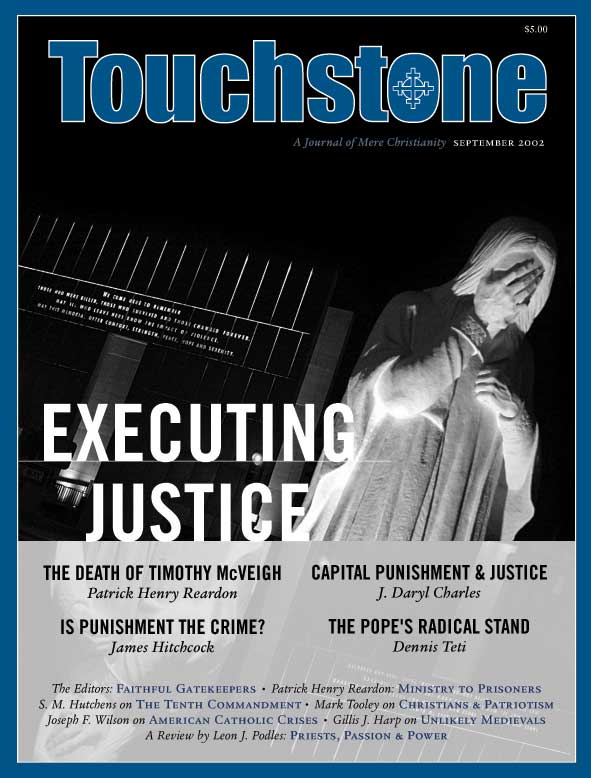
A Papal Remedy
Capital Punishment, the Demise of Natural Law & John Paul II
by Dennis Teti
According to his own testimony, the late Oklahoma City mass murderer Timothy McVeigh was unable to distinguish between his own democratically chosen government and foreign tyrannies, could not tell the difference between fellow-citizens and invading soldiers, and shrugged off murdered innocent babies as “collateral damage.” If the term “moral monster” has any meaning at all, it surely refers to a person who, with no ability to perceive those distinctions, acts violently on the basis of that inability. Such a monster was McVeigh.
Nevertheless, Pope John Paul II, taking his usual strong stand against every application of capital punishment, petitioned President Bush for clemency to commute McVeigh’s death sentence.
Catholic commentators have reacted to the pope’s “new turn” in two ways. Some, who had favored the death penalty until it was criticized in an encyclical a decade ago, now defend a presumed papal authority to alter many centuries of magisterial doctrine on the subject. Others, however, criticize the pope for making that very presumption. Both sides, I contend, are mistaken.
Although John Paul has yet to spell out entirely the logic of his position on capital punishment, he has called it “cruel” and “unnecessary” and located its practice within the context of today’s “culture of death.” Still, the pope has never said that the death penalty violates the principle of justice.
Roman Catholics believe that papal authority, even when exercised infallibly (which is not the case here), falls within certain well-understood and defining contexts; for example, it cannot disregard either the Bible or previous pronouncements of the church’s magisterium, though it can express and further explain them. Now with respect to the principle of justice that requires the death penalty, both Sacred Scripture and the Catholic tradition are unambiguous about the legitimacy of capital punishment in principle. It would be wrong, then, for a Catholic simply to suppose that Pope John Paul’s intention is to contradict either the revealed Word of God or the ancient tradition supporting recourse to this ultimate penalty.
The most reasonable explanation for the current pope’s stance on this question is that his opposition is an exercise in prudence, which is the application of eternally true principles to the changing circumstances of time and place. The highest virtue of political action, prudence involves making judgments about which well-intentioned men may in good conscience disagree. Prudence is not a relativism that denies either the existence or the knowability of eternal or objective truths. Disagreements about prudential judgments are legitimate and should be expected, because not all contemporary circumstances can be perfectly known or future circumstances safely predicted. Aspects of this uncertainty constitute the proper matter for deliberation, balance, and debate.
The Old Testament & Capital Punishment
One of the two best-known biblical endorsements of capital punishment resides in the Old Testament, the other in the New. As always, accurate biblical interpretation requires more than the mere quotation of an isolated verse or two; it is essential, rather, to consider such verses within their entire textual economy, and in both texts to be examined here, their respective settings shed helpful light on the textual intention. I will argue that even the scriptural demand to execute murderers paradoxically finds its justification in Jesus’ two great commandments of love: “‘Teacher, which is the great commandment in the law?’ And [Jesus] said to him, ‘You shall love the Lord your God with all your heart, and with all your soul, and with all your mind. This is the great and first commandment. And a second is like it, You shall love your neighbor as yourself. On these two commandments depend all the law and the prophets’” (Matt. 22:36–401).
The biblical teaching favoring the death penalty is indisputably clear. God himself obliges Israel to carry out capital punishment, instructing Moses in Leviticus 24:17, 21: “He who kills a man shall be put to death.” Again, in Numbers 35:31, God says: “You shall accept no ransom for the life of a murderer, who is guilty of death; but he shall be put to death.”
A Journal of Mere Christianity—Delivered to Your Door
- Essays on theology, culture, and the Church
- Contributors from across the Christian traditions
Six print issues (one year) of Touchstone, plus full online access and PDF downloads for only $39.95.
Get a one-year full-access subscription to the Touchstone online archives for only $19.95.
bulk subscriptions
Order Touchstone subscriptions in bulk and save $10 per sub! Each subscription includes 6 issues of Touchstone plus full online access to touchstonemag.com—including archives, videos, and pdf downloads of recent issues for only $29.95 each! Great for churches or study groups.
Transactions will be processed on a secure server.
more from the online archives

calling all readers
Please Donate
"There are magazines worth reading but few worth saving . . . Touchstone is just such a magazine."
—Alice von Hildebrand
"Here we do not concede one square millimeter of territory to falsehood, folly, contemporary sentimentality, or fashion. We speak the truth, and let God be our judge. . . . Touchstone is the one committedly Christian conservative journal."
—Anthony Esolen, Touchstone senior editor