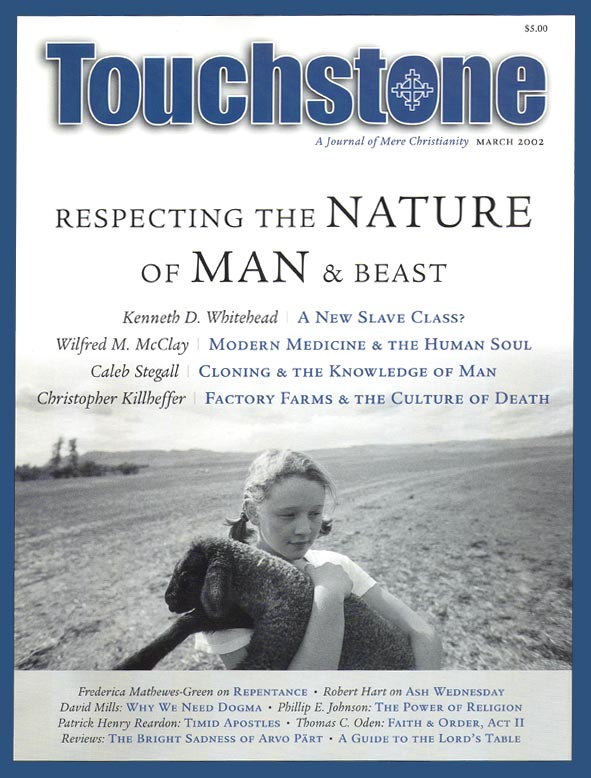
Remember, O Man by Robert Hart

Remember, O Man

Robert Hart on Ash Wednesday

In its emphasis on mortality and guilt, Ash Wednesday offers a two-fold remedy to what ails society. That is, to what ails society because of the prevalent deception that is in the air, and is, like most unthought-out yet strongly held opinions, caught like a virus. Only someone with a Christian mind understands why the thought of our death and our guilt brings comfort. But then, this also suggests why only the Christian can, in the end, be truly happy.

Mortality & Guilt

About death and dying, popular thinking seems itself to be in a state of denial. Perhaps with the beginning of the worship of youth in the 1950s, and the resulting youth culture, people began to seek to avoid death by avoiding age, perhaps by avoiding adulthood itself (after all, the word adult is beginning to mean nothing more than childish delight in things pornographic). If we do not grow up, we cannot grow old, and we can live forever. Viagra can even take away the (to them) greatest disadvantage of age, the loss of sexual gratification.

Maybe we can stay young forever, like Hugh Hefner, who at 75 may still ponder what he wants to be when he grows up. But for now he has nothing more important to do than to score with the chicks, his seven live-in girlfriends. As long as we can sing with Peter Pan, “I won’t grow up,” how can we grow old? How can we die?

The only virtue recognized by the Zeitgeist is that of staying in the best physical shape, having the sleekest and strongest body, and maintaining peak sexual performance. We cannot die. Let us eat, drink, and be merry, for tomorrow we shall live.

So much for mortality. As for guilt, somehow our society has bought the lie that guilt is no problem at all, unless it is felt. All fingers must point to the professions of psychology and psychiatry for forging this deception, and selling it after the model of the most talented con artists and snake oil salesmen. The feeling of guilt is now a medical disability; the reality of guilt must at all costs be denied.

I recall vividly an experience from some 20 years ago, as I sat eating in a restaurant within hearing distance of two men who had no interest in keeping their comments private. “Look, she made the decision to have the abortion,” the conversation went. “Well, that’s that. Now she feels sad all the time because she feels guilty. The doctor told us that we have to be tough with her for her own good, and tell her to knock it off, quit moping, and get on with it.”

Funny how the doctor knew that would happen. Probably, as my experience of sidewalk counseling has made me know, one of these heroes was the sperm donor who, after a bit of pleasure, had to muscle his girl into making what he considered to be the responsible decision. First the girl was deprived of her child, and now she is deprived of her mourning, her conscience—her soul. Part of her very inconvenient humanity had to be eradicated, of course for her own good, just as the child was exterminated for its own good. It’s always for their own good: “The tender mercies of the wicked are cruel” (Prov. 12:10).

The feeling of guilt, even when it is another doing the feeling, gets in the way of sheer pleasure. The feeling of guilt is a malady, and must be treated by searing the conscience with a hot iron. After that, one can sleep nights, if not with peace, at least without painful, annoying distractions.

Thank God for Ash Wednesday. We are reminded by the words, “Remember, O Man, that thou art dust, and unto dust shalt thou return,” that death is a certainty, and we can cease from endless, tireless labors to stay young and naturally immortal. We can focus on something bigger: the eternity into which we most surely shall enter.


Robert Hart is rector of St. Benedict's Anglican Catholic Church in Chapel Hill, North Carolina (Anglican Catholic Church Original Province). He also contributes regularly to the blog The Continuum. He is a contributing editor of Touchstone.

A Journal of Mere Christianity—Delivered to Your Door

  • Essays on theology, culture, and the Church
  • Contributors from across the Christian traditions

Subscribe (Print + Online)

Six print issues (one year) of Touchstone, plus full online access and PDF downloads for only $39.95.

Subscribe (Online Only)

Get a one-year full-access subscription to the Touchstone online archives for only $19.95.


bulk subscriptions

Order Touchstone subscriptions in bulk and save $10 per sub! Each subscription includes 6 issues of Touchstone plus full online access to touchstonemag.com—including archives, videos, and pdf downloads of recent issues for only $29.95 each! Great for churches or study groups.

Transactions will be processed on a secure server.


more from the online archives

24.6—Nov/Dec 2011

Statutes of Liberty

on the Tyranny of Modern Freedom versus the Freedom of Jesus by Gillis J. Harp

25.6—Nov/Dec 2012

Clashing Symbols

The Loss of Aristotelian Logic & the Social, Moral & Sexual Consequences by Peter Kreeft

30.6—Nov/Dec 2017

The Messiah's Beauty

on Benedict XVI on the Fairest of the Sons of Men by Michael Martin De Sapio

calling all readers

Please Donate

"There are magazines worth reading but few worth saving . . . Touchstone is just such a magazine."
—Alice von Hildebrand

"Here we do not concede one square millimeter of territory to falsehood, folly, contemporary sentimentality, or fashion. We speak the truth, and let God be our judge. . . . Touchstone is the one committedly Christian conservative journal."
—Anthony Esolen, Touchstone senior editor

Support Touchstone

00