Reading Tolkien by David Mills
Reading Tolkien
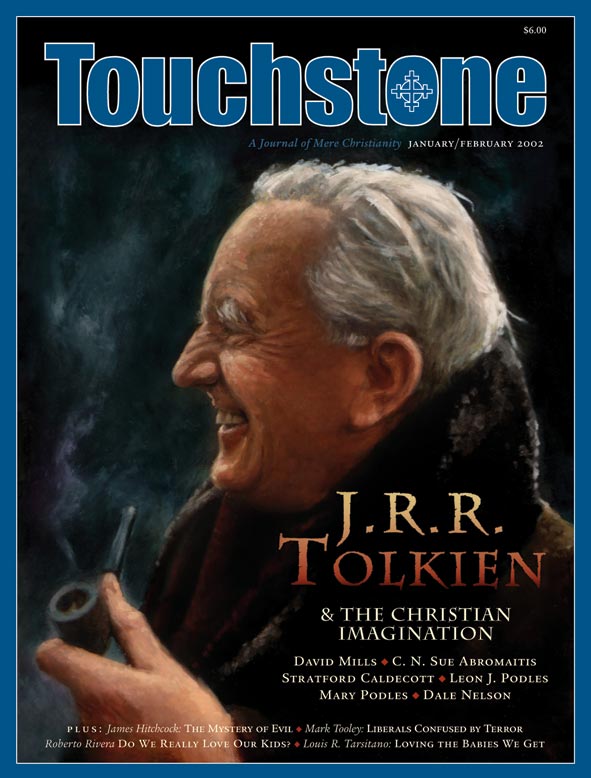
Tolkien: A Celebration
edited by Joseph Pearce
San Francisco: Ignatius Press, 2001
(210 pages; $12.95, paper)
reviewed by David Mills
Although the average Christian reading The Hobbit and especially The
Lord of the Rings knows that they are Christian works, and with good reason,
the hundreds and hundreds of people who have written serious studies of the
books disagree widely on the nature and place of religion in them. No God ever
appears in them, and despite Tolkien’s own belief that they are not only
religious but Christian works, the absence of God has let many critics say that
Tolkien is wrong.
A startling number of them do not realize or (I suspect) do not want to see
that the books are essentially religious. I sometimes get the feeling that this
kind of reader prefers the apparently godless world of Middle-earth and wants
adventure and heroism without the moral order that makes heroism meaningful.
Others argue that the books are religious but that the religion is not Christianity
but the paganism of the ancient north. This is an interesting idea, though I
think it much truer to say that the northern legends Tolkien loved reflected
the kind of Christianity he favored.
Still others see that the books are Christian works but hold this a weakness.
These critics tend to think Tolkien’s type of Christianity—doctrinally
orthodox Christianity expressed in a morally and socially ordered world—to
be an instrument of social and sexual oppression.
Tolkien’s work has such cultural importance and influence that a certain
sort of academic critic will find in it a summary of everything he thinks wrong
with Western culture and especially with Christianity. The books have sold too
many copies to be ignored by the sort of scholar who believes popularity a sign
that the work supports the oppressive beliefs of the mass of men.
Celebrating Tolkien
Against this kind of negative reading, which is more common than you might
expect—it started with the first reviews of The Fellowship of the
Ring—many writers have explained the Christianity of Tolkien’s
works, but their work has been scattered about in journals and books, most of
them hard for the average reader to find. Tolkien: A Celebration collects
several very good essays on the subject (and some weak ones), which together
will give the average reader—everyone but the scholar and the fanatic—as
much on the subject as he is likely to need. Seven are reprints, and eight are
original.
It is an ecumenical collection, and the writers range from Stratford Caldecott
of the Centre for Faith and Culture in Oxford, a Catholic, to the Reformed theologian
Colin Gunton of King’s College, London, to the author of Defending
Middle Earth, Patrick Curry, who does not seem to be a Christian. The writers
also include two Jesuits, James Schall and Tolkien’s friend Robert Murray;
another friend of Tolkien’s, Richard Jeffery; the Evangelical fantasy
writer Stephen Lawhead; Walter Hooper; and the editor himself.
The editor, Joseph Pearce, now the writer in residence at Ave Maria University,
has written several books, including Literary Converts and Wisdom
and Innocence, a biography of G. K. Chesterton that is one of the
two I recommend. Both books are published in this country by Ignatius Press,
and both have the marks of Pearce’s writing: extensive research, a care
to make only the most justified and judicious of judgments about his subjects,
a somewhat partisan defense of his subjects, and extensive quotation from primary
and secondary sources.
Pearce also wrote a biography of Tolkien, Tolkien: Man and Myth,
published by Ignatius in 1998. (The reprinted essays in Tolkien: A Celebration
are those he came across while researching the biography and thought needed
to be offered to new readers.) It does not replace Humphrey Carpenter’s
authorized biography, J. R. R. Tolkien, first published in
1977 and still in print, and in fact seems to draw almost all the details of
Tolkien’s life from Carpenter’s work, padded out with long quotes
from secondary sources and the writer’s own commentary, which is not always
precise enough to be helpful.
No Sex, Please
It may be worth looking at an example of Tolkien’s critics to understand
the usefulness of Tolkien: A Celebration. Many of these critics are feminists,
who argue that his imaginative world carries hidden within it a deep prejudice
against women, no matter what Tolkien thought he was doing. In an essay still
sometimes referred to by writers on Tolkien, “No Sex, Please, We’re
Hobbits: The Construction of Female Sexuality in The Lord of the Rings,”
an English teacher named Brenda Partridge blamed the “Norse and Christian
mythologies in which he was immersed” for reinforcing Tolkien’s
alleged low view of women, which he shared with “countless generations.”
I happened to read this essay at the same time I was reading the book I am reviewing,
and it is a good example of the sort of thinking the Christian reader who believes
Tolkien’s Christianity a good thing is up against. I will describe the
essay at some length, as an example of the sort of treatment Tolkien has received.
In the following I am assuming, by the way, that readers of this review have
read The Lord of the Rings. If you have not read the book, put down the review,
find a place where you will not be disturbed for two or three days, and start
reading. (Have your meals delivered. You will need to sleep, but you can skip
showers.)
To expose what she takes to be Tolkien’s real meaning, Partridge used
the now standard analysis, by which every possible bit of evidence for the writer’s
misogyny is presented as proven, and every possible bit of evidence that he
was not a misogynist is explained away as a more subtle way of stereotyping
women. When told that The Lord of the Rings illustrates Tolkien’s “prejudices
against women” (her term), most readers will think of the Elf queen Galadriel.
She is a leader of her people and of the free peoples of Middle-earth, who is
in fact shown to be both wiser and more merciful than her husband, and who in
renouncing the Ring when she has the power to take it, proves one of the moral
heroes of the book.
But Partridge has an answer for this. However grandly Tolkien may describe
Galadriel, she is really only “an idealized female deity who, though wise
and inspirational, is still in many ways remote and passive: still the lady
on the pedestal who inspires the knight.” Although “she is the source
of inspiration, it is the male heroes that play the active role in setting the
world to right.” If Tolkien makes her great, her greatness is only a more
subtle way of removing women from the real world in which the really worthwhile
actions are taken.
If you think Galadriel a hero, Partridge responds that Tolkien relied “on
myth to portray women characters with its two dimensional stereotyping”
and that this “reveals a lack of knowledge and wariness of women.”
As he relied just as much on myth to portray his male characters—if she
is right in putting it this way, which I don’t think she is—this
does not tell us much about Tolkien. But it is enough to flay Tolkien with,
if you are so inclined.
And of course she included the suggestion, which she wisely hedged after having
planted the idea in the reader’s mind, that her subject may have been
homosexually interested in a close friend, in this case C. S. Lewis. Her
evidence—the experienced reader would have been expecting this, by the
way—is that Tolkien and his wife slept in different rooms (which English
couples often do), that Tolkien resented Charles Williams’s intrusion
into his friendship with Lewis (as many of us, including Partridge herself,
might well have done), and that Lewis’s marriage distressed him (though
a Catholic was bound to find distressing his friend’s marriage to a divorcee,
which fact she does not mention). She hopelessly misunderstands friendship,
or perhaps just men.
A Symbolic Shelob
Later in the essay, she finds in the monstrous spider Shelob that “Tolkien
is following a tradition in portraying woman as a threat, with implied sexual
overtones. . . . Tolkien interprets myth in such a way as to
reveal his inner fear or abhorrence of female sexuality, but his attitude is
reinforced by the prejudices inherent in the religious symbolism itself.”
This comes after a section in which she found homosexuality of a sort in the
friendship of Frodo and Sam. Sam’s care for Frodo lying wounded after
being tortured by Orcs she described as “the final, full yielding of Frodo’s
body to Sam’s arms” and a paragraph later spoke of the “consummation”
of their friendship. I don’t know quite what to say of writers who cannot
understand love without thinking it sexual, and critics who do not stop to think
that writing in the forties Tolkien would not have written the passage as he
did if he thought such care for a friend homosexual.
The essay is a feast of clumsy Freudianism, which reminded me of the line in
one of Tom Lehrer’s songs that “anything’s a phallic symbol
if it’s longer than it’s wide.” Partridge bases part of her
reading on “the obvious phallic symbolism of the sword,” which might
be obvious if swords were not the only things the characters in such a story
could possibly use as weapons. Did she think that the creatures of that world
could defend themselves with bazookas? As Freud himself famously said, sometimes
a cigar is just a cigar.
But not to the critic determined to convict Tolkien of prejudice. To Partridge,
Shelob’s cave symbolizes the female sexual organs, and the cobwebs covering
the entrance to the cave symbolize pubic hair. The normal reader will wonder
where else you would find a giant spider in treeless mountains, if not in a
cave, and what else you would expect to find at the entrance, if not cobwebs.
He would also note that a writer might well set a story in a cave because caves
with monsters in them are scary.
Frodo’s cutting through the web with his sword becomes in Partridge’s
reading sexual penetration because “the diction used to describe the tearing
of the web, ‘rent’ and ‘veil,’ is traditionally associated
with the tearing of the hymen.” She does not seem to have thought that
“rent” might best describe the opening of that sort of barrier,
and that to Tolkien it might have had biblical rather than sexual echoes.
She went on at some length to describe in the same way Sam’s battle
with Shelob as “a violent sexual struggle between man and woman.”
He has that phallic sword, you see, and Shelob is a female, you see, and . . .
oh never mind. It is a very funny passage.
Though “No Sex, Please, We’re Hobbits” does a good job in
arranging the evidence to fit her scheme, it is not a very helpful essay, unless
you are committed to its writer’s ideology. Partridge gives the feminist
version of the common belief that Christianity is bad and Christian works corrupting.
A lot of critics believe this and will be hostile to Tolkien’s book to
the extent they believe it a Christian work.
All that said, the essay does suggest some useful lines of thought about the
extent to which The Lord of the Rings is a “boy’s book,”
and even its Freudianism may identify unsuspected meanings in the book, even
if it explains them in a uniformly hostile way. If Partridge is right about
the symbolism of the battle with Shelob, for example, the story still may not
necessarily express the fear of women she finds in it, but offer an insight
into the horror of disordered fertility—an insight the critic’s
ideological commitments prevent her from seeing.
Partridge’s essay is one of the cruder treatments of Tolkien you can
find, but other critics of Tolkien still mention it from time to time as giving
insight into his works. The Lord of the Rings is simply too popular
a work, and too obviously traditional a work, for critics to leave it alone.
They must deconstruct it to reveal its complicity in all forms of social and
sexual oppression. I would not be surprised, now that the movies are coming
out, to find academic presses producing volumes of such essays.
A Useful Book
This predictable hostility to Tolkien’s faith is one reason Tolkien: A Celebration is so useful. Its best essays not only explain how and why his books
are essentially Christian works, but also make this Christianity compelling.
The two best essays, I think, are Stratford Caldecott’s and Colin Gunton’s.
In his “Over the Chasm of Fire: Christian Heroism in The Silmarillion
and The Lord of the Rings,” Caldecott argues that “The
Lord of the Rings is not a flawless work, but it is richer and deeper than
many books more carefully crafted by shallower men.” People read it over
and over because “the ‘truth’ in myths and legends bears repeating
because it cannot be taken in all at once. There are stories we have to grow
into; stories that deal with the way the world is made, and the way the
Self is made.” (And unmade as well.) Because they can “restore a
balance to the psyche by turning our energies and our thoughts towards truth . . .
[r]eading them can be a bit like praying.”
Caldecott treats the story as the story of a quest, not just for treasure (the
ironic treasure of the freedom from a treasure) and victory, but for transformation.
This is where, though never mentioned in the book, God comes in.
The Saviour of Middle-earth turns out to be One who works through the love
and freedom of his creatures, and who forgives us our trespasses “as
we forgive those who trespass against us,” using even our mistakes and
the designs of the enemy . . . to bring about our good. The
ending of The Lord of the Rings is a triumph of Providence over Fate,
but it is also a triumph of Mercy, in which free will, supported by grace,
is fully vindicated.
After explaining how the story of Beren and Lúthien, a story from The Silmarillion of great courage and faithfulness in Middle-earth’s ancient
past, gives the pattern for heroism that is followed by the heroes in The
Lord of the Rings, Caldecott shows that the humble Sam Gamgee is the central
hero of the work. As Tolkien himself wrote, the book is concerned with “the
ennoblement (or sanctification) of the humble,” and Caldecott shows in
detail how Sam grows from the eavesdropping gardener into a man (if you will)
whom the king entrusts to represent him in the northern kingdom, and illuminatingly
ties even Sam’s story to the story of Beren and Lúthien.
And here you see one of the benefits of a Christian writing on the books, because
he loves the things Tolkien loved and knows intuitively what Tolkien knew. One
of Partridge’s denser misreadings is her claim that “the only function”
of Sam’s marriage at the end of the book “lies in Tolkien’s
habitual tidying up of loose ends.” The marriage is only second best,
as “the companionship it provides will never reach the depths of passion
and spiritual intensity of the relationship of Sam and Frodo.”
She must have read the ending and seen only the story of a man who goes out
for a night with the Elves—after all those exciting months saving the
world—and comes home to his wife, who has to make him dinner. She apparently
thought that dull and boring. The reader without her ideology would assume that
the book ended with Sam at home with his wife and child for a reason, and in
fact Tolkien left off the rest of the ending he had written, published now in
volume IX (pages 114–135) of The History of Middle Earth, to
make it end where it did.
The last chapter, which I think one of the most moving stories in modern literature,
shows that the end and goal of all true heroism is the ennoblement and sanctification
of the domestic, the intimate, the personal: that a man goes out into the world
on a quest so that he can come home and hold his child on his lap and talk to
his wife. This Caldecott sees, but Partridge didn’t. Caldecott, one suspects,
has the richer life.
In “A Far-Off Gleam of the Gospel: Salvation in Tolkien’s The Lord of the Rings,” Gunton looks at the book as “in a broad sense about
salvation” and finds the book and the Christian teaching of the Atonement
“mutually illuminating.” He describes three sources of images for
the Christian view of salvation: sacrifice (the cleansing from pollution), law
(the forgiveness of sins), and battle (the triumph of light over darkness).
The last is Tolkien’s “chief cue in his great story.”
He goes on to describe the parallels between Tolkien’s world and the gospel
(eleven by my count, though it would have been helpful if he or the editor had
listed them clearly). Among them is Tolkien’s understanding of “the
person in relation.” Gunton argues that Christianity holds that “To
fall into the power of the evil one is to be depersonalized,” and Tolkien’s
story illustrates this in several ways. The herald of Sauron, for example, who
had forgotten his own name and called himself only “the Mouth of Sauron,”
shows that “to serve the power of evil is to lose one’s name, that
which we gain by virtue of our loving relationship with others; it is to enter
a slavery in which our very identity is taken away.”
Other Essays
Many of the other essays are also helpful and stimulating. In “J. R.
R. Tolkien and the Art of the Parable,” Robert Murray uses Tolkien’s
idea of a story’s “applicability” to understand the purpose
and use of Jesus’ parables. Tolkien famously disliked allegory, and wrote
in the foreword to The Lord of the Rings that he preferred to allegory
“history, true or feigned, with its varied applicability to the thought
and experience of readers,” as applicability “resides in the freedom
of the reader, and [allegory] in the purposed domination of the author.”
In his parables, Murray argues, Jesus told “applicable” stories
because he wanted the hearer to choose him. “He therefore chose not to
confront them all immediately with a challenge for which many might not be ready,”
Murray argues, “but rather to use a medium which could first attract and
then fascinate and tease the mind, even for a long time, till the hearers might
form their own response.” He shows how this applicability justified the
early and medieval Church in reading the parables allegorically.
Kevin Aldrich’s “The Sense of Time in Tolkien’s The
Lord of the Rings” reflects on “the way men and elves respond
to the mystery of Time, a mystery of our own lives.” He finds in Tolkien’s
treatment of time and our inevitable death a “poignancy, in which sorrow
overpowers joy,” and examines how in the story Men are tempted to cheat
death by stealing immortality and the Elves by freezing time and refusing change.
He concludes with a moving reflection on immortality and the fact that “there
is no escape from death except through death, if at all. . . .
What The Lord of the Rings has to say ultimately is that if true happiness
is to be found by mortals, it will be found not in time but in eternity.”
Other essays of note include Charles Coulombe’s “The Lord of the Rings: A Catholic View,” which lists the “recurring images in Catholic
culture” that shaped Tolkien, not just the obvious ones like the Virgin
Mary and the sacraments, but less obvious images taken from European history,
like the age of faith and the organic society. In just a few pages, James Schall’s
“On the Reality of Fantasy” explains the effective realism of Tolkien’s
story, so that “the unsuspecting reader who thinks he is only reading
‘fantasy’ in reading Tolkien will suddenly find himself pondering
the state of his own soul because he recognizes his own soul in each fairy-tale.”
Tolkien’s friend George Sayer opens the book with charming and revealing
memories of Tolkien. And in “Modernity in Middle Earth,” Patrick
Curry defends Tolkien against the usual charge that he is a romantic and reactionary.
Tolkien, he argues, “deserves credit for having perceived the destructive
consequences of modernity long before the great majority of his peers. . . .
As a conservative Catholic medievalist, he was sufficiently marginal to the
mainstream to see the modern world relatively objectively, yet sufficiently
erudite to contextualize and articulate his perceptions.”
Friends’ Disagreements
As in any such book, the Tolkien reader will disagree with many of the writers’
claims, even if he agrees with them in general. I am not sure that many of the
writers’ criticisms of Tolkien’s work convince, because they seem
often to misunderstand what Tolkien was, or seems to have been, doing. I will
give two examples, which struck me as I was reading and which serve as good
examples of the sorts of disagreements so great a work will create among its
admirers.
First, in his “Root and Tree: The Growth of Tolkien’s Writings”—a
good short study of the subject—Richard Jeffery argues that the last volume
of The Lord of the Rings “is a mixture of compelling parts and parts he’d
have done better to rethink completely.” The three chapters describing
Sam and Frodo in Mordor he thinks “just dull, the orcs sound far too much
like ordinary grumbling soldiers.”
I do not think the chapters dull, but a well-done mixture of two realities:
the excitement of heroes toiling under constant risk of discovery and death,
and the pain and drudgery of their march to Mount Doom. If it is dull, I think
Tolkien intended it to be dull in that way, so that the reader begins to feel
a small part of Frodo and Sam’s particular suffering. His point, I think,
is that great acts are most often accomplished by small people simply persevering
in doing the hard and boring thing, and not, or not only, in great men doing
exciting things.
In the same way, the Orcs do sound like ordinary grumbling soldiers, but I think
that Tolkien wanted them to sound like ordinary grumbling soldiers, because
he knew that this sort of creature does as much evil as the great villains.
The ordinary grumbling of the Orcs only heightens the story’s horror by
showing the banality of evil Hannah Arendt described a decade later. We tend
to assume that great evil is done for great ends, when it is often done for
very small and trivial gain.
Second, Gunton sees in Christianity’s eschatological vision (he quotes
Ephesians 1:9f.) “a radical difference from Tolkien’s tale. The
latter does sometimes reveal a nostalgic pessimism: the old order has gone,
is tired and soiled, and will never return. . . . It is a rather
backward looking vision: the best was in the past, and will not return.”
(He mentions as evidence the Elves leaving Middle-earth.) The Christian vision
is “eschatological, and reminds us that hope is a primary Christian virtue.”
I think this misreads Tolkien rather badly. His imagined world shared the
laws of the primary or real world, which includes the primacy of hope and the
reality of the End. But the Christian has no reason to believe that history
is getting better, or that the best was not indeed in the past—we are,
after all, creatures exiled from Eden. It may be that the eschaton will arrive
at the “absolute nadir” of human fortune, as it did in The Lord
of the Rings. If I understand Tolkien rightly, he felt that many good things
were passing away forever—diversity, for example, which he saw disappearing
in our world with its “Americo-cosmopolitanism” as it was in Middle-earth
with the departure of the Elves.
But the story does depend upon hope, if “hope without guarantees”
as Tolkien put it. Frodo does succeed against all odds, but at a cost, the loss
of everything he loved, which could only be healed in the next world. Tolkien’s
vision of hope amid loss is better suited for the world in which he grew up
than Gunton’s cheery “eschatological” hope, and I think better
suited for the world into which we seem to be moving.
A Lesson in Hope
That is, I think, a very good reason to remember that Tolkien’s work
is, as Tolkien himself put it in a letter, “a fundamentally religious
and Catholic work.” It is a reason to reject the readings of those hostile
to Tolkien’s Christianity, even when they are not so comical as Partridge.
The Lord of the Rings is not only a marvelous story, with much to
teach us about good and evil, and damnation and salvation, about the nature
of history and the uncertainties and the changes in the affairs of men. It is
also a lesson—still powerful though given in an imagined world—in
knowing what history offers us and acting well nevertheless, an encouragement
in keeping faith with the God who “works through the love and freedom
of his creatures, and who forgives us our trespasses ‘as we forgive those
who trespass against us’, using even our mistakes and the designs of the
enemy . . . to bring about our good.”
“No Sex, Please, We’re Hobbits” can be found in J.
R. R. Tolkien: This Far Land, edited by Robert Giddings (Barnes & Noble,
1983).
David Mills is deputy editor of First Things. He was editor of Touchstone from 2003-2008. His most recent book is Discovering Mary: Answers to Questions About the Mother of God (Servant Books). He lives with his wife and four children outside Pittsburgh, where they attend St. Joseph’s Catholic Church in Coraopolis. |