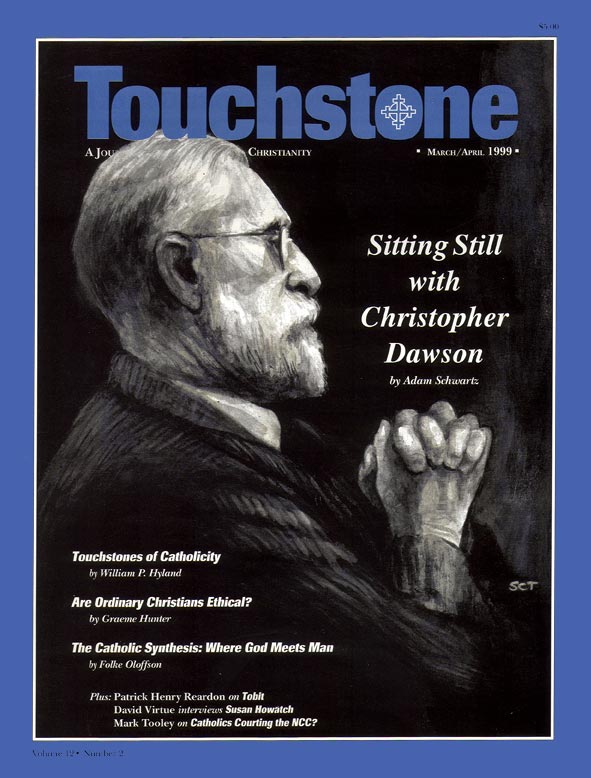
Sitting Still with Christopher Dawson by Adam Schwartz
Sitting Still with Christopher Dawson
Eternity in Time: Christopher Dawson and the Catholic Idea of History
edited by Stratford Caldecott and John Morril
Edinburgh: T&T Clark, 1997
(214 pages; $39.95, cloth)
reviewed by Adam Schwartz
While lecturing in the United States in the early 1930s, T. S. Eliot was asked
which of his contemporaries was the most powerful intellectual influence in
Britain. He could have nominated well-known figures like his Bloomsbury friends,
Chesterton, Auden, or Shaw; but Eliot selected another: Christopher Dawson.
Dawson’s work was similarly praised across the ideological and theological
spectra, as the likes of G. K. Chesterton, Barbara Ward, Russell Kirk, Dorothy
Day, C. S. Lewis, Arnold Toynbee, and Lewis Mumford all testified to its importance
for their efforts.
Yet despite this chorus of applause, Dawson’s writing has suffered,
especially since his death in 1970, from what E. P. Thompson called the “condescension
of posterity.” In recent years, however, signs of renewed interest in
Dawson and his copious reflections on history, culture, and modern society have
emerged; this volume of essays is an important contribution to that renaissance.1
Like all such collections, however, its quality is uneven. The best contributions
will be studied profitably by both novices and veterans of Dawson; but the weaker
offerings illustrate to varying degrees a troubling trend in current Christian
scholarship: the treatment of the work of great minds instrumentally rather
than analytically.
The details of Dawson’s life (1889–1970) and milieu are not as
widely known as those of peers like Eliot, Chesterton, and Lewis. This book’s
first two articles, then, will be useful to all readers, particularly to newcomers
to his work. Christina Scott’s discussion of Dawson’s vision and
legacy is a cogent précis of his career and the main lines of his thought.
As such, it both summarizes and supplements her careful 1984 biography of Dawson
and should encourage fresh readings and rereadings of that narrative.2
Scott especially stresses here how Dawson’s sense of the relationship
between religion and culture and his passion for unity helped integrate his
disparate efforts as a scholar and social critic. She notes rightly that this
sensibility fostered a precocious and often misunderstood ecumenical attitude,
plus a nuanced worldview whose complexity even some admirers fail to comprehend
fully.
Fortunately, Aidan Nichols possesses an erudition as subtle as his subject
demands. His sketch of Dawson’s Catholic setting is an excellent elucidation
of one crucial context in which Dawson worked, as it capsulizes signal figures,
trends, and events without oversimplifying often complicated ideas and developments.
Nichols argues that the historical significance of the twentieth-century British
Catholic revival is its “theology of culture”: “its main claim
to the attention of posterity lies in this resolute endeavor to bring a Catholic
sensibility to bear on cultural life” (27), one premised on the belief
that “art, philosophy and social politics are inextricably interrelated,
and that the key to their unity belongs with religion” (39). Nichols demonstrates
Dawson’s centrality to this movement, particularly through his participation
in the Order Group, a collection of Catholic intellectuals that also included
the artist and poet David Jones (whose recondite work Nichols makes accessible
without vulgarizing it). He traces its evolution from its heyday in the 1930s,
through its response to traumas like the Spanish Civil War and World War II,
to its postwar eclipse. Although this essay contains some questionable judgments—particularly
its uncharacteristically unrounded rendering of Dawson’s conversion to
Roman Catholicism—it is indispensable for tyros in this field, and should
also prove piquant for those well read in it.
The Christian View of History
As both Scott and Nichols suggest, Dawson’s religious faith undergirded
all his intellectual efforts. He believed that people are naturally religious
and, hence, as a historian, concluded (with Lord Acton) that “religion
is the key of history.” Yet Dawson also contended that the Christian faith
makes the distinctive claim to be an essentially historical religion, one based
on belief not just in the general direction of history by Providence, but in
“the intervention by God in the life of mankind by direct action at certain
definite points in time and place,” culminating in the Incarnation. This
“central doctrine of the Christian faith” is hence “also the
center of history,” a synergy that, according to Dawson, generated a unique
vision of history:
The Christian view of history is not a secondary element derived by philosophical
reflection from the study of history. It lies at the very heart of Christianity
and forms an integral part of the Christian faith. Hence there is no Christian
“philosophy of history” in the strict sense of the word. There
is, instead, a Christian history and a Christian theology of history, and
it is not too much to say that without them there would be no such thing as
Christianity.3
The Christian, then, considers the sacred not just a force within history,
but also the source of its significance. Dawson in particular found “a
natural affinity and concordance between the spirit of Catholicism and the spirit
of history”4 in his day, believing that “Catholicism differs
from other forms of Christianity in representing this incarnational principle
in a fuller, more concrete, and more organic sense,” due to its rejection
of the twin temptations of idealism and liberalism that he was convinced modern
Protestantism had succumbed to.5 The majority of the essays under review
deal with this view of history, either in Dawson’s work or more generally,
although even the best ones seem surprisingly unaware of these theoretical comments
by Dawson.
Dermot Quinn and Fernando Cervantes attend more to this outlook’s presence
in Dawson’s thought. Quinn’s interpretation of Dawson’s historiography
is panoramic, yet not diffuse, as he views it through the lens of Dawson’s
concern for unity and integration and demonstrates effectively how Dawson’s
Catholicism was his oeuvre’s centripetal principle. Quinn also supplies
a good sense of how Dawson’s commitment to this idea of history made him
a dissenter from modern scholarly methodologies, while further revealing some
striking affinities it has with the thought of Hans Urs von Balthasar. His broader
remarks about the nature and problems of Catholic history, plus his defense
of Dawson’s approach against Hayden White’s criticism of it, however,
would have benefited from more specific references to Dawson’s own commentary
on the Catholic theology of history.
Cervantes is also interested in how Dawson’s larger concerns shaped
his historical scholarship, but his focus is more microscopic, as he undertakes
a close reading of Dawson’s The Making of Europe (1932). Cervantes
provides a skillful exegesis of this text, disclosing especially the shaping
influences of Dawson’s desire to assert the value of tradition in an apparently
presentist age and his anxieties about the centrifugal force of modern nationalism.
Moreover, Cervantes also notes how Dawson’s argument in this volume that
the Dark Ages were actually ages of the dawn of Christendom set his view of
the period at odds with received interpretations of it. Indeed, it is unfortunate
that Cervantes did not examine the impact of Dawson’s thesis on subsequent
historians of this epoch, an enterprise that would have been more profitable
than the predictable philippic about the current state of Western culture with
which he concludes his otherwise informed and useful presentation of a central
Dawson book.
Francesca Murphy and Glenn Olsen deal less with the Catholic idea of history
as found in Dawson’s work than with it as a concept, thereby developing
themes expressed embryonically in John Morrill’s introduction. Both authors
distinguish between two definitions of this model: the first sees Catholic history
as history about Catholics or distinctly Catholic topics. Olsen deems this approach
at least more honest in foregrounding its principle of selecting material than
some secular schemas are, but Murphy eschews it as a form of identity politics.
Each, though, has greater sympathy for a second, more Dawsonian, understanding
of Catholic history as a “quality of imagination” (128) that produces
interpretations “superior to, more illuminating of, man’s situation
in history” (141) than alternative paradigms. Olsen’s explication
and defense of this perspective are more thorough, as he specifies its components
as a sense of God’s glory, of mystery and an ensuing humility, and of
the Fall’s tragic implications, with a corresponding distrust of Progressive
ideologies. Both scholars, however, present standpoints essentially in agreement
with Dawson’s and thereby provide useful glosses on his outlook, while
also illuminating the distinctive challenges confronting current historians
who wish to imitate his integration of faith and work.
The Connection Between Religion & Culture
The contributors to this collection are united in agreeing that one of Dawson’s
most significant insights was his emphasis on the connection between religion
and culture. Just as he asserted that people are naturally religious and that
religion is the key of history, so he believed that religion is the basis of
culture: “It is the religious impulse which supplies the cohesive force
which unifies a society and a culture. The great civilizations of the world
do not produce the great religions as a kind of cultural by-product; in a very
real sense the great religions are the foundations on which the great civilizations
rest.” He thus considered the seeming secularization of Western civilization
a form of cultural suicide, as “a society which has lost its religion
becomes sooner or later a society which has lost its culture.”6
Yet Dawson did not think this process was irreversible for, as Nichols points
out, he and his fellow Catholic thinkers devoted themselves to a “theologically
informed program for culture’s Christian revivification” (28).
Similar concerns guide the musings of Michael O’Brien and Stratford
Caldecott. O’Brien’s essay is the longest in the book but also the
one least concerned with Dawson. While entitled “Historical Imagination
and the Renewal of Culture,” it is really more about aesthetics, agreeing
implicitly with Gregory Wolfe that beauty will save the modern world. As such,
O’Brien’s thesis that the “death of the imagination”
(156) in modernity has created “the culture of negation” (181) resonates
only tangentially and in the most general way with Dawson’s chief interests;
in fact, O’Brien’s preoccupations correspond much more closely to
David Jones’s. His survey of art history is skillful and at times eloquent;
but, given the paucity of Dawson scholarship, the space reserved for this article
would have been better devoted to examining topics more directly linked to his
work and primary concerns.
Although Caldecott’s contribution is also not a specific analysis of
Dawson’s thought, it does help situate it within a tradition of Catholic
cultural criticism. Caldecott’s main text is John Paul II’s
Tertio Millennio Adveniente (1994), and his fine close reading of that
encyclical offers a bridge connecting Dawson’s views and hopes for cultural
conversion with the present pope’s, while noting comparable notions held
by Chesterton and von Balthasar in the process. Caldecott’s presentation
of these intellectual and theological likenesses could have been more systematic;
but depicting Dawson as engaged in a conversation across the ages about modernity’s
fate supplements and amplifies Nichols’s description of his contemporary
Catholic community of discourse.
A Prophet or a Thinker?
Other members of that company—such as Chesterton—are often dubbed
prophets. Dawson, too, has often been so designated, and many of this volume’s
contributors characterize him as one. There is danger in so labeling a thinker,
however, as attention can be diverted from the intricacies of his thought and
devoted instead to assessing its applicability to current issues. Such an approach
to subtle worldviews frequently entails a loss of nuance in their understanding
and portrayal, and hence creates the misleading impression that their authors
are glib, ephemeral thinkers.7 The work of Chesterton and Lewis has
been subject to this process of appropriation and distortion, and as interest
in Dawson’s has increased, it has not been immune either.
Both Cervantes and O’Brien give in to this temptation to some extent,
but Russell Sparkes’s essay exemplifies this tendency best. Although entitled
“Dawson and ‘Economic Man’,” Sparkes’s effort
is less an analysis of Dawson’s economic views than his own condemnation
of classical liberal economics and contemporary capitalism, with Dawson’s
writing invoked occasionally to buttress his conclusions. Yet the topics Sparkes
takes up and the rhetoric he uses—the Roman Empire as an analog for contemporary
society, the relevance of “medieval” ideals for modern times, the
connection between Protestantism and capitalism, and a romantic-distributist-style
critique of capitalism—are all subjects Dawson addressed and tropes he
employed, ones that have received little scholarly treatment. Discussing and
contextualizing their presence in his thought would thus have been more productive
than presenting extracts that do not convey the richness and depth of Dawson’s
social criticism: his thought is too textured to serve polemical purposes without
forfeiting its profundity. Sparkes’s intentions are good, and he is hardly
alone in so regarding Dawson’s thought. But Dawson’s reputation
will rest ultimately not on his works’ ability to solve the problems of
a particular period, but on its expression of the permanent things in a distinctive
voice. Christina Scott’s admonition cannot be commended too highly: “his
writings should never be used as a handle in current theological [or political]
issues” (16).
Most of the contributors to Eternity in Time, however, have kept
their eyes on the long run, when we will all be dead, but the writings of authors
like Dawson and thoughtful commentary on them will live on. In so limning his
life, ideas, and some of the contexts in which he worked, they continue that
gradual, yet finally rewarding process of restoring Dawson’s reputation
to its rightful stature as one of twentieth-century Christianity’s leading
lights. Efforts like Eternity in Time, and those that may be inspired
by it, make it increasingly difficult for posterity to continue condescending
to Christopher Dawson. His permanent wisdom transcends the exigencies of any
era, making every age eligible to learn from it. But that knowledge and its
implications can only be gleaned through patient study: rushed attempts to redeem
the time lack that vision without which even the best-intentioned plans perish.
Learning to sit still with those dead who give us life is also learning to hope.
As Eliot put it,
And what there is to
conquer
By strength and submission, has already been
discovered
Once or twice, or several times, by men whom one
cannot hope
To emulate—but there is no competition—
There is only the fight to recover what has been lost
And found and lost again and again: and now, under
conditions
That seem unpropitious. But perhaps neither gain
nor loss.
For us, there is only the trying. The rest is not our
business.
Notes:
1. A further harbinger of a possible Dawson revival and an excellent complement
to this volume is Christianity and European Culture: Selections from the
Work of Christopher Dawson, ed. Gerald J. Russello (Washington, D.C.: The
Catholic University of America Press, 1998). Russello’s preface to this
book is the best single introductory essay on Dawson’s work yet composed.
2. Christina Scott, A Historian and His World: A Life of Christopher Dawson
(London: Sheed & Ward, 1984). [See the review of this title in Touchstone,
Summer 1987, pp. 12–14. —Ed.]
3. Christopher Dawson, “The Christian View of History” (1951),
in Dynamics of World History, ed. John J. Mulloy (Peru, Illinois: Sherwood,
Sugden & Co., 1978), pp. 234, 235.
4. Christopher Dawson, Religion and the Modern State (New York: Sheed
& Ward, 1935), p. 82.
5. Christopher Dawson, “The Kingdom of God and History” (1938),
in Dynamics of World History, p. 284.
6. Christopher Dawson, Progress and Religion (1929; reprint, Peru,
Illinois: Sherwood, Sugden & Co., 1992), p. 233.
7. The seminal work on this topic is John Rodden, The Politics of Literary
Reputation: The Making and Claiming of “St. George” Orwell
(Oxford: Oxford University Press, 1989).
Adam Schwartz is Assistant Professor of History at Christendom College. |