




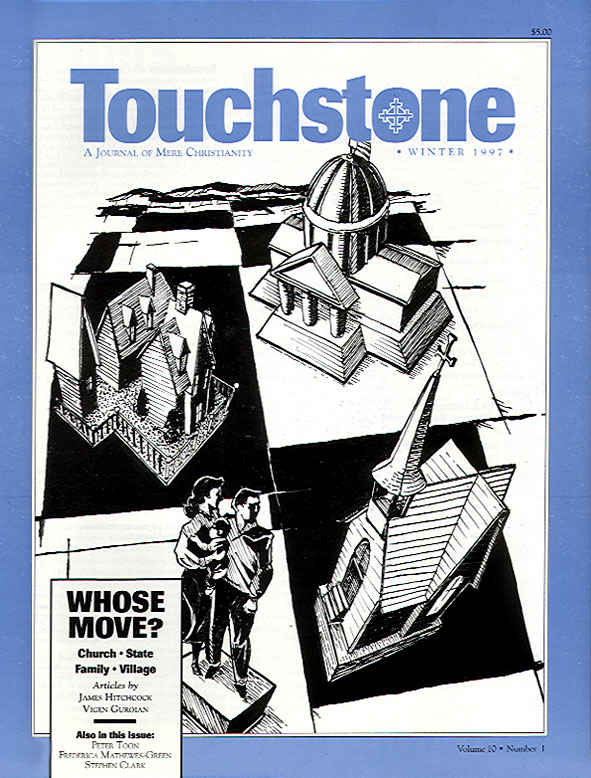
A Bridge or an Abyss?
The Debate over the Family in the American Political “Village”
by Vigen Guroian
In his acceptance speech for the Democratic presidential nomination, President Bill Clinton said he wanted to build bridges to the future. And he promised that he would commit the federal government to a strong role in supplying the building materials so that Americans might successfully cross over into the perennially promised new era that American politicians like to reimagine every presidential election year.
During the 1996 presidential campaign Clinton and the Republican nominee Bob Dole linked almost every domestic issue to one theme—family values. Each nominee insisted he was the most committed to the American family and that he also knew best how to rescue the core family values that were needed for a healthy society and a strong nation. Dole maintained that the difference between Clinton and himself was that he did not believe the values and virtues, the ethical material for the bridge, ought to come from the state. In his acceptance speech for the Republican nomination Dole said:
The state is now more involved than it has ever been in the raising of children, and children are now more neglected, abused, and mistreated than they have been in our time.
This is not a coincidence. . . . I am here to tell you that permissive and destructive behavior must be opposed, that honor and liberty must be restored, and that individual accountability must replace collective excuse.
But Dole also added that, while he could not “magic[ally] restore to every child who lacks a father or a mother that father or that mother, . . . I would never turn my back on them, and shall, as president, promote measures that keep families together.” So Dole too would turn to the powers of the national government to bridge the gap in values and fill the sinkhole of moral decline and social disintegration.
I happen to believe Dole spoke the truth when he stated repeatedly that he was more inclined than his opponent to embrace federalism and localism and the resources of voluntary associations to remedy the decline of the American family—though the difference was a matter of degree. And I take it that when Clinton stated repeatedly that his solutions differed significantly from Dole’s and the Republicans’ that he understood that his program would rely much more on the power of government.
Yet both of the candidates identified a multitude of ways that the federal government, even the President himself, might lend support to the family and strengthen so-called family values. Tax breaks for the family and married couples, alternatives for educating children, liberal leave policies for new mothers, child-care support for single working mothers, a war against drugs, and so on were outlined by both candidates.
The Tensions of Family & State
What one did not hear from either candidate is the recognition that throughout recorded history the family and the state have lived in sharp tension with one another. Dole, however, was being respectful—even if not deliberately mindful—of this fact when he insisted that the family ought to be trusted more than the state in matters of morality. Clinton did not admit this tension exists, but through his openly stated belief in the wisdom of government and enthusiasm for using its powers to prevent and root out the social pathologies generated by and within the modern family, he paid respect to this fact as well.
Vigen Guroian was, until his retirement, Professor of Religious Studies in Orthodox Christianity at the University of Virginia in Charlottesville. His books include Tending the Heart of Virtue: How Classic Stories Awaken a Child's Moral Imagination (2002) and The Orthodox Reality: Culture, Theology, and Ethics in the Modern World (Baker Academic, 2018).
A Journal of Mere Christianity—Delivered to Your Door
- Essays on theology, culture, and the Church
- Contributors from across the Christian traditions

Six print issues (one year) of Touchstone, plus full online access and PDF downloads for only $39.95.

Get a one-year full-access subscription to the Touchstone online archives for only $19.95.
bulk subscriptions
Order Touchstone subscriptions in bulk and save $10 per sub! Each subscription includes 6 issues of Touchstone plus full online access to touchstonemag.com—including archives, videos, and pdf downloads of recent issues for only $29.95 each! Great for churches or study groups.
Transactions will be processed on a secure server.
more on america from the online archives

29.4—July/August 2016
Russell Kirk: American Conservative by Bradley J. Birzer by Hunter Baker
30.5—Sept/Oct 2017
The Christian Cure for What Ails Modern Politics by David Bradshaw
29.2—March/April 2016
The History of Family Strength in America May Reveal Good News by Allan C. Carlson
more from the online archives

33.2—March/April 2020
Encounters with Faith & Forgiveness in Communities of Faith by Nicole M. King
14.1—January/February 2001
The Christian Heart of Fatherhood
The Place of Marriage, Authority & Service in the Recovery of Fatherhood by John M. Haas
29.3—May/June 2016
A Deathbed Reflection on Catholic Social Teaching & Our Future Prospects by Karl D. Stephan
calling all readers
Please Donate
"There are magazines worth reading but few worth saving . . . Touchstone is just such a magazine."
—Alice von Hildebrand
"Here we do not concede one square millimeter of territory to falsehood, folly, contemporary sentimentality, or fashion. We speak the truth, and let God be our judge. . . . Touchstone is the one committedly Christian conservative journal."
—Anthony Esolen, Touchstone senior editor
