





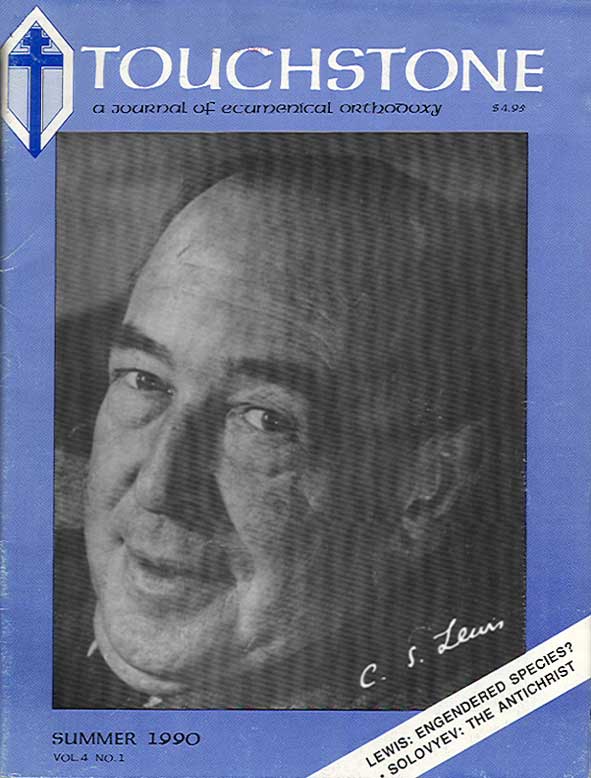
C. S. Lewis on Gender Language in the Bible
A Caution
by Wayne Martindale
For most Americans, the issue of gender language in the Bible seems quite contemporary. For example, a professional association of homiletics professors decided a few months ago that they would dispense with gender language when referring to God and the Bible in their own meetings. But C. S. Lewis, so often perceptive about the way the wind of ideas is blowing, wrote about this and a related concern as early as 1948 in his God in the Dock article “Priestesses in the Church?” To those who wish to tamper with the biblical imagery referring to God as “He” and “Father,” Lewis issues a caution.
But first, to give them their due, Lewis states the opposition well and fairly:
Common sense, disregarding the discomfort, or even the horror, which the idea of turning all our theological language into the feminine gender arouses in most Christians, will ask “Why not? Since God is in fact not a biological being and has no sex, what can it matter whether we say He or She, Father or Mother, Son or Daughter?”1
Perhaps the prior question is why we wish to change. Is our concern to purify our conception of God? When we approach the issue, as Lewis points out, we must first agree with those who say we err when we allow our language about God to confine our concept of Him. If our use of masculine words to refer to God causes us to reduce our conception to an anthropomorphic finitude, then we are in trouble. Lewis is often working to expand our ideas of the vastness of God. The very universe demands an expansive view and was perhaps created on such a mind-boggling scale to communicate the greatness of God, as suggested by this passage of exalted praise from the end of Perelandra:
“Yet this seeming dialogue also is the end and final cause for which He spreads out Time so long and Heaven so deep; lest if we never met the dark, and the road that leads nowhither, and the question to which no answer is imaginable, we should have in our minds no likeness of the Abyss of the Father, into which if a creature drop down his thoughts for ever he shall hear no echo return to him. Blessed, blessed, blessed be He!”2
We must acknowledge at the outset that any attempt to name or describe God is fraught with problems. What shall we try? If we cease to refer to God as either male or female, we must stop referring to God as a person at all. Lewis illustrates the problem of using abstract terms: “‘Bright blur’ is not a very good description. In fact,” Lewis laments, “you can’t have a good description of anything so vague. If the description became good it would become false.”3 If we think of God in terms of abstractions, we will be further from the truth, not nearer. As Lewis explains in Miracles:
If anything is to exist at all, then the Original Thing must be, not a principle nor a generality, much less an ‘ideal’ or a ‘value,’ but an utterly concrete fact.
. . . We must beware, as Professor Whitehead says, of paying God ill-judged ‘metaphysical compliments.’ We say that God is ‘infinite.’ In the sense that His knowledge and power extend not to some things but to all, this is true. But if by using the word ‘infinite’ we encourage ourselves to think of Him as a formless ‘everything’ about whom nothing in particular and everything in general is true, then it would be better to drop that word altogether. Let us dare to say that God is a particular Thing. Once He was the only Thing: but He is creative, He made other things to be. He is not those other things. He is not ‘universal being’: if He were there would be no creatures, for a generality can make nothing. He is ‘absolute being’—or rather the Absolute Being—in the sense that He alone exists in His own right.”4
If we accept the biblical view at all, then we must agree with Lewis that “God . . . has purposes and performs particular actions, . . . does one thing and not another, [is] a concrete, choosing, commanding, prohibiting God with a determinate character.”5 Does it not then follow that one who “purposes and performs particular actions” is more like a person than anything else we can think of? That God is, in fact, a person—an entity with self-conscious personhood, feelings, intentionality and so on—seems unavoidable. Lewis has argued the point brilliantly in the first two books of Mere Christianity without making any reference to Scripture. And for those that claim any authority for Scripture at all, personhood is evident. How else may the words of Jesus about his coming be understood (say in John)? What could the Incarnation mean? What does it mean for us to be “in His image”? On this point, Lewis concludes:
Wayne Martindale is a professor of English at Wheaton College in Wheaton, Illinois.
A Journal of Mere Christianity—Delivered to Your Door
- Essays on theology, culture, and the Church
- Contributors from across the Christian traditions
Subscribe (Print + Online) 
Six print issues (one year) of Touchstone, plus full online access and PDF downloads for only $39.95.
Subscribe (Online Only) 
Get a one-year full-access subscription to the Touchstone online archives for only $19.95.
bulk subscriptions
Order Touchstone subscriptions in bulk and save $10 per sub! Each subscription includes 6 issues of Touchstone plus full online access to touchstonemag.com—including archives, videos, and pdf downloads of recent issues for only $29.95 each! Great for churches or study groups.
Transactions will be processed on a secure server.
more on C. S. Lewis from the online archives
22.5—June 2009
C. S. Lewis on Civilization & the Natural Order by Timothy L. Hall

26.1—Jan/Feb 2013
The Alternate & Alternative Worlds of H. P. Lovecraft & C. S. Lewis by C. R. Wiley

more from the online archives

27.6—Nov/Dec 2014
Tales of Forbidden Stereotypes
Real-Life Men & Women & the Tragic Loss of Human Comedy by Anthony Esolen
calling all readers
Please Donate
"There are magazines worth reading but few worth saving . . . Touchstone is just such a magazine."
—Alice von Hildebrand"Here we do not concede one square millimeter of territory to falsehood, folly, contemporary sentimentality, or fashion. We speak the truth, and let God be our judge. . . . Touchstone is the one committedly Christian conservative journal."
Support Touchstone
—Anthony Esolen, Touchstone senior editor
